Tuesday
01 September, 2026
News Flash
News Flash
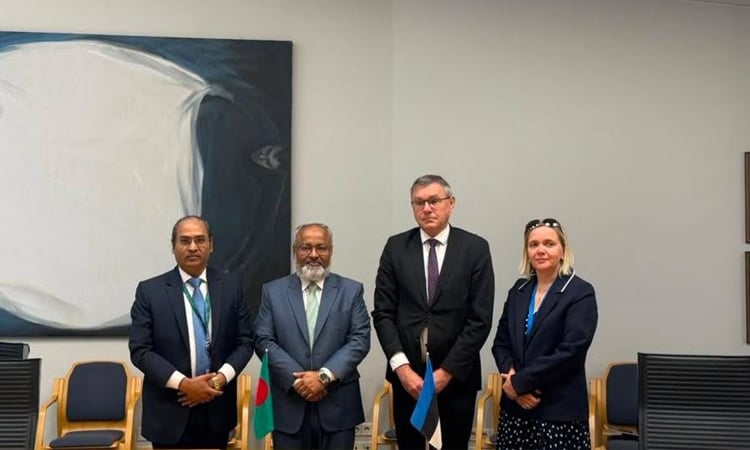
DHAKA, Aug 10, 2026 (BSS) - Estonia today expressed readiness to support Bangladesh in e-governance and deepen cooperation in digital technologies as the two countries agreed to broaden bilateral ties in trade, investment, skilled migration and other areas.
The understanding was reached at the second Foreign Office Consultations (FOC) between Bangladesh and Estonia held in Tallinn today, according to a foreign ministry press release.
Bangladesh's delegation was led by Ambassador Dr M. Nazrul Islam, Secretary (Bilateral-East and West) at the Ministry of Foreign Affairs, while Mati Murd, Head of Asia and the Pacific Region at Estonia's Ministry of Foreign Affairs, headed the Estonian side.
During the consultations, the two sides placed particular emphasis on cooperation in ICT, digital governance, interoperability, electronic identification systems, secure data exchange, innovation and business partnerships.
Estonia expressed its readiness to extend support to Bangladesh in e-governance, while noting that several Estonian companies and investors in the digital sector are interested in investing in Bangladesh and collaborating with Bangladeshi counterparts.
Estonian companies were invited to explore opportunities in Bangladesh's emerging sectors to increase business-to-business engagement and identify areas of mutual benefit.
The two sides identified significant untapped opportunities for mutually beneficial cooperation and attached high priority to expanding and recalibrating bilateral relations.
They stressed the importance of deepening political engagement and proposed reciprocal visits by the foreign ministers of the two countries.
The two sides also discussed the possibility of forming a Bangladesh-Estonia Parliamentary Friendship Group to facilitate regular interaction between parliamentarians.
On trade, investment and economic cooperation, they agreed to encourage greater private-sector interaction and exchanges of business delegations.
The Bangladesh side highlighted the country's position in key manufacturing sectors, including ready-made garments, jute and jute products and pharmaceuticals, and invited Estonian investors to explore opportunities in Bangladesh's Special Economic Zones.
Dhaka also proposed forming a Joint Working Group on Trade and Economic Cooperation, signing a memorandum of understanding between the apex chambers of the two countries and arranging an exploratory visit by an Estonian private-sector delegation.
Employment and skilled migration also featured prominently in the discussions.
Bangladesh highlighted its growing pool of skilled workers, including IT professionals, engineers, electricians, plumbers and healthcare workers.
The two sides discussed expanding skilled manpower migration from Bangladesh to Estonia under the European Union's Talent Partnership programme, particularly in ICT, caregiving, construction, hospitality and tourism, agriculture and agri-processing. Estonia expressed optimism over enhanced cooperation in this area.
Both countries also agreed to strengthen people-to-people contacts through cooperation in education and sports, scholarships, research collaboration and exchanges involving students, youths, tourists and cultural troupes.
They discussed concluding several bilateral instruments at the earliest in areas including trade and economic cooperation, culture, tourism promotion, avoidance of double taxation, investment promotion and protection, and industrial cooperation.
During the meeting, Estonia congratulated Foreign Minister Dr Khalilur Rahman on his election as President of the 81st Session of the United Nations General Assembly and expressed its full support during his tenure.
The Bangladesh delegation reiterated the country's commitment to international law, sovereignty, non-interference, equality and mutual respect among nations, while highlighting Bangladesh's contribution to UN peacekeeping.
The two sides agreed to deepen regional and global coordination, including mutual support for candidatures in international elections and cooperation across multilateral platforms, including the United Nations.
Estonia assured Bangladesh of its possible support on issues of Dhaka's interest within the European Union and also pledged support in international forums on matters related to the repatriation of the Rohingyas.
The two delegations exchanged views on critical regional and global developments and underscored the importance of promoting stability and inter-regional connectivity.
The Bangladesh delegation also held discussions over lunch with Karin Maandi, Acting Under Secretary of Estonia's Department of NATO and Transatlantic Relations, on issues of mutual interest.
Both sides expressed confidence that the second FOC would give fresh momentum to bilateral engagement and agreed to hold the third round of consultations in Dhaka at a mutually convenient time.