Tuesday
01 September, 2026
News Flash
News Flash
DHAKA, August 9, 2026 (BSS) - Rehan Asif Asad, Adviser to the Prime Minister on Posts, Telecommunications, Information Technology, Science and Technology, has outlined the government’s five priorities for ICT and telecom, a designated thrust sector.
The priorities are (i) consistent, forward-looking policy under a five-year tax framework — noting the telecom sector’s 51–56% effective tax burden against a global average of 22–27%, and the removal of the SIM tax; (ii) improved mobile and broadband connectivity, as Bangladesh ranks seventh globally in subscribers but far behind in service quality; (iii) Digital Public Infrastructure under “One Citizen, One ID, One Digital Wallet,” built on the Estonian X-Road platform, offered free of cost, with every ID connected to bank accounts and the National Board of Revenue.
The priorities are also (iv) AI-ready talent, equipping the 23,000–30,000 annual engineering and science graduates with AI, cybersecurity, and data skills, and introducing these subjects into the school curriculum; and (v) electronics manufacturing, with garment-sector-style incentives, citing Vietnam’s growth from US$1 billion to US$217 billion in consumer electronics exports in a decade. He cited the UN–ITU finding that every 10% improvement in broadband penetration adds 1% to national GDP.
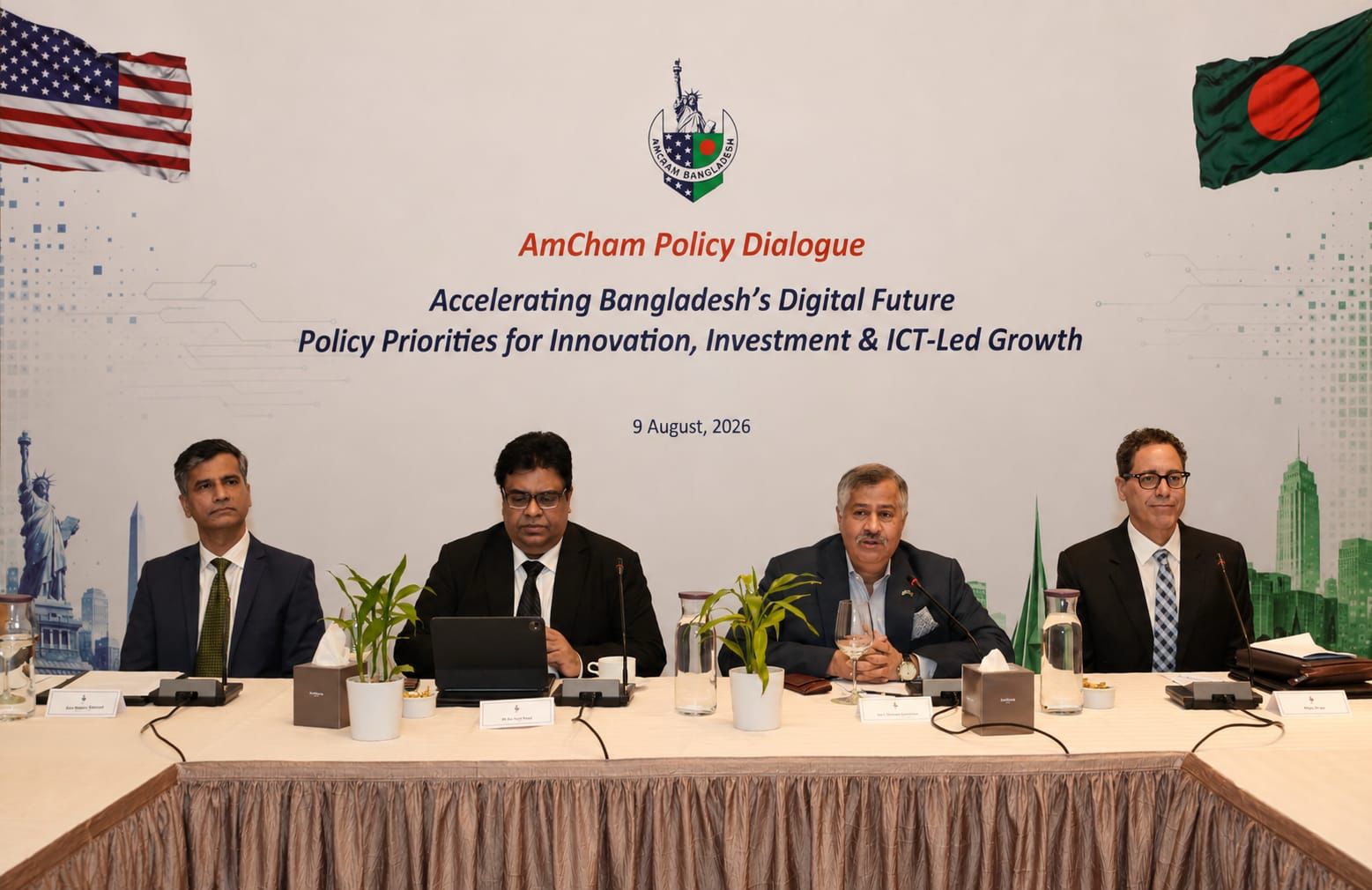
The Adviser highlighted the priorities as the chief guest at a Policy Dialogue “Accelerating Bangladesh’s Digital Future: Policy Priorities for Innovation, Investment & ICT-Led Growth” hosted by American Chamber of Commerce in Bangladesh (AmCham) at a hotel in the capital.
In his opening remarks, Syed Mohammad Kamal, President of AmCham and Vice President of Mastercard, thanked the government for ratifying the Personal Data Protection Act (PDPA), noting AmCham's persistent engagement from the very beginning and that the final Act reflects most of AmCham's recommendations and welcomed key measures of the Finance Act 2026, including the tax exemption for freelancers and content creators and customs relief on computers, digital devices, and semiconductor-related materials, said an AmCham press release.
He called for greater clarity on the new digital permanent establishment provision linked to the 100,000-subscriber threshold, reconsideration of the increase in ISPs’ turnover tax from 1% to 1.5% of gross receipts and easing of inbound and outbound international payments for technology companies and startups.
He emphasized that involving foreign investors in the policymaking process and relevant national business forums would enrich policy formulation with global expertise and international best practices, ultimately helping to foster a more competitive, transparent, and investment-friendly business environment in Bangladesh.
The dialogue, moderated by Rubaba Dowla, Chair of the AmCham ICT Subcommittee and Country Managing Director for Bangladesh, Nepal, and Bhutan at Oracle, covered four agendas: enabling a competitive digital economy; building trusted digital infrastructure; accelerating AI, innovation, and talent; and government–industry partnership.
AmCham ICT sector Leaders of Citibank N.A., Cisco, HSBC, Mastercard, MetLife, Pathao, PwC, Standard Chartered Bank, ShopUp, Visa and other member companies raised specific issues: introducing open-loop ticketing for metro and toll systems; opening Bangla QR and the “One Citizen, One Wallet” initiative to international payment networks; rectifying the 15% VAT waiver under the NBR Startup Sandbox, which risks anti-competitive outcomes; aligning the cloud policy for banks and NBFIs with the PDPA to allow use of public cloud platforms; early formation of the National Data Governance Authority; enabling digital signatures and enforceable electronic agreements; strengthening national cybersecurity; and closing the AI and data engineering talent gap through industry–academia collaboration.
In response, the Chief Guest confirmed that RFID-based automated toll collection is under trial; Bangladesh Bank has agreed to open Bangla QR for inward international payments as a first step; the “One Citizen, One ID” platform will be open to both domestic and international networks; and the Startup Sandbox provisions will be fine-tuned in consultation with the wider startup community.
He identified the National Cyber Security as his immediate priority and announced that formulation of a national AI policy will begin in the fourth quarter, through a joint team of the private sector, government, academia, and researchers.
He underscored the urgent need to expand submarine cable capacity, currently six terabytes against a peak national demand of 12 terabytes, with traffic doubling every two years, stressing that new submarine cables take two to three years to build and are fundamental to Bangladesh’s digital sovereignty.
The session concluded with a vote of thanks by Ala Uddin Ahmad, Vice President of AmCham and Chief Executive Officer of MetLife Bangladesh.
The dialogue brought together the AmCham Executive Committee, AmCham members from ICT sectors and officials from the U.S. Embassy, and, reflecting the AmCham’s commitment to supporting Bangladesh’s digital transformation. The event was supported by Cisco.