Sunday
23 August, 2026
News Flash
News Flash
MYMENSINGH, July 27, 2026 (BSS) - Researchers at Bangladesh Agricultural
University (BAU) have achieved encouraging results in the development of a
low-cost vaccine against duck plague using a locally isolated duck plague
virus, with expectations of providing more than 90 percent protection against
the deadly disease.
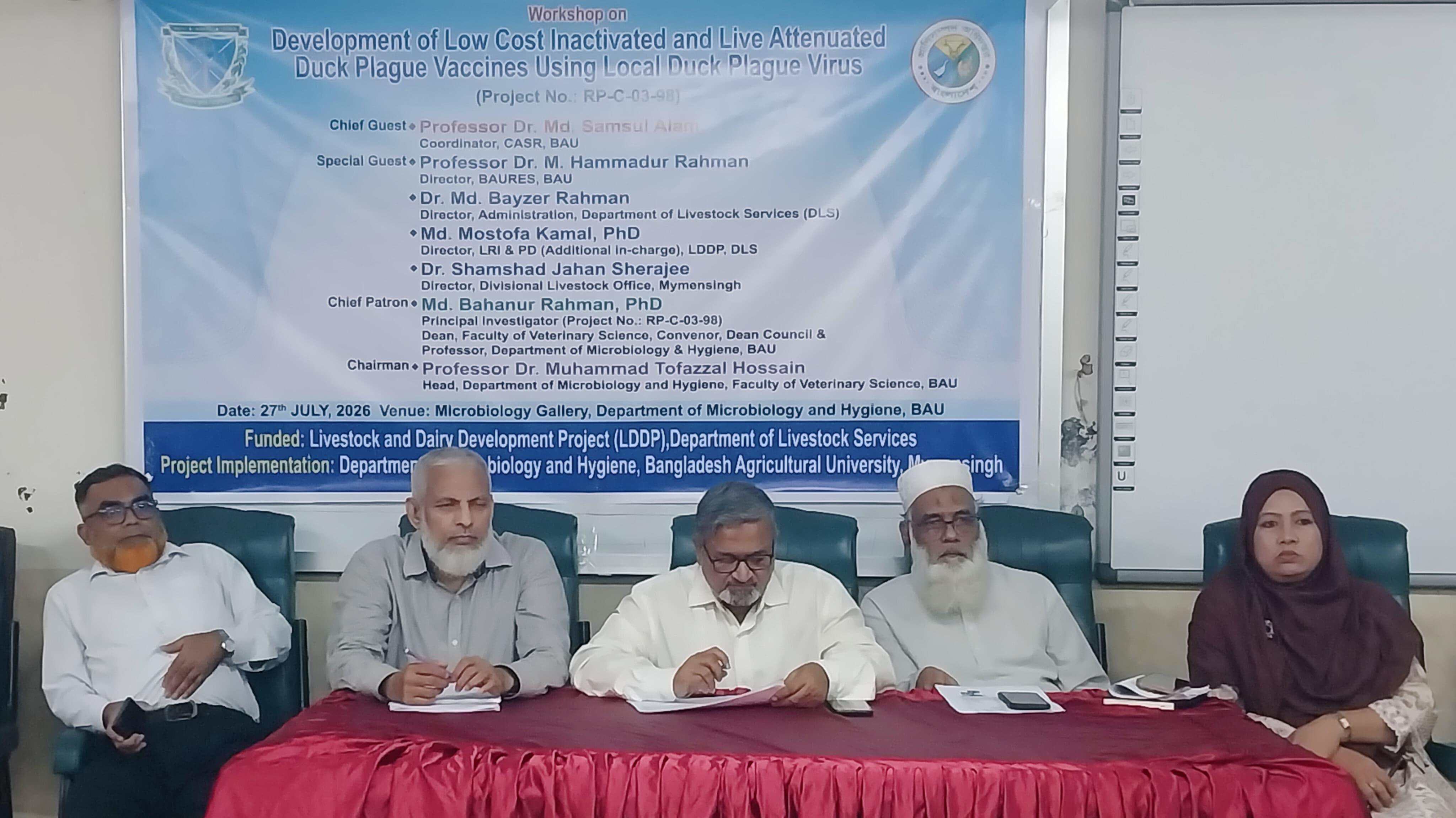
The findings were presented on Monday at the concluding workshop of the
research project held at the Microbiology Gallery of the university. The
project was funded by the Livestock and Dairy Development Project (LDDP).
Presenting the project's progress and achievements, Principal Investigator
Professor Dr. Md. Bahanur Rahman said duck plague is a highly fatal viral
disease, with mortality rates ranging from 40 to 100 percent.
The primary objective of the research was to develop an attenuated vaccine.
However, following a request from the Department of Livestock Services (DLS),
the research team also worked on inactivated and DNA vaccines.
According to Prof. Rahman, while the inactivated vaccine did not produce the
desired results, both the DNA and oral vaccines demonstrated promising
outcomes. The vaccine is now awaiting field trials, and if all regulatory
procedures are completed successfully, it is expected to reach duck farmers
within the next one to one-and-a-half years.
He expressed optimism that the vaccine would provide more than 90 percent
protection against duck plague and, through the DLS, would make a significant
contribution to Bangladesh's duck farming sector.
The workshop was attended by Coordinator of the University Committee for
Advanced Studies and Research (CASR) Prof Dr. Md. Samsul Alam as the chief
guest.
Special guests included Director of the Bangladesh Agricultural University
Research System (BAURES) Prof Dr. M. Hammadur Rahman, Director of the
Mymensingh Divisional Livestock Office Dr. Shamsad Jahan Shiraji, and LDDP
Chief Technical Coordinator Dr. Md. Jahangir Hossain.
Prof Dr. Mohammad Ferdousur Rahman Khan, Prof of the Department of
Microbiology and Hygiene and Co-Investigator of the project, delivered the
welcome address.
In his remarks, Prof Dr. Samsul Alam said that duck plague is extremely
difficult to treat once birds become infected, making vaccination the most
effective preventive measure.
He said that BAU's Department of Microbiology and Hygiene has a long-standing
tradition of vaccine research, and the current study using a local duck
plague virus has established an important foundation for developing an
affordable and effective vaccine.
He also expressed hope that the vaccine's effectiveness could be further
improved in the future by addressing the evolving characteristics of the
virus.