Sunday
23 August, 2026
News Flash
News Flash
By BM Nur Alam
DHAKA, July 23, 2026 (BSS) – To make the Buriganga River pollution-free, the government has taken the initiative to bring the Effluent Treatment Plant (ETP) systems of industries that discharge liquid waste under online monitoring system, alongside conducting regular enforcement activities to ensure that these treatment plants remain operational at all times.
The Director General of the Department of Environment, Dr. Md. Lutfor Rahman, told the state-run news agency BSS that efforts are being made to restore the river's natural flow by increasing the water flow in the Buriganga.
Besides, the Bangladesh Inland Water Transport Authority (BIWTA) is carrying out regular dredging operations to increase the river's navigability by removing polluted sediment.
To prevent water pollution, the government plans to monitor ETP systems online, he added.
As part of this initiative, IP cameras will be installed in pollution-prone areas, he said.
In addition, dedicated control rooms will be established at shipbuilding and ship repair yards to monitor and control the discharge of hazardous waste, he added.
An ETP is a wastewater treatment system that treats contaminated liquid waste generated by industries before it is released into the environment.
In other words, the primary purpose of an ETP is to reduce industrial wastewater to safe levels through chemical, biological, and mechanical treatment processes before it is discharged into rivers, canals, or other water bodies.
He said wastewater discharged from factories contains various toxic chemicals, dyes, oil, heavy metals and other hazardous substances.
If untreated wastewater is released directly into drains or rivers, it can pose serious threats to the environment, aquatic life and public health, he said.
ETPs are primarily used to prevent environmental pollution and make water reusable, he added.
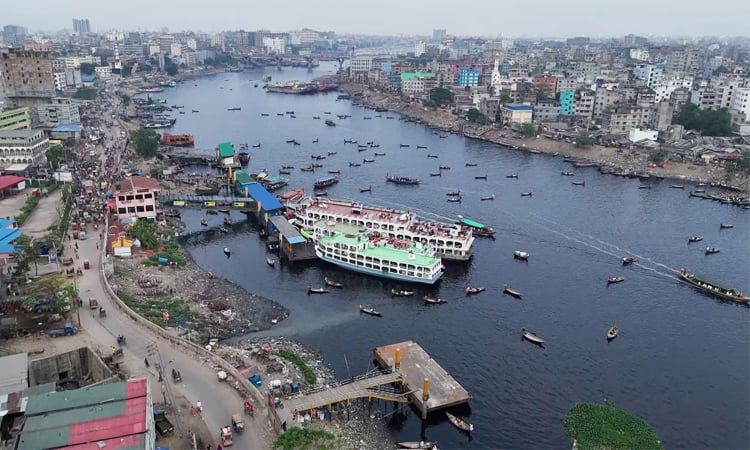
A visit to different areas along the Buriganga River in the capital found that untreated industrial waste, household garbage dumped directly into the river and plastic waste have turned the river water black and foul-smelling.
Numerous dyeing and washing factories, as well as shipbuilding and ship repair yards (dockyards), have been established along the banks of the Buriganga and its surrounding areas.
These illegal establishments have long been polluting the river by violating environmental regulations.
Prof Dr A.K.M. Saiful Islam of the Institute of Water and Flood Management (IWFM) at Bangladesh University of Engineering and Technology (BUET) told BSS that direct dumping of household waste into the river must first be stopped to reduce water pollution.
He said waste should be transferred to treatment plants through sewerage systems, while river boundaries should be demarcated, illegal structures removed and regular dredging carried out to remove plastic, polythene and polluted sediment.
He said dredging is essential to improve navigability and remove contaminated sediment.
He also stressed the need for legal action against those responsible for directly dumping waste into the river and polluting its water.
Officials of the Department of Environment said regular enforcement drives are being conducted to prevent pollution in the rivers and water bodies surrounding Dhaka as part of efforts to clean up the Buriganga.
Earlier, the National Environment Policy 2018 was formulated, setting updated policies for protecting the ecosystems and environment of rivers, floodplains, wetlands and other water bodies, while identifying the necessary measures and implementing agencies.
According to the Department of Environment, the Environment Conservation Rules, 2023, have been formulated by updating the previous environmental conservation regulations.
For waste management, the Solid Waste Management Rules, 2021, have been formulated under the Bangladesh Environment Conservation Act, 1995 (last amended in 2010).
The rules, once fully implemented, are expected to play an important role in managing waste in canals, wetlands and other water bodies.
In addition, under the Bangladesh Environment Conservation Act, 1995, and the Environment Conservation Rules, 2023, obtaining and renewing environmental clearance certificates has been made mandatory for establishing industrial units.
BIWTA is conducting regular drives to free rivers from encroachment by evicting illegal structures, dockyards and other establishments along riverbanks.
BIWTA Director (Ports and Transport) Md Saiful Islam told BSS that 307 waste discharge outlets have been identified along the Buriganga River.
He said notices have already been served on the owners of illegal riverside structures, dockyards and other establishments, directing them not to discharge waste and garbage directly into the river.
Legal action will be taken against those who fail to comply with the directives, he added.
He further said necessary measures would be taken to prevent waste from entering the Buriganga directly through the identified discharge outlets.
He also said the Buriganga, Turag, Shitalakkhya and Balu rivers surrounding Dhaka were inspected recently.
The Buriganga is a river flowing through Dhaka and Narayanganj districts in the north-central region of Bangladesh.
The river is 29 kilometres long, has an average width of 302 metres and follows a meandering course.
According to the Bangladesh Water Development Board (BWDB), the Buriganga is listed as River No. 47 in the north-central river system. Dhaka city was established on its banks around 400 years ago.