Sunday
23 August, 2026
News Flash
News Flash
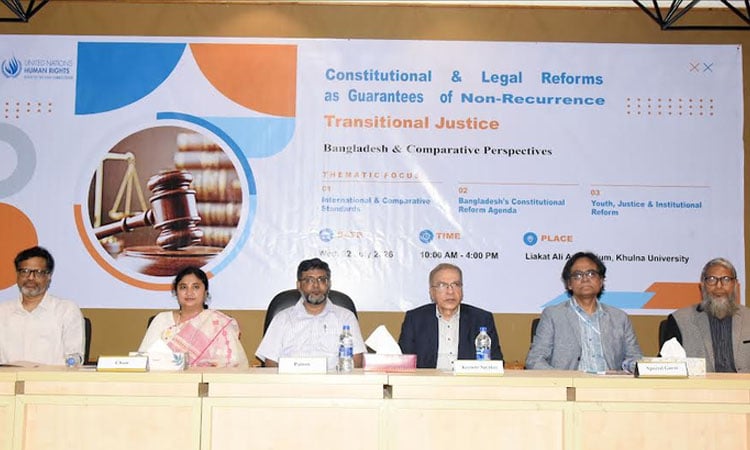
KHULNA, July 22, 2026 (BSS) – A national seminar here today highlighted the need for strengthening human rights protection, ensuring accountability and preventing the recurrence of rights violations through effective institutional reforms.
The seminar, titled "Constitutional and Legal Reforms as Guarantees of Non-Recurrence in Transitional Justice," was jointly organised by the Law Discipline of Khulna University (KU) and the Office of the United Nations High Commissioner for Human Rights (OHCHR) Bangladesh at the university’s Journalist Liaquat Ali Auditorium.
Chairing the inaugural session, Head of the Law Discipline Poonam Chakraborty stressed the importance of constitutional and legal reforms in establishing the rule of law and preventing future human rights violations.
Dean of the Law School Prof. Dr. Md. Nasif Ahsan addressed the programme as special guest, while OHCHR Bangladesh Human Rights Officer Md. Zahid Hossain delivered the opening remarks. Prof. Dr. Md. Waliul Hasanat of the Law Discipline welcomed the participants.
Delivering the keynote address, Executive Director of Transparency International Bangladesh (TIB) and Chairman of the interim government's Anti-Corruption Reform Commission Dr. Iftekharuzzaman said Bangladesh now stands at a moment of significant opportunity following the August 5, 2024 mass uprising.
He underscored that citizens are the ultimate source of state power and that public accountability must remain central to governance.
Member of the interim government's Constitution Reform Commission, author and researcher Firoz Ahmed said universities have historically played a vital role in nation-building across the world.
Referring to institutions such as Oxford and Harvard, he said Bangladeshi universities and their students must continue contributing to the country's future development, as demonstrated during the 2024 mass uprising.
Other speakers at the seminar emphasised that Bangladesh should undertake effective constitutional, legal and institutional reforms by drawing on both international experience and domestic realities to prevent the recurrence of human rights violations, strengthen the rule of law and build accountable state institutions.
In the technical sessions, Dr. Iftekharuzzaman presented a paper titled "Guarantees of Non-Recurrence in Transitional Justice in Bangladesh" and discussed "Corruption and Anti-corruption in Bangladesh: Opportunities and Challenges of Enduring Legal and Institutional Change."
Firoz Ahmed presented another keynote paper titled "Preparing the Legal Framework for National Healing."
During the first session, OHCHR Bangladesh Assistant Human Rights Officer Saima Karim Shanon discussed "International & Comparative Standards on Non-Recurrence," highlighting the United Nations standards and the experiences of South Africa, Nepal, Colombia and Tunisia in transitional justice.
An interactive student dialogue titled "Youth, Justice and Institutional Reform" provided a platform for students to share their views on judicial reform, constitutional change and institutional accountability.