Tuesday
08 September, 2026
News Flash
News Flash
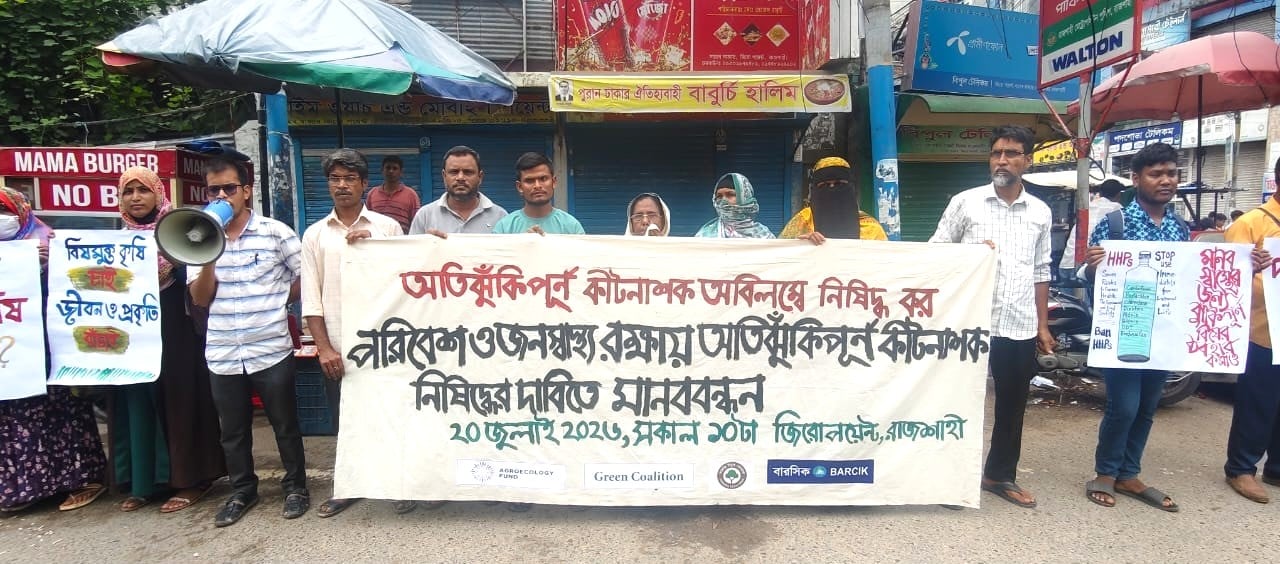
RAJSHAHI, July 20, 2026 (BSS) - A human chain was formed today in Rajshahi to demand a phased ban on Highly Hazardous Pesticides (HHPs) used in the region to protect the environment, public health, biodiversity, and a safe food system.
The human chain was jointly organized by the development research institution BARCIK, the Barendra Youth Forum, and the Green Coalition at Shaheb Bazar Zero Point in Rajshahi.
Farmers, environmental activists, youth representatives, researchers, members of civil society and representatives of various social and cultural organizations participated in the human chain.
The human chain was presided over by Rahima Begum, President of Green Coalition, Paba Upazila, and moderated by Md. Atikur Rahman, President of Barendra Youth Forum.
Speakers at the human chain said that various chemical pesticides used for a long time in the name of increasing food production are having a serious negative impact not only on harmful insects but also on humans, bees, fish, birds, soil, water and the entire ecosystem.
Abu Sama, General Secretary of Nauhata Fishermen's Association, said fish fry dies due to poison from the fields sent into the water, and fish have also decreased.
Upen Rabidas, President of Adivasi Youth Council, said due to excessive use of pesticides, wild vegetables, medicinal plants, indigenous fish, snails, crabs and other natural foods are rapidly disappearing.
Atikur Rahman, President of Barendra Youth Forum, said agriculture dependent on pesticides and chemicals can never be sustainable. Agroecology is the most effective way for that transformation.
BARCIK researcher Shahidul Islam said many countries in the world today have made significant progress in controlling highly hazardous pesticides and expanding alternative agricultural methods. In Bangladesh too, scientific re-evaluation of highly hazardous pesticides according to international standards and their phased ban is now the demand of the time.
Agro ecology, Integrated Pest Management (IPM), biological pest control, conservation of local seeds and agroecology-based agricultural practices can be the basis for safe food and a climate-resilient agricultural system."
The speakers said that the demand to ban highly hazardous pesticides is not the demand of a single organization; it is the demand for public health, safe food, environment, biodiversity, farmers' rights and the security of future generations.
Through a scientific, participatory and justice-based agricultural transformation, Bangladesh can build a safe, productive and climate-resilient food system.