Sunday
23 August, 2026
News Flash
News Flash
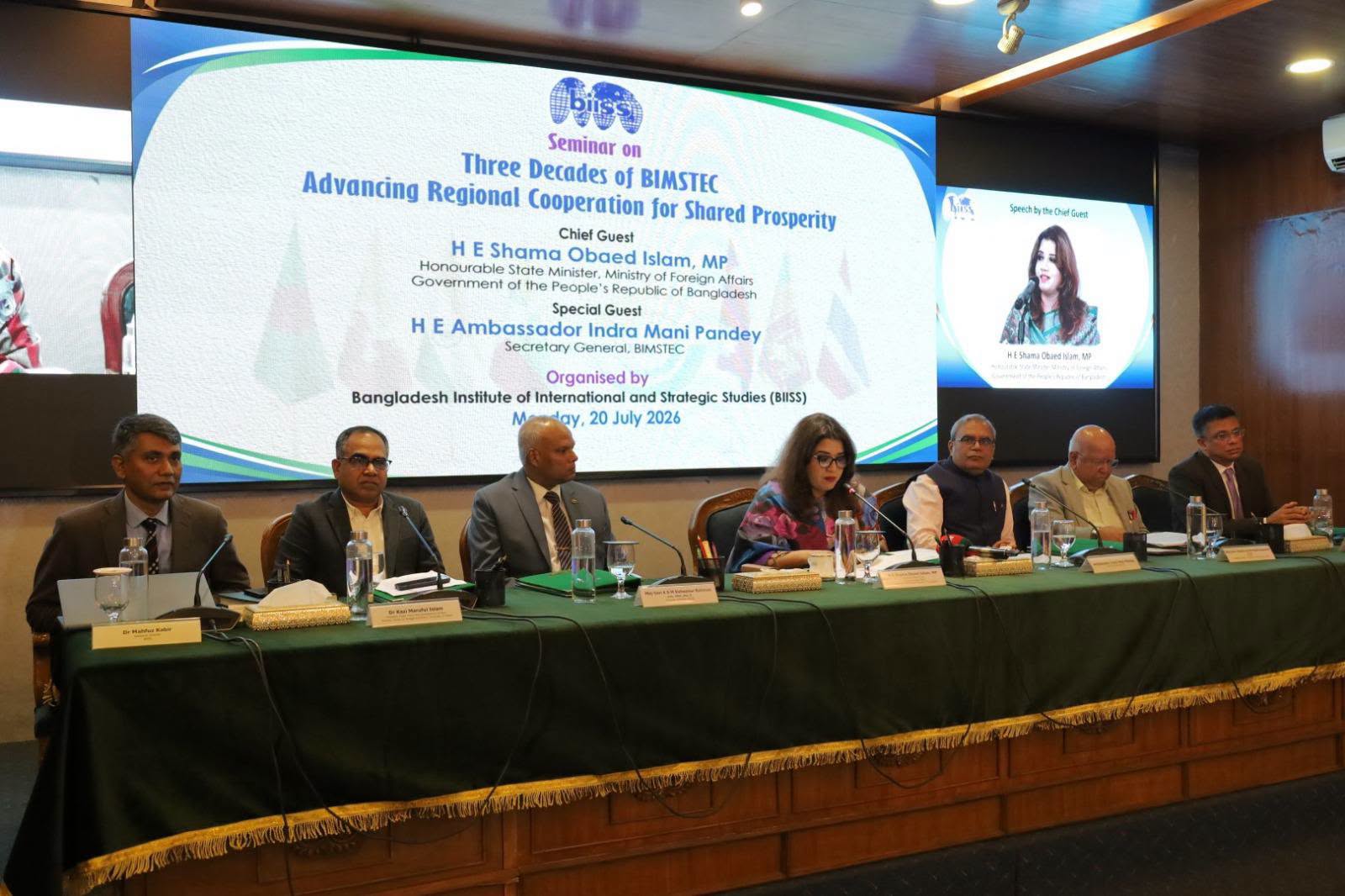
DHAKA, July 20, 2026 (BSS) - Bangladesh today urged BIMSTEC member states to play a more active role in intensifying international pressure on Myanmar to help find a sustainable solution to the protracted Rohingya crisis.
State Minister for Foreign Affairs Shama Obaed Islam made the call while addressing a seminar titled "Three Decades of BIMSTEC: Advancing Regional Cooperation for Shared Prosperity" at the Bangladesh Institute of International and Strategic Studies (BIISS) auditorium here.
"Effective international pressure needs to be exerted on Myanmar to ensure the safe, voluntary and sustainable repatriation of the Rohingyas," she said.
The state minister stressed that coordinated efforts by BIMSTEC member states could play an important role in this regard.
The state minister reaffirmed Bangladesh's strong commitment to BIMSTEC and to promoting a peaceful, resilient and prosperous Bay of Bengal region.
She emphasized the importance of translating regional commitments into concrete actions through greater implementation, practical cooperation and strengthened institutional mechanisms.
As the current Chair of BIMSTEC, Bangladesh remains committed to advancing economic integration, connectivity, trade and investment, the Blue Economy and people-centric regional cooperation, she said, stressing the importance of working closely with all member states to realise the organisation's shared objectives.
Shama expressed confidence that recommendations emerging from the seminar would contribute to strengthening Bangladesh's leadership during its BIMSTEC Chairmanship and support the organisation's future development.
BIMSTEC Secretary General Ambassador Indra Mani Pandey, who attended the seminar as special guest, highlighted the organisation's ongoing projects and initiatives in areas including women's development, climate adaptation, grid interconnection and technical capacity-building in the energy sector.
He also highlighted BIMSTEC cooperation in drug control, cyber, maritime and human security, counterterrorism and transnational crime, tourism, visa facilitation, trade and investment.
BIISS Director General Major General A S M Ridwanur Rahman delivered the welcome address, while BIISS Research Director Dr Mahfuz Kabir presented the keynote paper.
Professor Dr Rasheduzzaman of the Department of International Relations at the University of Dhaka and Professor Dr Kazi Maruful Islam, Director of the Centre on Budget and Policy at the same university, made panel presentations.
The session was chaired by Bangladesh Institute of Peace and Security Studies (BIPSS) President Major General A N M Muniruzzaman (Retd).
The keynote presentation and panel discussions reviewed BIMSTEC's evolution over the past three decades and assessed the opportunities and challenges facing the regional grouping.
The discussions highlighted the need to strengthen BIMSTEC's institutional capacity, enhance regional connectivity, expand economic cooperation and foster greater collaboration across its priority sectors.
Participants also stressed practical and action-oriented initiatives to advance regional integration and contribute to peace, stability, resilience and sustainable development across the Bay of Bengal region.
An interactive discussion focused on regional cooperation, connectivity, trade and investment, security cooperation and people-to-people engagement, while participants underscored the importance of stronger partnerships among member states and evidence-based policy dialogue to enhance BIMSTEC's effectiveness.
Senior government officials, ambassadors and high commissioners, representatives of BIMSTEC member states and international organisations, academics, researchers, members of the armed forces, development partners, private sector stakeholders, media representatives and policy practitioners attended the seminar.