BSS
  13 Jun 2026, 17:57
Update : 13 Jun 2026, 18:42

Proper enforcement of laws essential to protect women’s and children’s rights: Zahid 

Photo: BSS

DHAKA, June 13, 2026 (BSS) – Women and Children Affairs and Social Welfare Minister Abu Zafar Md. Zahid Hossain, MP, has said that although Bangladesh has many good laws to protect the rights of women and children, challenges remain in their implementation and in changing social attitudes.

“The enforcement and practice of laws must be ensured properly. Although the government has adopted a zero-tolerance policy against drugs and violence, delays in the justice system remain a major problem in the country,” he said.

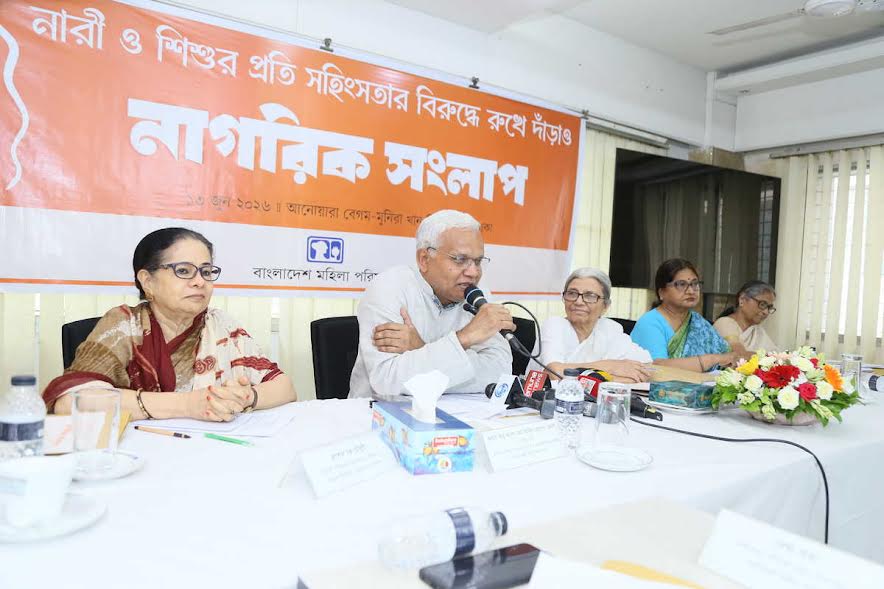
The minister made the remarks while addressing a citizens’ dialogue as the chief guest at the Bangladesh Mahila Parishad’s Anowara Begum–Munira Khan auditorium in capital's Segunbagicha area this morning.

The dialogue was held under the theme, ‘Stand Up Against Violence Against Women and Children' (Nari O Shishur Proti Sohingsotar Biroddhey Rukhey Darao).

The dialogue was chaired by Bangladesh Mahila Parishad President Dr. Fauzia Moslem, while the organisation’s General Secretary Maleka Banu delivered the welcome address. 

Rekha Saha, Legal Aid Secretary of the Bangladesh Mahila Parishad Central Committee, presented the organisation’s written statement.

Speaking on the occasion, Minister Zahid also said that society is gradually drifting away from moral and ethical values, which has contributed to growing challenges in ensuring the rights and protection of women and children. 

He said lawyers have an important role to play in safeguarding these rights and stressed the need to increase the number of adolescent clubs to strengthen the capacity and awareness of young people.

He said that, in addition to raising public awareness about the enforcement and application of laws, extensive campaigns should be conducted to promote the rights of women and children and foster a more inclusive society.

The minister noted that despite continued efforts by various stakeholders, violence against women and children remains a serious concern, as its roots run deep within society. 

To address the problem effectively, he emphasized the need for further modernization of forensic services, stronger protection mechanisms for victims, a more responsible role by social media platforms and the elimination of drug abuse.

Highlighting the government’s commitment to the positive use of technology, he said the issue is being given the highest priority. 

Photo: BSS

Referring to the rise in violence against women in 2025, he said that legal action should proceed without interference.

Dr Zahid said DNA laboratories are being established at the divisional level, while One-Stop Crisis Centre (OCC) services are being expanded to 37 medical colleges across the country, with plans to extend the programme to every district in the next phase.

He called upon all sections of society to work together to uphold the rights of women and children and prevent violence against them.

Former Appellate Division Judge of the Bangladesh Supreme Court Krishna Debnath and Executive Director of Campaign for Popular Education (CAMPE) Rasheda K. Choudhury were present on the occasion, among others.

Former Appellate Division Judge Krishna Debnath said the Constitution guarantees equal rights for women, but certain provisions limit those rights in practice. 

She stressed the need for proper implementation of existing laws, particularly in addressing violence and rape.

CAMPE Executive Director Rasheda said religion is still used in many families to undermine women’s rights. 

She called for action against cyber-bullying, greater engagement with content creators and internet service providers and awareness-building through religious leaders and media platforms.

Columnist and Liberation War Museum Trustee Mofidul Hoque said society is facing a deep crisis, with incidents such as the Ramisa case exposing underlying social problems. 

He emphasized the need for cultural activities, responsible use of digital platforms and stronger cooperation between the government and society.

Deputy Commissioner of Police of the Women Support and Investigation Division of DMP, Liza Begum, stressed awareness campaigns, effective law enforcement, proper investigation of cases and victim-centered policing. 

She also called for victim support centers in every district and national initiatives against cyber violence.

Bangladesh Sangbad Sangstha (BSS) Managing Director and Chief Editor Md Kamal Uddin Mozumder said no form of violence is acceptable in a healthy society. 

He emphasized moral, religious and social values alongside law enforcement and urged the positive use of social media.

Dhaka University Criminology Department Chairman Rezaul Karim Shohag said punishment alone is not enough and measures for offender rehabilitation are also necessary. 

He stressed addressing the social and family factors behind violence and ensuring justice for victims.

Professor Dr. Mahjabeen Haque, Department of Educational and Counselling Psychology of Dhaka University, said psychological factors, including childhood experiences, play a major role in violent behavior. 

She highlighted the need for a humane and values-based education system.

Bangladesh Society for the Change and Advocacy Nexus (B-SCAN) Executive Director Salma Mahbub said violence against women with disabilities often remains overlooked. 

She warned that growing drug abuse and pornography usage are contributing to criminal behavior.

Bangladesh Adivasi Forum Treasurer Mainthin Promila said the condition of marginalized and poor women reflects a society’s progress. 

She urged coordinated action by different ministries and called for a safe and peaceful environment for women, particularly indigenous women facing multiple forms of discrimination.

In her concluding remarks, Bangladesh Mahila Parishad President Dr. Fauzia Moslem described the current situation of violence against women and children as alarming. 

She called for an end to impunity, reforms in the justice system, and united efforts to create a safe environment for children.

General Secretary Maleka Banu said nearly 1,000 women and girls faced violence in the past five months. 

She warned that growing insecurity, impunity and weak implementation of laws are fueling violence and called for collective action by the state and civil society.