News Flash

DHAKA, June 7, 2026 (BSS) - Health Minister Sardar Md Sakhawat Hossain today said dengue is no longer an ordinary disease; it has become a major challenge for the entire nation, and every citizen must be involved in tackling the crisis.
"I can put pressure on city corporations and deputy commissioners and ask them to conduct cleanliness drives. But I cannot guarantee whether it is possible to eliminate 100 percent of mosquitoes or larvae.
Mosquitoes can fly up to 200 metres and enter homes through any opening. Therefore, this is a very difficult battle," he said.
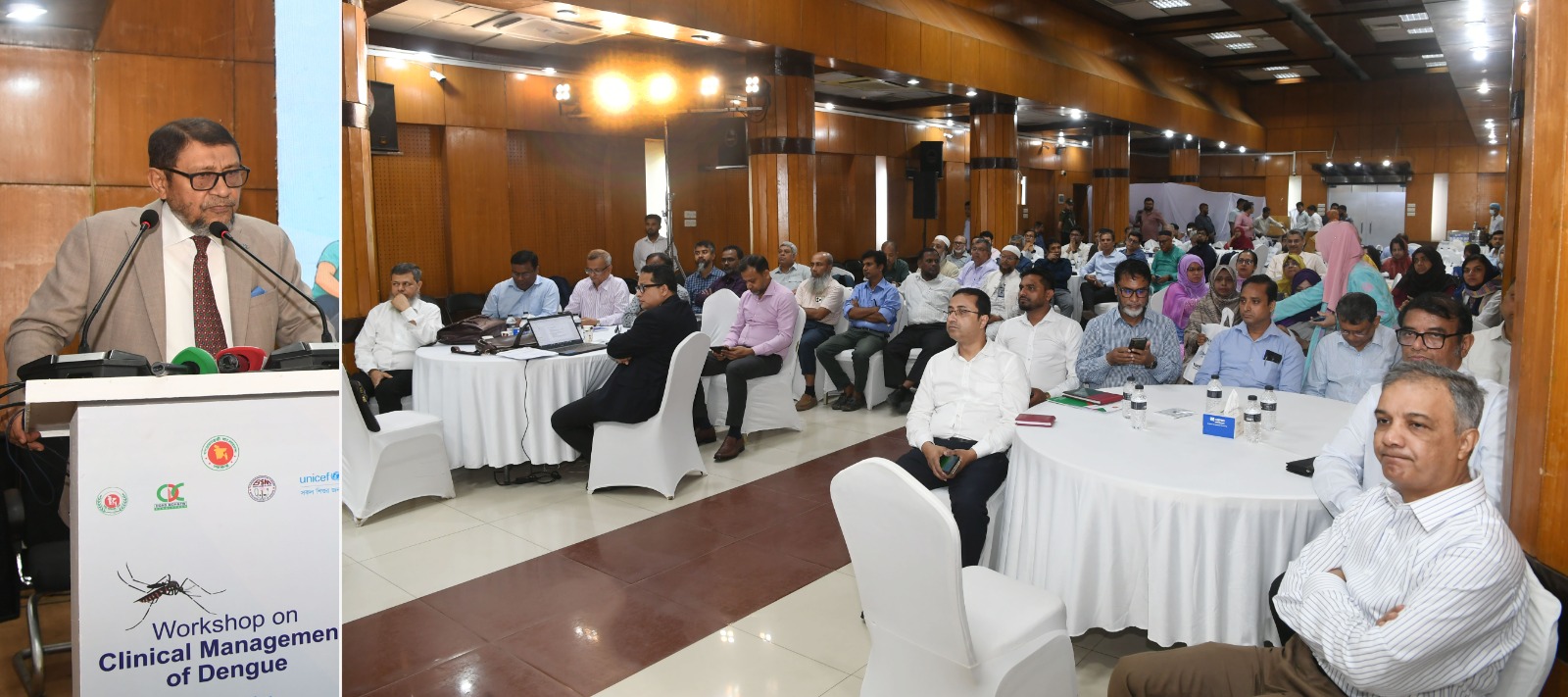
He made the remarks while inaugurating the first batch of the National Training of Trainers Programme on Clinical Management of Dengue at Shaheed Dr Milon Hall of Bangladesh Medical University (BMU) in the capital.
Describing the dengue situation as a "total fight", the minister said it would not be possible to win the battle unless every drain, ditch, waterlogged area and water hyacinth-infested location across the country is cleaned.
No single institution or individual can address the crisis alone; a coordinated national effort is required, he added.
The programme was organised with the support of the Ministry of Health and Family Welfare, UNICEF Bangladesh and the Bangladesh Society of Medicine.
Referring to discussions on a dengue vaccine, the health minister said the issue of introducing a vaccination programme remains under consideration, but it is extremely expensive and difficult to implement.
“If we have to go for mass vaccination, a huge budget will be required. If vaccinations are needed every four months, it will create enormous pressure on the country's health budget. Therefore, greater emphasis must be placed on prevention rather than treatment," he said.
Explaining the causes behind the spread of dengue, he said rainwater accumulates in countless small places in both urban and rural areas, creating breeding grounds for Aedes mosquitoes. Larvae are being found in stagnant water left after washing vehicles in garages, discarded tyres, unused cans, small potholes on roads, as well as in large drains and canals filled with waste.
The minister said preventive measures are difficult to make 100 percent effective.
“Therefore, our highest priority should be ensuring proper treatment," he said.
Addressing physicians, he said the most important aspect of dengue treatment is the timely identification of plasma leakage. Doctors must remain vigilant about when a patient's condition is moving towards a critical stage, he said.
He also said physicians are being trained under the leadership of the Society of Medicine in accordance with proper treatment protocols.
The minister urged that messages on modern treatment methods must be disseminated to doctors at the district and upazila levels as well.
He said the government is working to ensure the availability of necessary supplies for the treatment of dengue patients.
BMU Vice-Chancellor Professor Dr F M Siddiqui attended the workshop as the guest of honour, with Bangladesh Society of Medicine Convener Professor Dr Mohammad Monir-Uz-Zaman in the chair.
UNICEF Bangladesh Health Manager Dr Riyad Mahmud spoke as a special guest, while Director General of the Directorate General of Health Services (DGHS) Professor Dr Prabhat Chandra Biswas also addressed the event.
Speaking at the programme, BMU Vice-Chancellor Professor Dr F M Siddiqui said constant vigilance is essential in managing dengue patients. Regular CBC tests and monitoring of plasma leakage are necessary to assess a patient's condition.
Increased plasma leakage can rapidly lead to shock, creating a life-threatening situation, he added.