Monday
24 August, 2026
News Flash
News Flash
By Tanzim Anwar
DHAKA, May 17, 2026 (BSS)- European aerospace giant Airbus has made a fresh proposal to Biman Bangladesh Airlines to supply 10 aircraft, days after the national carrier signed a US$3.7 billion deal with rival Boeing, officials said today.
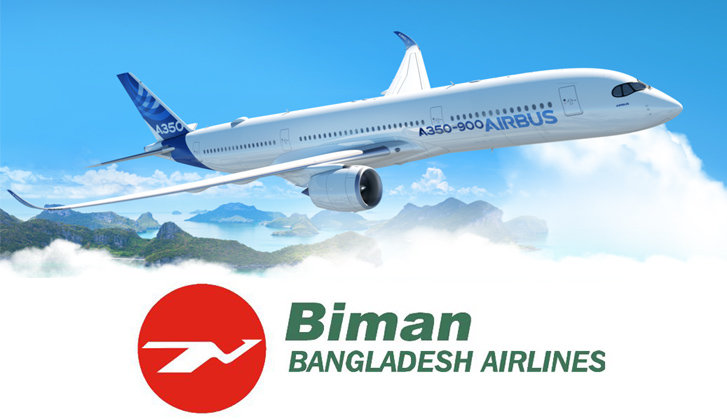
Biman sources said, Airbus has formally submitted the new fleet proposal to Biman’s techno-finance committee, offering four Airbus A350-900 wide-body aircraft and six Airbus A321neo jets as part of the airline’s next phase of expansion.
“We have received a fresh proposal from Airbus recently and our techno-finance committee is now evaluating it,” Biman General Manager (PR) Bushra Islam told BSS.
The fresh pitch comes only days after Biman formally signed an agreement with Boeing to acquire 14 aircraft- eight Boeing 787-10 Dreamliner, two Boeing 787-9 Dreamliner and four Boeing 737 MAX 8- in a landmark deal financed by the US Export-Import Bank.
Airbus Vice President Edward Delahaye recently met Civil Aviation and Tourism Minister Afroza Khanam, State Minister M Rashiduzzaman Millat and senior Biman officials in Dhaka, where the European manufacturer formally pitched a mixed-fleet strategy for Biman’s long-term expansion.
The renewed proposal comes as the government reviews a roadmap to expand Biman’s fleet to 47 aircraft by fiscal year 2034-35 as part of efforts to modernise the national carrier and strengthen global connectivity.
Aviation expert ATM Nazrul Islam said Airbus sees the expansion roadmap as a major opportunity to break Biman’s long-standing all-Boeing fleet structure after nearly four years of intense competition between the two aircraft manufacturers.
The proposed A350-900 typically accommodates around 300 to 350 passengers depending on cabin configuration, while the A321neo can carry approximately 180 to 220 passengers, making it suitable for regional, Gulf and medium-haul Asian markets.
Islam said adopting a mixed fleet strategy could provide Biman a greater operational flexibility, stronger route adaptability and long-term commercial efficiency.
“A mixed fleet allows an airline to deploy the most suitable aircraft depending on passenger demand, route performance and cost structure,” he said, adding that pilots and engineering teams can be trained to transition between both manufacturers without major operational barriers.
He said such a strategy can ultimately strengthen route economics, improve operational resilience and optimise long-term fleet management.