Monday
24 August, 2026
News Flash
News Flash
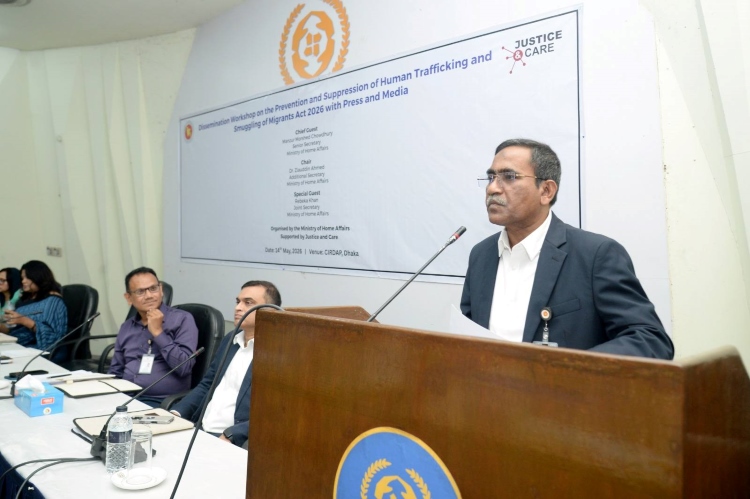
DHAKA, May 2026 (BSS) – Senior Secretary of Home Ministry Manzur Morshed Chowdhury today reaffirmed Bangladesh’s commitment to combating human trafficking and illegal migration through laws aligned with international standards, describing the crimes as major global challenges.
He made the remarks while speaking at a daylong awareness workshop on the “Prevention and Suppression of Human Trafficking and Migrant Smuggling Act-2026” at the CIRDAP auditorium in Dhaka, according to a home ministry press release.
Chowdhury also said the law was enacted in line with the UN Convention against Transnational Organised Crime (UNTOC) and its TIP and SOM protocols.
The workshop was organized by the Home Ministry with support from Justice and Care and attended by media professionals.
The home secretary said the new law emphasizes both strict action against traffickers and protection of victims’ rights, while also bringing online fraud, scamming and ransom-related exploitation under its scope.
He stressed the need for public awareness and highlighted the media’s role in preventing trafficking.
The workshop, chaired by Additional Secretary Dr. Ziauddin Ahmed, was attended by Joint Secretary Rebeka Khan as special guest, while country director of Justice and Care Tariqul Islam presented the keynote paper.
Officials said the law strengthens investigative powers by allowing freezing of bank accounts, seizure of properties and trials in absentia. Passport and visa forgery linked to migrant smuggling has also been made punishable.
Investigators will be able to use powers under the Money Laundering Prevention Act-2012 to verify assets and income of traffickers, while tribunals may simultaneously try related offences including assault, drug trafficking and sexual violence.
Provisions for Mutual Legal Assistance (MLA) have also been expanded to help confiscate assets abroad.
The revised law clearly separates human trafficking and migrant smuggling as distinct crimes for the first time under a single legal framework in line with UN protocols.
It also introduces tougher penalties, including three to seven years’ imprisonment and fines for aiding traffickers, online migration fraud and document concealment, while offences involving sexual exploitation may carry three to 10 years in prison. Victim and witness protection measures have also been strengthened.
Threatening victims or witnesses may result in three to seven years’ imprisonment, while forcing settlements may lead to two to five years of rigorous imprisonment.
Victims compelled to carry forged passports or enter countries illegally will not be treated as accused persons. Shelter home authorities must also submit monitoring reports every six months on rehabilitation conditions.
A total of 48 representatives from leading print and electronic media outlets attended the workshop.
Speakers expressed hope that proper implementation and wider publicity of the law would help curb irregular migration and dismantle trafficking networks.