Monday
24 August, 2026
News Flash
News Flash
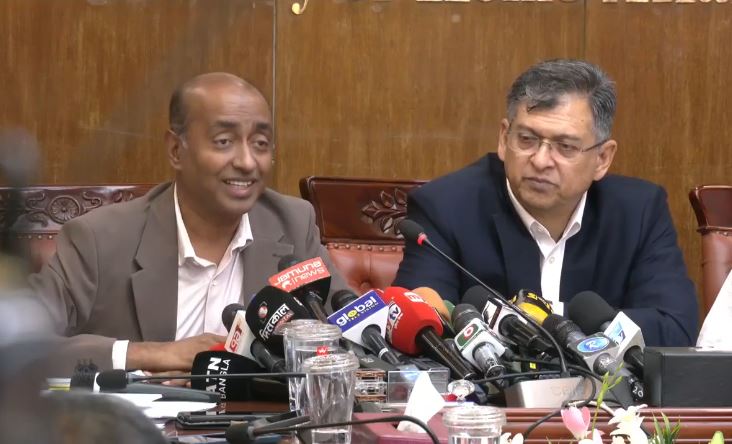
DHAKA, April 12, 2026 (BSS) - Law, Justice and Parliamentary Affairs Minister Md Asaduzzaman today said that out of the 133 ordinances originally promulgated by the previous interim government and recently placed before the parliament, 97 were passed without any changes.
"In compliance with the constitutional obligation under Article 93 of the constitution, we placed the 133 ordinances promulgated by the previous interim government before the Jatiya Sangsad (JS) within the stipulated time during the first session of the 13th parliament. Of the ordinances, 97 were converted into law in the form of bills without any changes. Another 13 ordinances were amended and enacted into law. Seven ordinances were lapsed and kept in abeyance," the minister said at a press briefing held at the home ministry this afternoon.
Home Minister Salahuddin Ahmed and Chief Whip Nurul Islam Moni were present on the occasion, among others.
The law minister said the special committee, after thorough examination, submitted its report on the ordinances to the Jatiya Sangsad on April 2. In light of the report, the relevant ordinances were introduced in parliament as bills over the past several days, where those were discussed extensively.
Md Asaduzzaman, a senior jurist himself, said the remaining 16 ordinances will be subject to further scrutiny and appropriate action will be taken as per the need in line with the recommendations of the special committee, as mentioned in its report.
"In the Jatiya Sangsad, detailed and lively discussions were held on three to four ordinances, with arguments and counterarguments. In particular, in-depth discussions took place on the National Human Rights Commission Ordinance, the Supreme Court Judge Appointment Ordinance, and the Supreme Court Secretariat Ordinance," he added.
The law minister said when the three ordinances were introduced in parliament as bills, their preambles and statements of objects and reasons stated that further consultation, review, and scrutiny were required before finalizing those.
"It was noted that the National Human Rights Commission Ordinance, 2025, needed additional consultation and examination with relevant stakeholders, the Supreme Court Judge Appointment Ordinance, 2025, required further detailed review of its provisions, and the Supreme Court Secretariat Ordinance, 2025, also required further consultation with concerned parties regarding the need for establishing a Supreme Court Secretariat," he stated.
Md Asaduzzaman said the preambles and statements of objects and reasons clearly reflect the government's goodwill.
"For those who claim that we do not want a strong Human Rights Commission, do not want a Supreme Court Secretariat, or do not want transparency in judicial appointments, this serves as a clear message that the BNP, as part of its election commitments, seeks to make these laws more transparent, accountable, and time-befitting. The BNP considers any justified demand of the people as highly important and gives it due consideration," the law minister said.