Tuesday
25 August, 2026
News Flash
News Flash
RAJSHAHI, April 8, 2026 (BSS)- A research project from the Research Division
of Rajshahi University of Engineering and Technology (RUET) has secured
second place.
The university's three-member research team from the Department of Chemistry
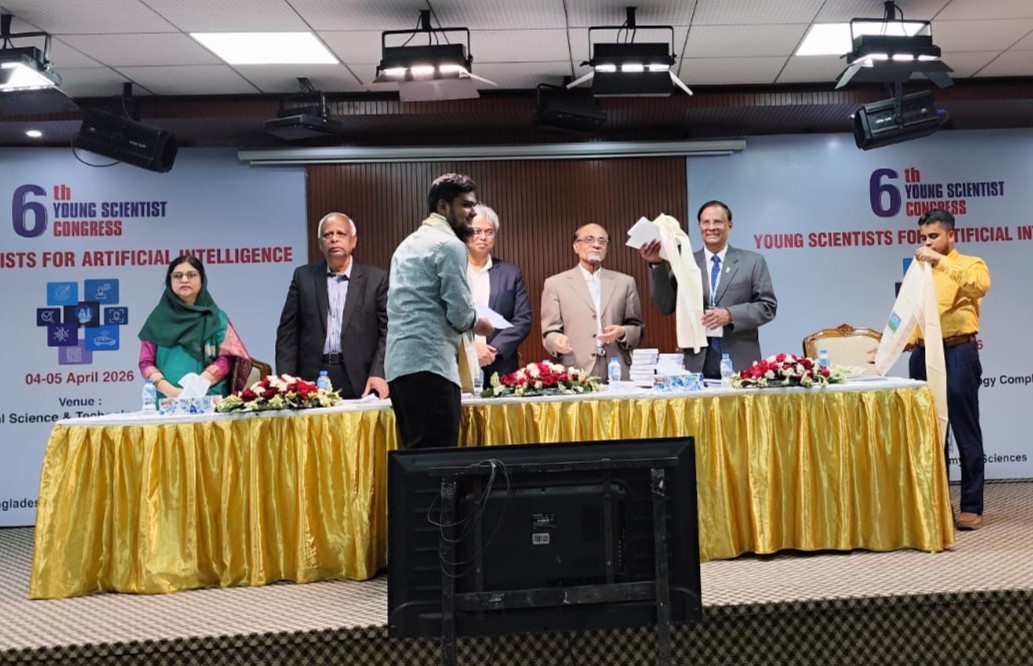
earned this honor by participating in the two-day Sixth Young Scientist
Congress, organised by the Bangladesh Academy of Sciences.
The congress was held on Saturday and Sunday (April 4-5) at the National
Science and Technology Complex in Agargaon, Dhaka.
During the event, young scientists from across the country presented
research, innovations, and opportunities in the field of Artificial
Intelligence (AI).
According to sources, representatives from various universities, research
institutions and technology-related organisations participated in the
congress.
The event featured multiple sessions, panel discussions, and technology
exhibitions.
Among the participants, the research paper of RUET master's student Mosfiqur
Rahman Maruf, under the guidance of Professor Al Amin Al Azadul Islam and
supervision of Associate Prof Dr. Jewel Hossain, won second place in the
poster presentation event under the category "Physical, Chemical, Natural
Resource and Environmental Science".
His research focused on: "Computational Investigation of Anodic Chlorine
Evolution Reaction over SiN4 Co-Doped Graphene Electrocatalyst".
The study employed Density Functional Theory (DFT) to analyze the anodic
chlorine evolution reaction (CER) on a new-generation SiN4 co-doped Graphene-
based electrocatalysts.
Associate Professor Dr. Jewel Hossain, supervisor of the research team in
RUET's Department of Chemistry, explained that chlorine is an essential
industrial raw material used as a disinfectant in water treatment and in
industries such as polymers, pharmaceuticals, textiles, and paper.
This research proposes a green, cost-effective, and metal-free carbon-based
nanomaterial as a potential alternative to the current highly energy-
intensive, expensive, and noble-metal-dependent chlorine production methods.
This new approach enables high-efficiency chlorine production at lower
overpotentials.
This research is particularly significant in the context of Bangladesh, where
the demand for chlorine in manufacturing industries is continuously growing.
Producing chlorine locally with an economical and efficient technology could
reduce import dependence, promote self-reliance in the industrial sector, and
accelerate economic development through energy savings.
RUET Vice-Chancellor Professor Dr. S M Abdur Razzak congratulated the student
on this achievement and wished him continued success in the future.