Tuesday
25 August, 2026
News Flash
News Flash
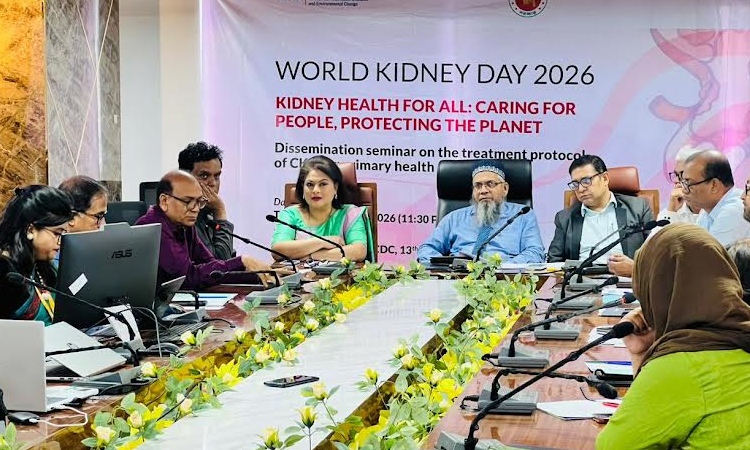
DHAKA, March 12, 2026 (BSS) - A national treatment protocol has been introduced to strengthen early detection, diagnosis and management of chronic kidney disease (CKD) in Bangladesh's primary healthcare system.
The protocol was jointly developed by the Non-Communicable Disease Control (NCDC) unit of the Directorate General of Health Services (DGHS) and the International Centre for Diarrhoeal Disease Research, Bangladesh (icddr,b).
It was unveiled today at an orientation meeting held at the NCDC office of the DGHS here marking the World Kidney Day 2026.
Experts said chronic kidney disease is emerging as a major public health concern in Bangladesh, as many cases remain undetected in the early stages and are diagnosed only when the disease becomes severe.
A study titled "Prevalence of Chronic Kidney Disease in Bangladesh: A Systematic Review and Meta-analysis" found that nearly one in four people in the country suffers from some form of kidney problem, which is higher than the global average.
Every year, around 35,000 to 40,000 people progress to kidney failure, putting pressure on the country's limited dialysis and kidney transplant facilities.
Under the new protocol, Community Health Care Providers (CHCPs) at community clinics will conduct initial screening for kidney disease, hypertension and diabetes, while doctors at Upazila Health Complexes will diagnose the disease, assess risk and manage treatment following the guidelines.
The protocol was developed under a research project funded by the National Institute for Health and Care Research (NIHR).
Additional Director General (Planning and Development) of DGHS Professor Dr Sheikh Saidul Haque said the protocol would play an important role in tackling kidney disease in Bangladesh by ensuring early detection and management at community and upazila levels.
The Directorate General of Health Services said the protocol will be introduced gradually across primary healthcare centres nationwide, alongside ensuring training for health workers and monitoring of implementation progress.