Tuesday
25 August, 2026
News Flash
News Flash
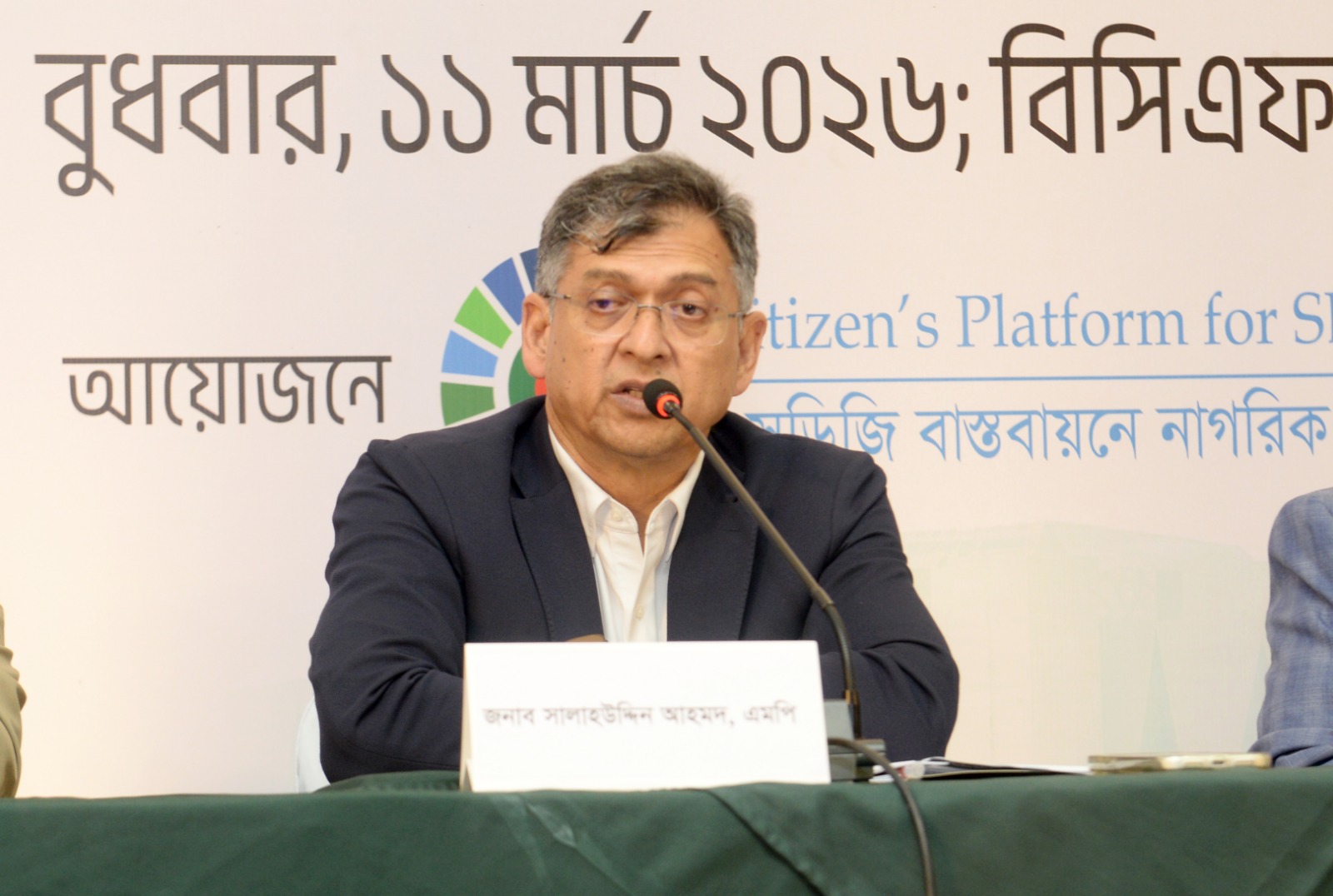
DHAKA, Mar 11, 2026 (BSS) - Home Minister Salahuddin Ahmed has said most of the ordinances issued by the interim government are likely to be accepted, though several will require discussion and possible amendments in parliament, including the Human Rights Commission Ordinance.
He made the remarks while speaking at a dialogue titled “Human Rights Commission Ordinance 2025: Expectations for the New Parliament”, organized by Citizen Platform Bangladesh for Implementation of SDGs.
In his speech, the minister warned against imposing decisions coercively, saying such actions never bring good results for the nation.
He emphasized the importance of consensus among political parties and stakeholders from different sectors of the society.
Referring to discussions held within the National Commission, he said several issues had been examined considering the social realities of Bangladesh.
Some proposals were deemed immediately implementable, while others were suggested to be tested through a trial-and-error process before broader application, he said.
The minister noted that the National Human Rights Commission issue had been discussed extensively in the commission.
He acknowledged that the country had witnessed serious human rights violations in the past, particularly under the previous regime, and reiterated the government’s commitment to protecting human rights and fundamental rights guaranteed by the constitution.
“These commitments are reflected in our manifesto and in our 31-point agenda,” he said.
The Home Minister said that although many ordinances could be accepted largely in their current form, some would require amendments before being passed as laws.
Those amendments would be introduced through bills in parliament, he said.
He also highlighted procedural challenges in approving ordinances within the constitutional timeframe.
According to parliamentary rules, ordinances must be approved within 30 working days of the start of a parliamentary session, he said.
With the first session of the new parliament scheduled to begin on March 12 and several public holidays and breaks in between—including Genocide Day on March 25 and Independence Day on March 26—the time available for legislative work will be limited.
The minister said the Ministry of Home Affairs alone has seven ordinances among the total issued, some of which may be approved without major changes while others, including those related to human rights and security matters, will require more extensive discussion.
He explained that proposed laws must go through the parliamentary process, including first, second, and third readings, and may also be referred to a special committee for detailed examination.
“Within these 30 days it will be difficult to pass every ordinance, but we will try to retain most of them,” he said, adding that those ones that cannot be passed in time may lapse but can later be reintroduced as bills in future parliamentary sessions.
The minister concluded by stressing that the government remains committed to strengthening the legal framework for human rights protection and ensuring that relevant laws are enacted through proper parliamentary debate and consensus.