Thursday
16 July, 2026
News Flash
News Flash
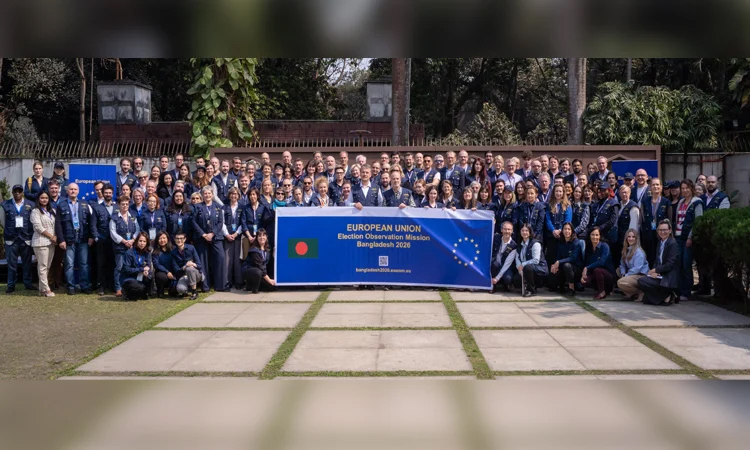
DHAKA, Feb 10, 2026 (BSS) – The European Union Election Observation Mission (EU EOM) today intensified its monitoring of Bangladesh’s national elections, highlighting its contribution to transparency by deploying short-term observers nationwide alongside long-term teams.
“With a total of 200 observers deployed across the country, we are contributing to the transparency of these historic elections,” said Ivars Ijabs, Chief Observer of the European Union Election Observation Missions to Bangladesh today.
This large and dedicated mission attests to the European Union’s unwavering commitment to the democratic governance of Bangladesh, he added.
He made the remarks while 90 short-term EU observers (STOs) were deployed today to observe election-day proceedings in all 64 administrative districts. Their work will cover the opening of polling centres, voting, closing, ballot counting and the tabulation of results.
“The short-term observers will be present in cities, towns and villages in almost every constituency. Their observations and reports throughout the day will be a critical element of our impartial and fact-based assessment of these historic elections,” said Ijabs.
The STO deployment builds on the work of 56 long-term observers who have been in Bangladesh since mid-January, monitoring the pre-election environment, including election administration preparations, campaign activities and voter education, while engaging with a broad range of political and civil society stakeholders.
The mission is further reinforced by a delegation of Members of the European Parliament, as well as 35 locally recruited short-term observers from the diplomatic missions of EU member states and partner countries, including Canada, Norway and Switzerland.
At full strength, the EU EOM comprises more than 200 observers drawn from all 27 EU member states, along with Canada, Norway and Switzerland.
The EU EOM said it will present its preliminary findings at a press conference in Dhaka on February 14.
A comprehensive final report, including recommendations for future electoral processes, will be submitted to the authorities after completion of the electoral process and made public on the Mission’s website.
The mission operated under a strict code of conduct requiring neutrality and non-interference and conducts its activities in line with the Declaration of Principles for International Election Observation endorsed under United Nations auspices in 2005.