Wednesday
26 August, 2026
News Flash
News Flash
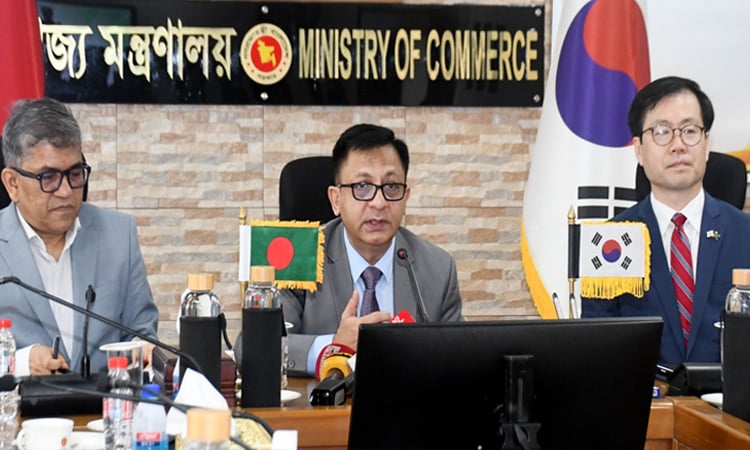
DHAKA, Aug 4, 2026 (BSS) - Bangladesh and South Korea have signed a bilateral trade agreement that will grant preferential tariff treatment to 97 percent of Bangladeshi goods entering the Korean market.
Under the Comprehensive Economic Partnership Agreement (CEPA), Bangladesh will also extend preferential market access to 87 percent of South Korean products, including selected agricultural goods, plastics and Completely Knocked Down (CKD) items.
Commerce Minister Khandakar Abdul Muktadir today disclosed the details while making a joint announcement after the signing ceremony at the Secretariat in the city.
Describing the agreement as a landmark achievement, Muktadir said it would create new opportunities for employment generation and accelerate the country's economic growth.
He said the agreement would enable Bangladeshi export products, including readymade garments, leather goods and jute products, to gain easier access to the South Korean market.
He added that the deal would support export diversification and enhance Bangladesh's competitiveness in the global market.
"The preferential market access secured for Bangladeshi exports in South Korea is a major milestone for the country," he said, adding that the agreement would play an important role in expanding bilateral trade.
Referring to the agreement as a milestone for Bangladesh's export sector, Muktadir said the CEPA would play a vital role in supporting the country's post-LDC trade transition while attracting greater foreign direct investment (FDI).
He said Bangladesh aims to become a $1 trillion economy by 2034, requiring an annual nominal GDP growth rate of around eight percent.
"As domestic resources alone will not be sufficient to achieve this target, attracting quality foreign investment is essential," he said, describing South Korea as a model economy with strong technological capabilities and a GDP of around $2 trillion.
The minister said the agreement would encourage Korean investment in high-value sectors such as semiconductors, information technology, shipbuilding, ship recycling and light engineering.
Speaking on the occasion, South Korean Trade Minister Yeo Han-koo congratulated Bangladesh on its economic progress and praised the country's leadership for concluding the agreement in a short period.
He said bilateral economic relations had traditionally centred on the textile sector but were now expanding into broader industrial cooperation and investment.
Highlighting Bangladesh's demographic advantage, he said the country's large young workforce makes it an attractive production base for Korean companies.
He noted that Korean firms could establish manufacturing facilities in Bangladesh to serve both the Korean market and global export destinations.
Responding to questions regarding the pace of negotiations, Muktadir said the process had been efficient rather than rushed.
He said while similar trade agreements often take between 10 and 20 years to conclude, the government completed the negotiations within six months through continuous efforts.
The minister also assured that the interests of local industries had been carefully safeguarded during the negotiations.
He said the CEPA would be made public for detailed review, adding that it was a transparent agreement whose long-term benefits would be evident to all stakeholders.
Both sides expressed confidence that the agreement would usher in a new chapter in Bangladesh-South Korea economic relations by expanding trade, strengthening investment and creating new opportunities for sustainable economic growth.