Sunday
23 August, 2026
News Flash
News Flash
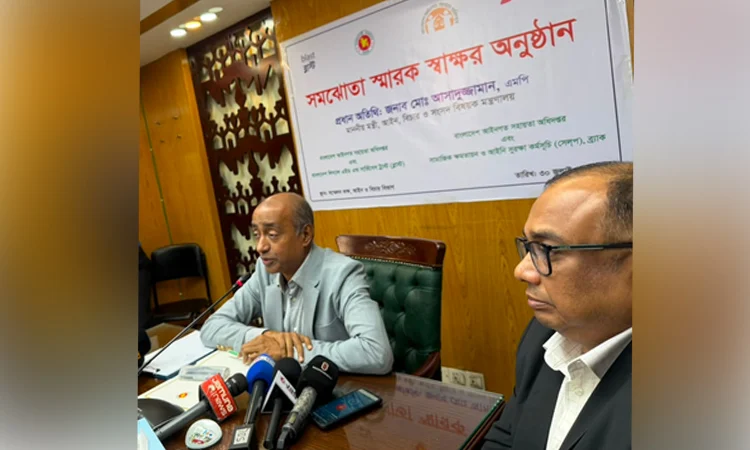
DHAKA, July 30, 2026 (BSS)- Law, Justice and Parliamentary Affairs Minister Md Asaduzzaman today said the government is attaching the highest priority to alternative dispute resolution (ADR) to reduce the longstanding backlog of cases in the country's judiciary and ensure speedy justice for ordinary people.
"Government's various initiatives and the effective use of ADR have resulted in a more than 62 per cent decline in the filing of cases under certain laws during the current period of 2026 compared with 2025," he said.
The minister made the remarks as the chief guest at the signing ceremony of two separate memoranda of understanding (MoUs) between the Directorate of Bangladesh Legal Aid, Bangladesh Legal Aid and Services Trust (BLAST) and BRAC's Social Empowerment and Legal Protection (SELP) at the ministry this morning.
"At present, nearly 45 lakh cases are pending before courts across the country, posing a significant burden on the judicial system.
The government has been working continuously to reduce this backlog," the law minister said.
He added that the government's legal aid programme was first introduced through an administrative order in 1994 during the tenure of the Begum Khaleda Zia government and was subsequently enacted into law in 2001. "We have now modernised that law to make it more responsive to present-day needs," Asaduzzaman further said.
The MoUs were signed today as part of the implementation of the Legal Aid Services (Amendment) Act, 2026, which, for the first time in the country, has created an opportunity to develop professional mediators and ensure their training and legal recognition.
Under the first MoU, the Directorate of Bangladesh Legal Aid (DBLA) and the Bangladesh Legal Aid and Services Trust (BLAST) will jointly recruit and deploy three court paralegals in Dhaka, Gazipur and Chattogram. Working under BLAST's supervision, the paralegals will provide only essential legal information to workers seeking assistance at labour law support cells. They will, however, adhere to the "Do No Harm" principle and will not be permitted to provide legal advice directly.
The MoU also stipulates that if mediation conducted by BLAST in compoundable disputes is successful, the DBLA will grant it official legal recognition. If the mediation fails, the concerned legal aid officer will issue a certificate of unsuccessful mediation, enabling the dispute to be filed as a regular case before the court.
Under the second MoU, BRAC will organise six regional training programmes for professional mediators with its own funding. The DBLA will award certificates to successful participants. Settlement documents prepared by BRAC-certified mediators will acquire legal validity after being verified by the respective Chief Legal Aid Officer (CLAO).
In cases where the respondent fails to appear, or mediation remains unresolved, the legal aid office will issue a report, allowing the dispute to proceed to court.
Speaking at the ceremony, Law, Justice and Parliamentary Affairs Minister Md Asaduzzaman said the institutional collaboration between the government's legal aid system and the country's leading NGOs would play a transformative role in delivering prompt legal services to marginalised communities and workers seeking justice.
"Government wants to leverage the expertise and extensive grassroots experience of organisations such as BLAST and BRAC. International development partners, including the Japan International Cooperation Agency (JICA), the German international cooperation agency GIZ and the United Nations Development Programme (UNDP), are also supporting efforts to strengthen alternative dispute resolution (ADR) mechanisms," he added.
Among others present at the MoU signing ceremony were Additional Secretary of the Law and Justice Division Md Khadem Ul Qayes, Additional Secretary SM Ershadul Alam, Director General of the Directorate of Bangladesh Legal Aid (DBLA) Md Monjurul Hossain, BLAST Executive Director Barrister Sara Hossain, and BRAC SELP Programme Associate Director Shashwata Biplob.