Sunday
23 August, 2026
News Flash
News Flash
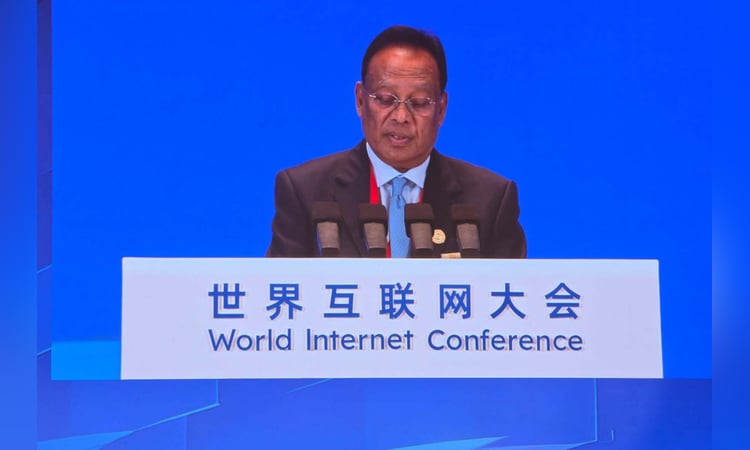
DHAKA, July 22, 2026 (BSS) - Posts, Telecommunications and Information Technology Minister Faqir Mahbub Anam has put forward a visionary three-point proposal aimed at promoting multilateral cyber governance, ensuring equitable access to technology and knowledge, and bridging the global digital divide to build an inclusive digital future.
He presented the proposal at the opening ceremony of the prestigious World Internet Conference 2026 in China while delivering a keynote address as a special guest, said a ministry press release today.
To advance shared digital prosperity, Faqir Mahbub Anam, also minister for Science and Technology, proposed the following three key pillars.
“Capacity Building and Knowledge Transfer: Invest not only in digital infrastructure but also in developing Bangladesh's young talent through collaborative platforms for nurturing cybersecurity professionals, digital experts and future innovators,” he said.
Secondly, he said “Affordable Connectivity: Promote affordable technology transfer and strengthen cooperation with global technology leaders to bridge the digital divide.”
He finally added, “Digital Public Goods: Recognize digital development as a global public good by making intellectual property (IP) frameworks and data architectures more open and accessible for the benefit of the international community.”
The theme of the conference "Pooling Intelligence on the Silk Road, Embarking on a Digital Future: Jointly Building a Community with a Shared Future in Cyberspace" held at the Xi'an International Convention Center.
Addressing emerging cyber challenges, the Minister stressed that cyber governance must be multipolar, transparent and firmly grounded in international law to effectively combat cybercrime, disinformation and data colonialism.
Recalling that the ancient Silk Road was built on trust and mutual confidence, he said "Our digital superhighways must be built on the same foundation of trust. Bangladesh stands ready to be a reliable partner in this journey, driven by connectivity, youthful energy and innovation."
Mentioning that the historic significance of the ancient Silk Road, Faqir Mahbub Anam said the conference theme resonates deeply with Bangladesh's national aspirations.
Noting that nearly 65 percent of Bangladesh's population of 180 million is young and of working age, he said under the visionary leadership of Prime Minister Tarique Rahman, Bangladesh is harnessing this demographic dividend to build a modern, technology-driven and knowledge-based nation.
Highlighting Bangladesh's remarkable digital transformation, the Minister said that more than 90 percent of the population now has access to mobile connectivity.
Mobile Financial Services (MFS) have brought banking services to the doorsteps of marginal farmers and small entrepreneurs, he said, adding that in addition, government services are being delivered efficiently through the National Portal and the d-Nothi (electronic file management) system.
He continued that the digitalization of land records, healthcare services and other public services is saving citizens’ millions of working hours every year.
The Minister observed digital transformation is not merely about physical infrastructure; it is equally about innovation, artificial intelligence and human talent.
Bangladesh is making significant investments in AI research, fintech innovation and advanced data centre infrastructure, he said.
At the same time, the country is developing technology-driven solutions to local challenges, including machine learning-based flood forecasting and drone-enabled precision agriculture, he added.
Describing Bangladesh's strategic location at the crossroads of South and Southeast Asia, the Minister said the Digital Silk Road serves as an economic lifeline for the country.
Through high-speed submarine cable connectivity, Bangladesh's digital economy is becoming increasingly integrated with China's technological capabilities and ASEAN's manufacturing networks, he said.
The two-day conference, held on 21–22 July, brought together approximately 800 participants and representatives from 52 countries and regions.
Discussions focused on artificial intelligence, digital trade, Silk Road e-commerce, cultural heritage preservation, smart healthcare and global digital cooperation.
Representatives from leading Chinese and global technology companies, including Qualcomm, Lenovo, ZTE, 360 Group, Sugon, Waterdrop, Qixin Technology and Penghua Fund, also participated in the forum.