Monday
24 August, 2026
News Flash
News Flash
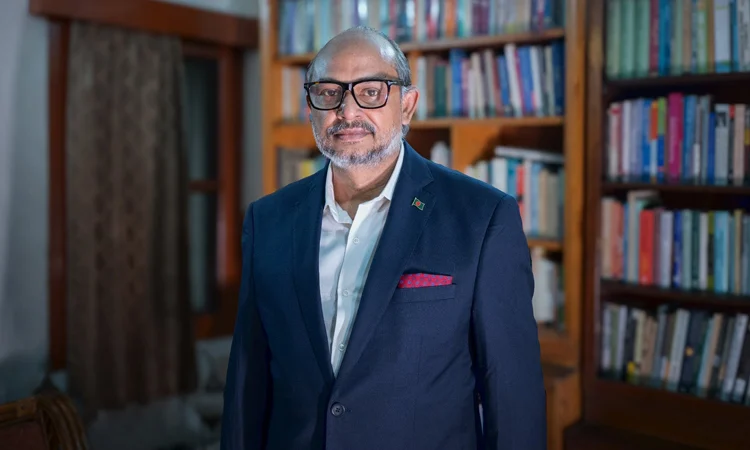
DHAKA, May 14, 2026 (BSS) - Adviser to the Prime Minister on the Ministries
of Finance and Planning Dr. Rashed Al Mahmud Titumir today said the
government's proposed Five-Year strategic economic framework would
"undoubtedly be a milestone" in the country's planning history as it seeks to
establish an accountable, transparent and implementation-oriented development
process.
"This is a different and timely initiative. In Bangladesh's recent history,
such an inclusive advisory committee for economic strategy formulation has
never been formed before," he said.
Speaking at a press briefing after attending the second meeting of the
Advisory Council on formulation of the strategic economic framework as the
chief guest at the NEC Conference Room, the finance and planning adviser said
the government was determined to move away from what experts described as the
ineffective planning culture of the past, where development plans often
remained only on paper.
State Minister for Planning, Md. Zonayed Abdur Rahim Saki remained present in
the meeting as the Special Guest, while Planning Adviser to the Interim
Government, Dr. Wahiduddin Mahmud, presided over the meeting. Planning
Secretary SM Shakil Akhter and GED Member of the Planning Commission Dr M
Monzur Hossain were present.
The meeting was attended by economists, business leaders, academics,
researchers, representatives of civil society and experts from different
sectors who reviewed the draft framework prepared by the government.
According to the finance and planning adviser, the participants expressed
satisfaction over the draft and appreciated the government's effort to
formulate a realistic and effective economic strategy through a participatory
process.
"They said previous plans effectively became dead documents from the very
next day of their approval because the strategies and targets were never
implemented," he said.
Titumir alleged that project selection and implementation during the previous
administration were heavily influenced by patronage, inflated expenditures
and lack of accountability, which ultimately imposed a significant debt
burden on the country.
He said the current government had already started reviewing many such
projects after assuming office.
"Projects were selected through patronage and expenditure was repeatedly
increased without proper justification. In many cases there was no relation
between project costs and actual requirements," he added.
He said the proposed framework introduces major structural reforms in the
planning process aimed at ensuring effective implementation and public
accountability.
He said the document contains separate chapters on implementation reforms,
monitoring and evaluation systems, inter-ministerial coordination and
ensuring free flow of information.
"We want to prepare a realistic and implementable planning document. That is
why reforms relating to implementation, monitoring and evaluation have been
incorporated directly into the framework," he said.
The finance and planning adviser particularly referred to the "June syndrome"
in public spending, where development expenditures are often rushed at the
end of the fiscal year, resulting in waste, irregularities and poor quality
implementation.
"We are introducing continuous monitoring and evaluation mechanisms so that
development works are not hurriedly completed at the end of the fiscal year,"
he said.
He added that the government wanted to institutionalize a culture of
transparency where citizens, researchers and academics would have easier
access to official data and project-related information.
"There was a culture of secrecy and data manipulation in the past. We want to
ensure free flow of information so that students, teachers, researchers and
citizens can independently verify whether project outcomes actually match
government claims," he said.
The adviser said the new framework to be implemented from next fiscal year
would also fundamentally change the "programming process" through which
development projects are selected and approved.
"Projects can no longer be selected merely for patronage distribution. These
are financed by taxpayers' money and therefore must reflect public
aspirations and economic rationale," he said.
He said the strategic framework had been designed in line with the
government's broader vision of building a "humane, democratic welfare state"
based on equality, dignity, justice and rule of law.
Referring to the Liberation War ideals, he said the government wanted to
ensure balanced socio-economic development, reduce inequality and strengthen
state capacity through a democratic planning process.
The adviser said the framework aims to help Bangladesh become a trillion-
dollar economy by 2034 through realistic macroeconomic targets, sector-based
strategies and measurable indicators.
"There will be sector-specific planning and clear indicators so that
implementation progress can be monitored properly," he said.
He also explained the participatory process followed in preparing the
framework.
According to him, ministries and divisions were instructed to submit three
separate documents - a 180-day action plan, plans for the next fiscal year
aligned with the government's election manifesto and a five-year sectoral
strategy.
At the same time, views and recommendations from economists, business
representatives, academics, researchers and civil society members were
incorporated into the draft framework.
"The framework has emerged through public mandate, institutional consultation
and participation of stakeholders. That is where its legitimacy lies," he
said.
The adviser said the draft was later reviewed by a technical committee before
being presented to the advisory council at today's meeting.
"The experts appreciated the realism of the framework. They observed that
there are no unrealistic promises or rhetorical targets in this document," he
added.
The draft framework will now be sent to the National Steering Committee and
subsequently to the National Economic Council for further discussion and
approval.
Replying to questions from journalists, the adviser said the government was
trying to strengthen institutions, particularly the Planning Commission, so
that it could function independently and professionally.
"In the past, many projects were approved without proper scrutiny and in some
cases even without appointing project directors. We want institutions to
function properly and ensure economic logic and public interest in project
approval," he said.
He also said the government planned to introduce project dashboards at local
levels so that citizens could monitor project progress, expenditures and
implementation status in real time.
On information access, Dr. Titumir said the government was working to make
data of the Bangladesh Bureau of Statistics (BBS) more accessible to
researchers and the public.
"We believe in accountability and therefore answer questions. Free flow of
information is essential for ensuring transparency, accountability and rule
of law," he added.