Friday
28 August, 2026
News Flash
News Flash
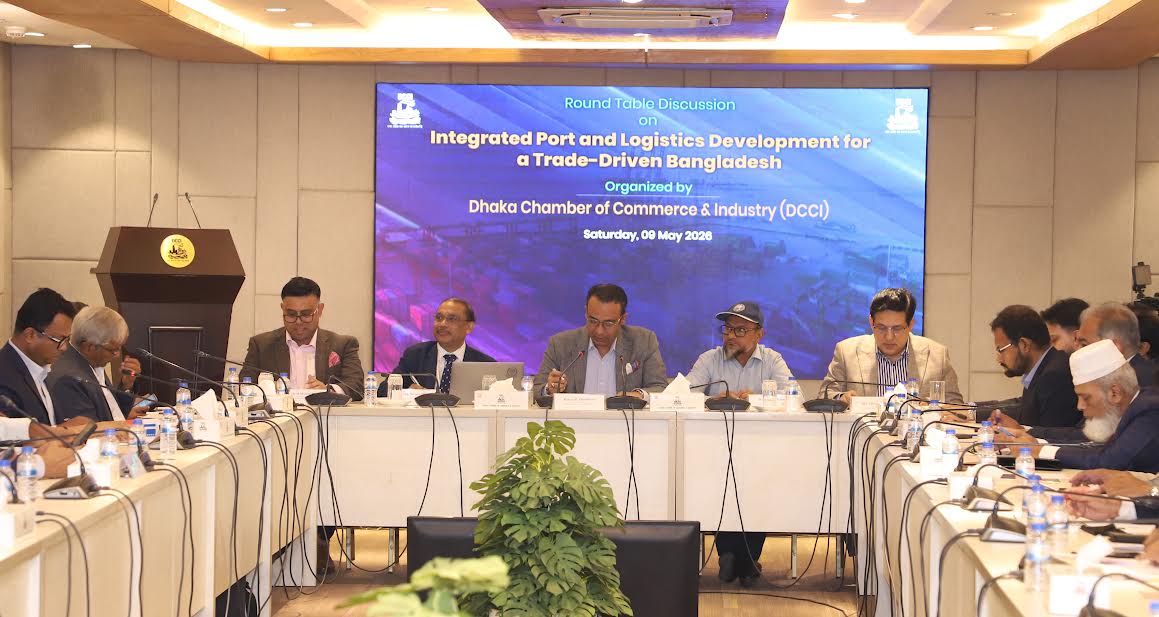
DHAKA, May 9, 2026 (BSS) – Speakers at a roundtable discussion today underscored the need for ensuring efficient and integrated logistics ecosystem to enhance the country’s export volumes alongside improving the overall business and investment climate.
They said this in a roundtable discussion on “Integrated Port and Logistics Development for a Trade-Driven Bangladesh” held at the DCCI Auditorium.
Md. Salim Ullah, Director General of Bangladesh Institute of Management (BIM), spoke as special guest.
Md. Salim Ullah said that Bangladesh remains significantly behind in the efficient management of integrated ports and logistics systems, which is continuously increasing the cost of doing business. He stressed the importance of coordinated efforts among all stakeholders to achieve the desired development in the sector.
In his keynote presentation Dr. M. Masrur Reaz, Chairman and CEO, Policy Exchange of Bangladesh, noted that manufacturing sectors contribute nearly 25% to Bangladesh’s GDP, which is considerably higher than many neighbouring countries.
“However, attracting more local and foreign investment is essential to further expand the contribution of manufacturing industries,” he said.
He mentioned that although Bangladesh’s export sector has undergone a remarkable transformation over the past four decades, exports remain concentrated in a limited number of products and markets.
“Therefore, diversification of the overall economy is essential to remain competitive with other countries,” he said emphasizing on enhancing trade-related capacity, improving infrastructures and modernizing policies and regulations.
Dr. Reaz identified weak logistics infrastructures and high business costs as key reasons behind the country’s lack of a trade-supportive environment. He stated that reducing logistics costs by 25% could increase exports by 20%, while a 1% reduction in transportation costs could raise exports by 7.4%.
He further stressed the importance of effective implementation of the national logistics policy, involving both international standard foreign operators and domestic private sector companies in port management, reducing container clearance time at Chattogram Port and removing policy-related barriers.
He underscored the necessity of ensuring an efficient and integrated logistics ecosystem to improve the country’s overall business and investment climate.
Md Habibur Rahman, Additional Secretary, Former Member (Admin and Planning), Chittagong Port Authority remarked that railway connectivity is the only viable long-term solution as there is limited scope for further expansion of the Dhaka-Chattogram highway.
He proposed establishing rail connectivity with ports to ensure faster and lower-cost cargo transportation. He also suggested involving the private sector in operating at least one seaport in Bangladesh, which could create competition for existing government agencies, improve service quality, and potentially reduce tariffs.
Dr. Md. Shamsul Hoque, Professor, Department of Civil Engineering, Bangladesh University of Engineering and Technology (BUET) noted that development planning in Bangladesh often lacks practicality, preventing the achievement of expected outcomes. He emphasized that communication infrastructure must be integrated to attain positive results; otherwise the country would continue to lag behind.
S.K Masadul Alam Masud, Managing Director, Shahariar Steel Mills Ltd. stated that entrepreneurs are reluctant to use the Pangaon Port due to the absence of necessary scanning devices. He also pointed out that insufficient inland waterway infrastructure is increasing industrial transportation costs.
Nusrat Nahid Babi, Senior Transport Specialist, World Bank Bangladesh observed that customs clearance procedures in Bangladesh have yet to be fully simplified and modernized. “In particular, digital systems have not been introduced effectively at land ports, resulting in prolonged cargo clearance processes and increasing business costs.”
Humayun Kabir, Senior Project Officer (Transport), Transport Sector Office, Asian Development Bank mentioned that ADB is currently working on the development of the Dhirashram Inland Container Depot and a multimodal logistics hub project. He also emphasized on ensuring digitization and automation across all levels of logistics services.
In his welcome remarks, Razeev H Chowdhury, Senior Vice President, DCCI stated that Bangladesh’s export competitiveness is being severely hampered due to infrastructural limitations and lack of institutional coordination in the country’s logistics sector.
He emphasized the need to ensure an efficient and sustainable logistics ecosystem through the introduction of paperless automated systems at ports, infrastructure development under Public-Private Partnership (PPP) initiatives and expanded investment in modern cold-chain logistics to facilitate both local and foreign investment.
During the open floor discussion session, DCCI Director Engr. M.A. Wahab, former Director A.K.D. Khair Mohammad Khan, Managing Director of EXG Projects Logistics (BD) Ltd. Md Abrarul Alam and representative of ANB Logistics Moktar Uddin Moti, among others spoke.
DCCI Vice President Md. Salem Sulaiman, members of the DCCI Board of Directors and representatives from both government and private sectors were also present at the event.