Tuesday
25 August, 2026
News Flash
News Flash
By Mutaher Hussain
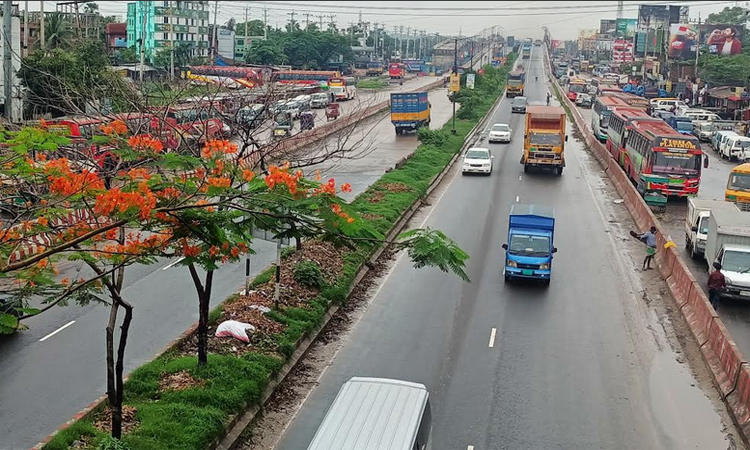
DHAKA, April 27, 2026 (BSS) - Congestion on two of the country's busiest highways- Dhaka-Chattogram and Dhaka-Sylhet-has eased significantly in recent days, offering much-needed relief to commuters and transport operators, thanks to coordinated government measures and improved traffic management.
Concerned authorities, including Wari Traffic Division under the Dhaka Metropolitan Police (DMP), are working tirelessly to further improve the situation.
For years, entry points to the capital, particularly along the Dhaka-Chattogram highway, were plagued by long traffic jams, slow movement and disorderly traffic systems.
Narrow roads, illegal parking, encroached footpaths and unregulated vehicle movement made daily travel a hardship for passengers and freight drivers alike.
However, the situation has improved significantly following a series of targeted interventions. Thousands of commuters and drivers using the routes are now experiencing smoother journeys and reduced travel time.
The improvement is not limited to the Dhaka-Chattogram highway, as traffic discipline has begun to return on the Dhaka-Sylhet highway via Jatrabari and Sayedabad, while congestion has declined significantly on the stretch beyond Kanchpur Bridge, easing travel to the northeastern region.
Similarly, traffic flow has improved on the route from Jatrabari through Postogola to the Dhaka-Mawa-Bhanga Expressway, reducing travel time to southern districts.
Roads linking Demra to Narayanganj have also seen better traffic management, while increased use of the alternative routes has helped reduce pressure on the main highways.
Overall, residents are gradually experiencing relief from longstanding congestion at major entry points under the Traffic Wari Division. The passengers have welcomed the improvement.
Talking to BSS, Shakil Hossain, a bus passenger from Sylhet, said even buses leaving early in the morning previously could not enter Dhaka before evening.
"We had to sit for hours in traffic. Children would fall ill. Now that suffering is almost gone," he said.
DMP Additional Commissioner (Traffic) Mohammad Anisur Rahman said several steps have been taken centering Sayedabad and Lalbagh areas.
He said monitoring has been intensified to prevent illegal roadside activities in the Dholai Par area, while regular supervision is being ensured.
"The Gulistan area is now largely under control, and necessary changes, including diversions, have been introduced. However, more work remains to do," he said, stressing the need for closer coordination with city corporations.
He added that plans are underway to prevent people who depend on footpaths for livelihood from encroaching onto main roads, while ensuring better regulation of bus movement, elimination of unpermitted buses and enforcement of designated stopping points.
"If we can keep the roads clear and ensure they are used only for vehicle movement, the situation will improve further," he said.
According to DMP, the areas of Jatrabari, Wari, Sayedabad and Demra-especially the part of Sayedabad-Jatrabari-Dholai Par-Mawa Expressway-had long suffered from severe congestion due to excessive vehicle pressure around the Sayedabad bus terminal and unregulated operations.
Previously, a bottleneck at the Kutubkhali section of the Mayor Hanif Flyover, where two lanes merged into one, created chronic gridlock. Besides, a large roundabout at Dholai Par hindered smooth movement.
Other contributing factors included multiple traffic signals, indiscriminate parking, encroached footpaths, roadside bus stoppages, illegal terminals and hawker encroachment. The uncontrolled movement of battery-run auto-rickshaws and other unauthorized vehicles further worsened the situation.
To address the challenges, authorities have widened the Kutubkhali section of the flyover, restoring two-lane traffic flow and significantly easing entry into Dhaka. The diameter of the Dholai Par roundabout has been reduced from 27 meters to 14 meters, effectively doubling traffic capacity.
Moreover, unnecessary signals have been removed, road layouts have been redesigned, footpaths cleared and action taken against illegal parking. Strict enforcement is underway to prevent vehicles from stopping outside designated bus stops, with violators facing legal action and vehicle impoundment.
Regular drives are also being conducted against illegal vehicles, particularly battery-run auto-rickshaws on expressways, with many vehicles being seized.
DMP also identified around 350 illegal ticket counters in the Jatrabari-Sayedabad area, which contributed significantly to congestion. These counters have been sealed, although bus owners have sought three months to relocate them. Officials expect that full removal will further ease traffic.
Drivers acknowledged the improvement but said challenges remain. Milan Mia, a bus driver with over 15 years of experience, said congestion has reduced but unauthorized auto-rickshaws and CNG-run vehicles still create disruptions.
"Now it takes around five hours on this route. If those vehicles are fully controlled, at least one hour could be saved," he said.
Another driver, Liton, said congestion on the Dhaka-Sylhet highway has declined significantly, although temporary jams still occur near fuel stations in areas like Bhairab and Ashuganj.
Deputy Commissioner of Traffic Wari Division Mohammad Azad Rahman said removal of illegal ticket counters would significantly improve traffic flow, while digital traffic signals already introduced on several VIP roads in the capital will be gradually expanded to the Wari zone.
He added that permanent rehabilitation of hawkers would help keep roads clear and further reduce congestion.
With continued enforcement and inter-agency coordination, officials hope the gains in traffic management will be sustained, making daily travel smoother for thousands of commuters.