Tuesday
25 August, 2026
News Flash
News Flash
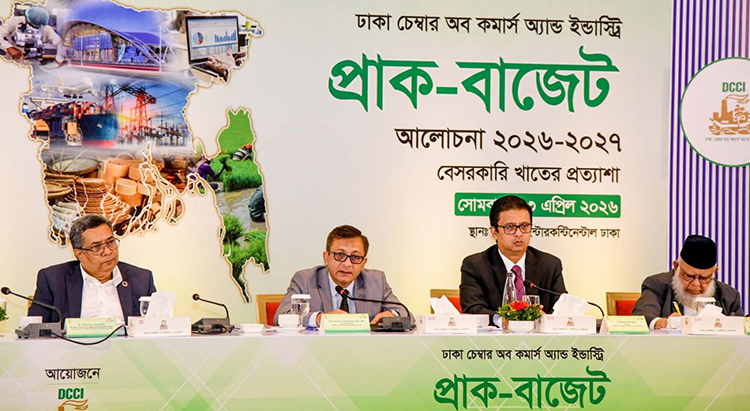
DHAKA, April 13, 2026 (BSS) - Commerce and Industries Minister Khandakar Abdul Muktadir today announced a major push toward deregulation and the simplification of bureaucratic processes to foster a more business-friendly environment.
"Despite significant global economic pressures, the government is committed to removing lingering processes that currently hinder trade," he said.
The Minister made these remarks while speaking as the chief guest at a high-level session titled "Live Pre-budget Discussion 2026-27: Expectations of Private Sector" at a city hotel.
The event was organized by the Dhaka Chamber of Commerce and Industry (DCCI) in collaboration with Channel 24 and Daily Samakal.
In his speech, Muktadir revealed that the current manual system for obtaining Import Registration Certificates (IRC) and Export Registration Certificates (ERC)-which often requires days of waiting-will be completely overhauled.
"We have decided to eliminate this process," the Minister stated, explaining that a new fully online system will allow business owners to submit documents, pay fees, and download certificates instantly.
This move is part of a broader strategy to heavily deregulate and streamline government interactions with the private sector, he added.
The Minister acknowledged the 'difficult maneuvering space' the government faces due to soaring global commodity prices.
He noted that the cost of LNG has doubled from $10 to $20 per MMBtu, crude oil has surged from approximately $55 to $116 per barrel, and fertilizer prices have also spiked.
"These challenges are compounded by the country's limited storage capacity for essential commodities like LNG and petroleum, which forces the government to purchase from the spot market at higher prices during emergencies," he added.
To counter this, he said, the government is focusing on ensuring the industrial sector remains a priority for energy allocation even during lean periods; increasing the number of Floating Storage Regasification Units (FSRUs) to boost LNG import capacity and focusing on local gas extraction; and planning for better storage facilities to avoid the volatility of spot market pricing.
The Minister, however, detailed plans to revitalize state-owned enterprises, such as sugar mills, by inviting international investors.
By utilizing the vast land holdings of these mills-some spanning 5,000 bighas, he said, the government aims to create specialized factory zones that could potentially employ up to 100,000 people, significantly reducing the current high production costs.
On the fiscal front, the Minister assured the business community that the goal is to expand the tax base rather than increasing individual tax rates.
Expressing full confidence in the Finance Minister's 'business-friendly' approach, he noted that the National Board of Revenue (NBR) is working on a vision that will be reflected in the upcoming budget.