Monday
24 August, 2026
News Flash
News Flash
DHAKA, April 7, 2026 (BSS) - State Minister for Planning Zonayed Abdur Rahim Saki today underscored the prioritization of Small and Medium Enterprises (SMEs) as the essential driver for Bangladesh's transition from Least Developed Countries (LDC) status and the realization of a balanced, sustainable economic structure.
"A robust SME sector serves as the indispensable foundation for the national economy. Large-scale industries cannot stand without a flourishing SME base," he said.
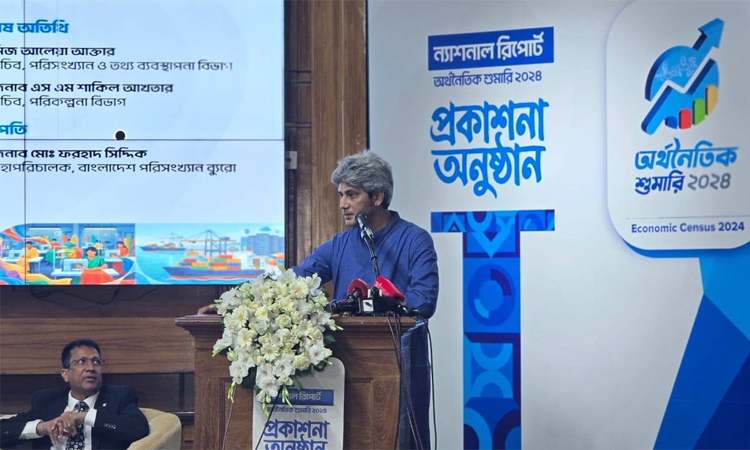
The State Minister made these remarks while speaking as the chief guest at the National Report of the Economic Census 2024 publication event at the Bangladesh Bureau of Statistics (BBS) Auditorium in the city.
Secretary of the Statistics and Informatics Division Alleyya Akhter and Secretary of the Planning Division SM Shakil Akhter attended the event as special guests.
BBS Director General Md. Farhan Siddique presided over the event while Project Director Dr. Dipankar Roy delivered the welcome address.
Deputy Project Director Md. Mizanur Rahman delivered a technical presentation on the national.
In his speech, Zonayed Saki critiqued the current economic reliance on a limited range of export-oriented products, observing that an economy dependent solely on exports-particularly a few specific commodities-cannot achieve long-term progress without a strong domestic market.
By reinforcing SMEs, he said, the government aims to foster a resilient economic framework.
The state minister highlighted several strategic benefits of this approach including establishing a stable and necessary base for the sustainability of large-scale industries; strengthening the internal market system to ensure domestic economic stability; reducing the national economy's vulnerability by decreasing over-reliance on limited export products; and mitigating economic disparity through a more inclusive industrial environment.
He noted that simplifying these entry requirements is a critical government goal.
By improving the business climate, he said, the government expects to catalyze a transformation within the SME sector, enabling new industrial units to emerge and contribute more effectively to the national GDP.
To ensure sustainable growth, the state minister emphasized a necessary pivot from operational spending toward capital expenditure.
He contended that government investment must be scaled in a manner that stimulates and facilitates broader private sector investment.
A vital component of this fiscal shift is the expansion of the tax net, he added.
Since the current tax base remains limited, the state minister argued that SME growth is the primary mechanism required to broaden the revenue base, allowing the government to reinvest income into the economy rather than relying on borrowing for development.
The State Minister for Planning concluded by reiterating that the synergy of SME development, fiscal discipline, and technological empowerment constitutes the government's comprehensive strategy for the holistic economic transformation of Bangladesh as it moves beyond LDC status.
Regarding the report, Mizanur Rahman said that the total number of economic units across the country has surged to 11,702,792 in 2024, rising from 7,818,565 in 2013-a robust growth of 49.68%, he added.
While the volume of economic units has expanded rapidly, he said, the Total Persons Engaged (TPE) grew by 25.03% during the same period, reaching 30,632,661, suggesting that the increase in units is currently outpacing the rate of employment generation.
He mentioned that the 2024 census results demonstrate a dual-track growth pattern where both rural and urban sectors have expanded significantly.
While rural areas remain the backbone of the economy in terms of sheer volume, the urban sector has witnessed a dramatic acceleration in economic activity, he added..
He mentioned that the total number of economic units in rural areas was 73,85,828 and in urban areas 43,16,964 in 2024.
In contrast in 2013, he said, the number of economic units in rural areas was 55,89,019, while in urban was 22,29,546.
According to the report, out of the total economic units (1,17,02,792), permanent is 62,69,457 (53.57%), temporary 5,73,969 (4.91%) and economic households 48,59,366 (41.52%).
By division, it is evident that the highest 27.08% of economic units are located in Dhaka, while the lowest, 4.67% in Sylhet.
Furthermore, the proportion of economic units located in Chattogram is 17.51%, followed by Rajshahi 14.36%, Khulna 12.73%; Rangpur 11.41%; Mymensingh 6.63% and Barishal 5.61%.
Among all economic units, micro industries account for, 66,31,482 (56.67%) and cottage industries, 45,33,589 (38.74%). In addition, the proportion of small industries is recorded as 4,92,323 (4.20%) followed by medium industries 36,112 (0.31%) and large industries 9,286 (0.08%).
Out of the total Permanent establishments of the country 54,77,024 (87.36%) are owned by individual/family, followed by non-profit institutions (NPI) 4,00,696 (6.39%), government and autonomous 1,39,194 (2.22%), private limited companies 1,14,386 (1.82%), and partnership-based establishments totaling 90,522 (1.44%).
The vast majority of the country's economic units, 1,05,34,443 units (90.02%), belong to the service sector and the remaining 11,68,349 units (9.98%) to the industrial sector.
According to the Economic Census 2024, the total number of persons engaged in economic units was 3,06,32,661, compared to 2,45,00,850 in 2013. It is observed that the TPE increased by 25.03% in 2024 compared to 2013. Of the TPE, Male accounted for 83.28% (2,55,11,652), Female for 16.71% (51,19,271), and Hijra for 0.01% (1,738).
Among the units of the Economic Census 2024, the largest share (40.19%) belongs to the wholesale and retail trade sector, followed by transportation and storage 22.22%, manufacturing 9.57% and accommodation and food service activities 8.11%.