Wednesday
26 August, 2026
News Flash
News Flash
DHAKA, Feb 25, 2026 (BSS) – Commerce Minister Khandaker Abdul Muktadir today said the United States tariff issue remains as an “evolving scenario,” stressing that Bangladesh has yet to receive any official written communication from Washington regarding the newly announced measures.
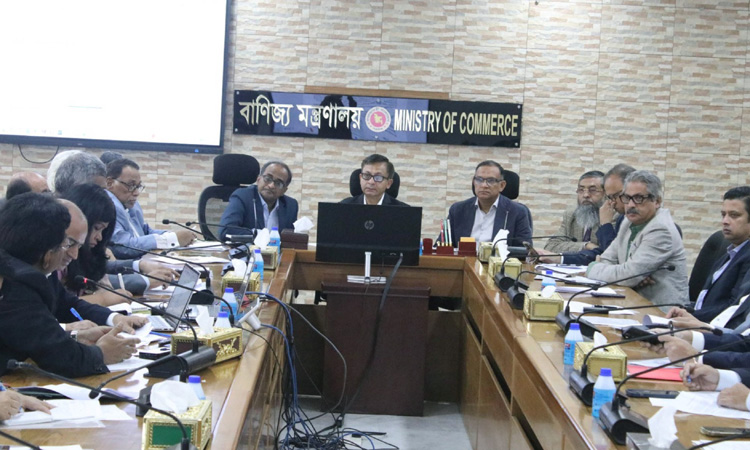
Briefing reporters after a meeting with business leaders from various sectors at the Commerce Ministry at Bangladesh Secretariat, the minister said the tariff situation has undergone significant changes following a ruling by the US Supreme Court.
He said the earlier tariff imposed under the International Emergency Economic Powers Act (IEEPA) was declared not maintainable by the court. Subsequently, the US government announced a fresh tariff under Section 122, initially at 10 percent and later raising it to a universal 15 percent applicable across the board.
“We have heard the announcement, but we have not yet received anything in writing through official channels,” he said.
Explaining the legal context, the minister noted that under Section 122, such a tariff measure must be ratified by the US Congress within a maximum of 150 days. “Beyond what we are seeing on television, in newspapers and on social media, we have not received any formal clarification at the government level,” he added.
Describing the matter as “very much evolving,” he urged the media to exercise restraint while reporting on the issue.
“This is a sensitive international trade matter involving a very important country. I would request you not to press for comments while the situation is still evolving. We all have to be cautious in our remarks,” he said.
On the trade agreement signed earlier this month by the previous government with the United States, the minister said the current administration has not yet taken a final position.
“We are reviewing the agreement. Every agreement has provisions that may be favourable and others that may not be. After examining the clauses carefully, we will determine our course of action,” he said.
He also mentioned that several procedural steps are involved before any agreement becomes fully operational.
“After an agreement is signed, there are processes to be completed before it comes into force. We have just assumed responsibility. We will assess everything before taking a decision,” he said, declining to set any specific timeline.
Responding to a question about whether the new uniform 15 percent tariff is more advantageous than the earlier 19 percent reciprocal duty, the minister explained that the previous rate varied from country to country, whereas the new rate applies equally to all.
“Earlier, different countries faced different reciprocal tariffs. Now it is same across the board – for Bangladesh, for Fiji, and for all others alike. Whether it is advantageous or not depends on the broader context,” he said.
He reiterated that the earlier tariff had been imposed under a legal provision that was not upheld by the US Supreme Court, rendering it ineffective. The new tariff, announced under Section 122, applies uniformly to all trading partners.
On the issue of a non-disclosure agreement (NDA), the minister clarified that it applied only during the negotiation period.
“The NDA was effective during the negotiation phase. It was meant to govern discussions while negotiations were ongoing,” he said.
The minister said the meeting with business representatives was not limited to the US tariff issue but covered a wide range of sectoral concerns.
“We invited representatives from various sectors so that they do not feel distant from the ministry. There are challenges in industry, textiles, pharmaceuticals and other sectors. We discussed how to accelerate exports in the coming days,” he said.
He added that the Commerce Ministry intends to hold separate meetings with different sectors in the future, but due to Ramadan and other priorities, a broader consultation was held for now.
Addressing concerns about market conditions during Ramadan, particularly reports related to Trading Corporation of Bangladesh (TCB) truck sales, the minister said essential commodities imported by the ministry to support the market remain stable in price.
He said that sudden spikes in demand ahead of Ramadan can temporarily affect prices, as many consumers purchase a month’s supplies at once. He also pointed to opportunistic behaviour by some traders.
Citing the example of lemons, he said prices had sharply increased just before Ramadan despite no fundamental supply shortage and returned to previous levels within a few days.
“This indicates there was no real supply gap. Some may have tried to take advantage of the situation,” he said.
On alleged allegations of extortion in goods transportation that increases costs before products reach markets, the minister said past assurances had not yielded results.
“Assurances have not worked before. So, do not take assurances from me. Please wait and see. Insh Allah, we will demonstrate through action,” he said.
The minister concluded by reiterating that the US tariff issue is still under review and that the government will proceed cautiously in safeguarding national interests while maintaining stable trade relations.