Wednesday
26 August, 2026
News Flash
News Flash
Tahmina Nupur
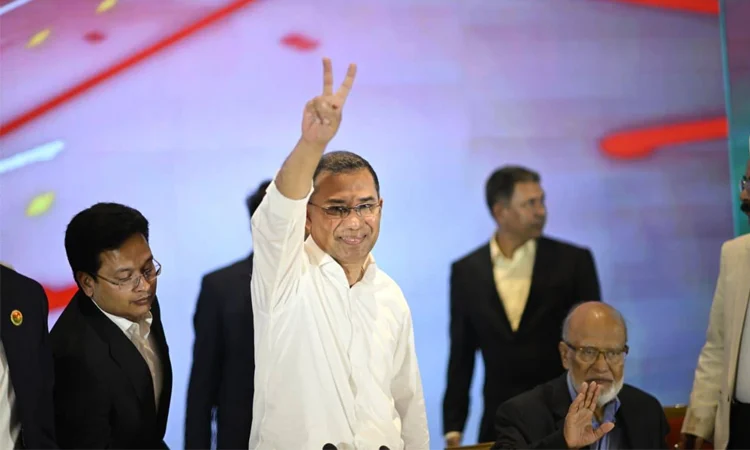
DHAKA, Feb 17, 2026 (BSS) – The people of Bangladesh have placed their unwavering faith in a plan. This faith manifested dramatically in the 13th National Parliamentary Election, where the Bangladesh Nationalist Party (BNP), under the leadership of Tarique Rahman, achieved a resounding landslide victory. The result affirmed that a clear vision can prevail over prolonged absence, uniting voters across generations in support of democratic renewal.
Tarique Rahman has taken oath as Prime Minister of Bangladesh, marking a historic transition. After more than 17 years in exile, he has returned to lead the nation. The BNP secured a decisive majority — winning 212 out of 299 seats according to official results—delivering a strong mandate for change.
A Legacy of Leadership and Resilience :
Tarique Rahman’s political journey is deeply rooted in Bangladesh’s history. His father, Shaheed President Ziaur Rahman, proclaimed independence in 1971, led the Z Force during the Liberation War, rebuilt the nation as Army Chief and head of state, and founded the BNP as a centrist, inclusive alternative to one-party rule. He introduced multiparty democracy before his assassination cut his life short, leaving a young Tarique Rahman without a father in a volatile political landscape.
His mother, Begum Khaleda Zia, rose from homemaker to become Bangladesh’s first female Prime Minister. She revived a divided BNP, led it to electoral triumphs against authoritarian regimes, and stood as a symbol of defiance — enduring imprisonment, illness, and relentless opposition while championing the rights of farmers, workers, and the middle class.
The turning point came in 2008, with political turmoil leading to Tarique Rahman’s exile in London for over 17 years. During this period, Bangladesh faced disputed elections in 2014 and 2018, enforced disappearances, extrajudicial actions, and severe repression. Many anticipated the BNP’s decline. Yet exile did not weaken him; it refined his approach. From afar, he maintained party unity, coordinated strategies across time zones, countered negative narratives with patience, and rebuilt organizational strength while his mother, Begum Khaleda Zia’s health condition deteriorated.
The significance of 31 point :
Tarique Rahman’s return to Bangladesh in December 2025, after 17 years, was marked by a single, powerful declaration: “I have a plan.” BNP’s comprehensive 31-Point Outline for Structural Reforms, a blueprint developed through consultations with democratic parties, citizens, and aligned with earlier frameworks like Ziaur Rahman’s 19-Point Program, Khaleda Zia’s Vision 2030, and the July National Charter.
The 31-point framework emphasizes institutional reset, democratic safeguards, and social restructuring:
Constitutional Reforms: Proposing a Constitutional Reforms Commission to review and repeal undemocratic amendments, restore national referendums for direct public decision-making, rebalance powers among the Prime Minister, Cabinet, Judiciary, and Parliament, and limit any individual to two consecutive terms as Prime Minister.
Electoral Integrity: Reinstating a non-partisan caretaker government system, restructuring the Election Commission for independent appointments, and advocating paper ballots alongside broader electoral law reforms to ensure credible transfers of power.
Judicial Independence: Establishing a Judicial Commission with a separate secretariat and merit-based appointments to uphold the rule of law.
Civil Liberties and Accountability: Forming a Media Commission, repealing restrictive laws like the Digital Security Act, restoring freedom of speech and press, ending enforced disappearances and extrajudicial actions, and strengthening human rights protections.
Anti-Corruption and Economic Equity: Adopting zero tolerance for corruption, publishing a White Paper on financial irregularities, bolstering the Anti-Corruption Commission, and creating an Economic Reforms Commission to promote equitable growth and reduce inequality.
Youth and Women Empowerment: Introducing unemployment allowances and skill development for educated youth, increasing women’s participation in governance, prioritizing women in nominations, and launching targeted programs to enhance their quality of life.
Social and Developmental Priorities: Implementing universal healthcare via a national health card, allocating 5% of GDP to education, decentralizing power to local governments, and addressing employment, environment, and livelihoods.
The agenda resonated because it combined structural reforms with tangible benefits for everyday citizens—offering not just rhetoric, but a roadmap to dismantle authoritarian legacies and build inclusive institutions.
From Absence to Authority :
For supporters, Tarique Rahman’s 17 years in exile represented endurance rather than detachment. It allowed him to observe, research, and strategize without the distractions of daily politics. He evolved from heir to architect—less focused on fiery rhetoric, more on frameworks and long-term planning.
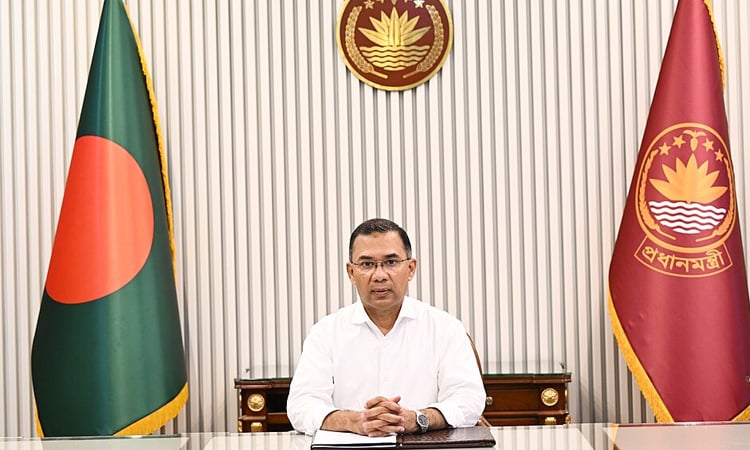
Today, Tarique Rahman stands at the helm of government, no longer speaking from afar but from the Prime Minister’s Office. The family legacy provided the foundation, but it is the quality of leadership in the coming years that will determine success. With a clear 31-point blueprint in hand, a powerful electoral mandate behind him, and a nation ready for change, the stage is set for transformation.
The journey from exile to executive authority is complete.
What lies ahead is the harder task: turning promises into progress, institutions into instruments of justice, and hope into lasting reality for every citizen of Bangladesh.