Saturday
22 August, 2026
News Flash
News Flash
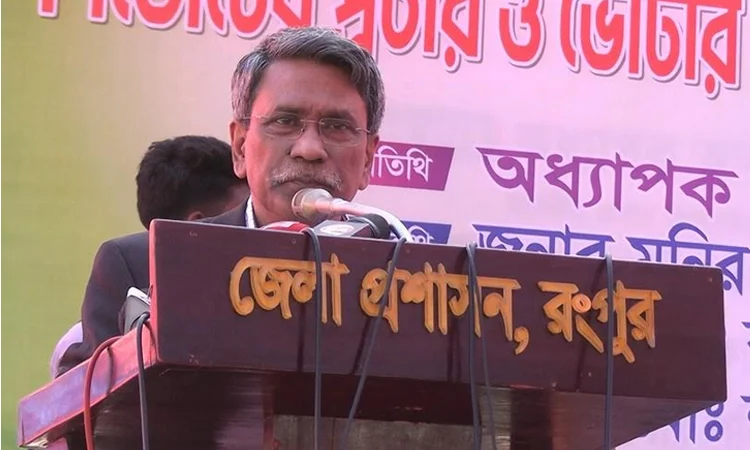
SYLHET, Jan 24, 2026) (BSS)- Professor Ali Riaz, Special Assistant to the Chief Adviser and Chief Coordinator of the referendum campaign, today said there is no legal bar for government officials from taking part in the campaign in favor of “Yes” vote in the referendum.
He said those who laid down their lives during the July mass uprising actually sacrificed their lives solely to establish people’s rights and this referendum is a major step toward realizing those rights, said an official handout.
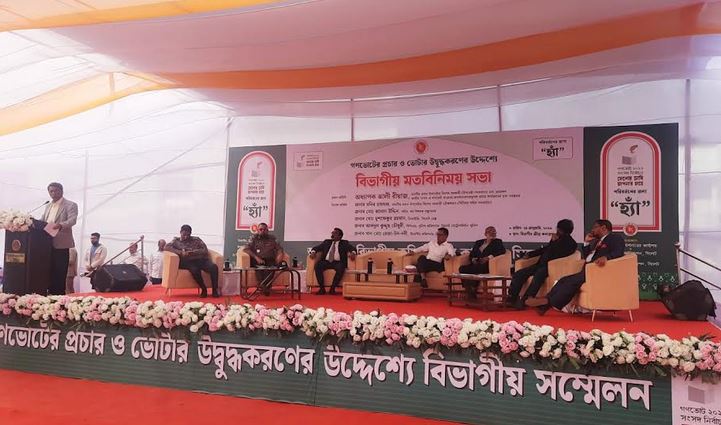
Ali Riaz made the remarks while speaking as the chief guest at a divisional views-exchange meeting in Sylhet aimed at promoting the referendum and motivating voters.
He emphasized that nowhere in the existing Constitution, the Representation of the People Order (RPO), the July National Charter Implementation Order 2025, or the referendum-related ordinance stated that employees of the Republic are prohibited from speaking in favor of positive change.
“No one, he said, can show any legal reference claiming there is any bar on such campaign,” he added.
“Those who are telling about the legal restriction are doing so with ulterior motives and are deliberately creating confusion,” he said.
Responding to those who question whether it is morally appropriate for government officials to campaign in favor of the referendum, Ali Riaz posed a counter-question: “What morality are you talking about—the morality that denies the blood of young people and their sacrifice?”
The meeting was organized by the Sylhet Divisional Administration at the Sylhet Divisional Sports Complex. Government officials working at the divisional headquarters as well as at district and upazila levels, along with representatives of various non-governmental organizations, attended the event.
Criticizing those who consider the current interim government to be a caretaker government, the CA’s special assistant said this interim government stands on the legitimacy earned through the July uprising and is by no means a caretaker government.
He said the current interim government is working with three mandates—reform, justice, and elections. Elections are not conducted by the government; rather, the government creates a conducive environment, while the Election Commission conducts the elections, he said adding similarly, justice is administered by the courts, and the government’s role is only to ensure an enabling environment so that the judicial process can proceed unhindered.
Therefore, he said, the core mandate of the government is state reform.
About the claims that such a referendum has never been held before, Ali Riaz said that between 1972 and 2024, 48 referendums were held in different countries around the world, and in most cases, governments actively campaigned in favor of a “Yes” vote.
“Therefore this is an internationally accepted practice, morally it is our duty and responsibility, and legally there is no obstacle,” he said.
Brushing aside the notion that ordinary people will not be able to understand the many questions and issues involved in the referendum, Ali Riaz said, “I do not agree with the idea that people who could liberate the country through the Liberation War, who could carry out the mass uprising of 1969 and the mass uprising of 2024, would fail to understand issues when it comes to their rights,” he said adding that “such idea is amount to disrespecting and belittling the people.”
Ali Riaz said those who faced repression during the previous authoritarian regime, who sacrificed their lives while struggling against injustice and oppression, who endured imprisonment, torture and repression, who became victims of enforced disappearances, killings and extrajudicial executions, have entrusted a responsibility to the government.
That responsibility, he said, is to ensure that Bangladesh can evolve as an accountable governance system in the future.
Highlighting the immense concentration of power in the hands of the Prime Minister under the existing system, Ali Riaz recalled that in 2011, a committee formed by the then government to amend the Constitution held 25 meetings and decided that the caretaker government system should continue with some changes.
However, after just a single meeting with the then Prime Minister, a decision was taken to abolish the caretaker government system altogether—solely based on the will of one individual, he said.
He said although constitutionally the President is supposed to appoint members of institutions such as the Election Commission, Public Service Commission, and judges, in reality all these decisions are made according to the Prime Minister’s wishes.
He said the July Charter and the referendum have been arranged to stop such one-person authority.
Chief Adviser’s Special Assistant Monir Haidar said that while the return of the previous fascist ruler is unlikely, the return of fascism itself is possible if the path is not blocked.
“Many parents lost their children in the mass uprising of 2024, and if fascism returns again, it could be our children who lose their lives,” he said.
The purpose of this referendum, he said, is to break this cycle and prevent the return of fascism. The referendum aims to realize the primary aspirations of the nation that emerged from the great Liberation War of 1971, he said.
Sylhet Divisional Commissioner Khan Md. Reza-Un-Nabi chaired the meeting while Religious Affairs Secretary Md. Kamal Uddin, Vice-Chancellor of Shahjalal University of Science and Technology Professor Dr. A.M. Sarwaruddin Chowdhury, concerned government officials, religious leaders, members of civil society, business representatives, and NGO representatives attended the meeting.