Sunday
23 August, 2026
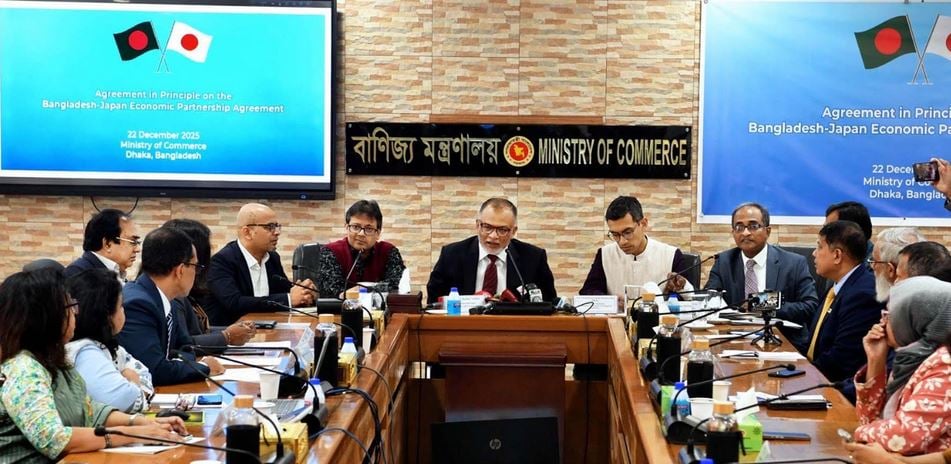
DHAKA, Dec 22, 2025 (BSS) - Commerce Adviser Sk. Bashir Uddin today said that the draft of the Economic Partnership Agreement (EPA) between Bangladesh and Japan has been finalised and is scheduled to be signed next month.
“This will be Bangladesh’s first-ever economic partnership agreement with any country,” he said, adding that the deal would significantly boost bilateral trade, investment and economic cooperation between the two countries.
Under the agreement, Bangladesh has agreed to open 97 sub-sectors for Japan, while Japan will open 120 sub-sectors for Bangladesh across four modes of service delivery.
The Commerce Adviser disclosed the information while speaking at a press conference on Bangladesh–Japan EPA negotiations held at the Commerce Ministry conference room at Bangladesh Secretariat this afternoon.
Chief Adviser’s Special Envoy on International Affairs Lutfey Siddiqi, Executive Chairman of the Bangladesh Investment Development Authority (BIDA) Chowdhury Ashik Mahmud Bin Harun, and Commerce Secretary Mahbubur Rahman were present at the briefing.
Once the agreement comes into effect, some 7,379 Bangladeshi products will enjoy immediate duty-free access to the Japanese market from the first day of signing.
On the other hand, some 1,039 Japanese products will receive immediate duty-free access to the Bangladeshi market.
Sk. Bashir Uddin said the EPA draft was finalised after intensive negotiations. “I spoke with Japan’s foreign minister over the phone today. The agreement will be signed next month,” he added.
He said the agreement would help attract greater investment, expand bilateral trade and deepen economic ties between the two countries.
Lutfey Siddiqi said Bangladesh had never entered into such an economic agreement before, which made the process challenging. “We did not initially have sufficient experience in this area, but through the collective efforts of the government, we have succeeded. This is undoubtedly a good agreement for Bangladesh,” he said.
BIDA Executive Chairman Chowdhury Ashik Mahmud Bin Harun said Japan has long been a trusted development partner of Bangladesh, but Japanese investment in Bangladesh currently stands at only about $500 million, which is low compared to other countries.
“Previously, when we sought more Japanese investment, the absence of a structured economic agreement often became a barrier. This EPA removes that limitation,” he said.
Referring to regional competition, he said Bangladesh is often compared with Vietnam, which has trade agreements with nearly 30 countries.
“We are just beginning this journey. This agreement will help us sign more economic partnerships in the future and ease the challenges of LDC graduation,” he added.
He said Japanese investment, which was previously concentrated in only a few sectors, would now expand to logistics, electronics, ICT and the automobile sector. “This will accelerate Japanese investment and technology transfer to Bangladesh,” he said.
Commerce Secretary Mahbubur Rahman said the negotiation process began at the end of 2024 and the agreement was finalised after eight rounds of meetings.
The press conference was informed that the agreement is expected to bring wide-ranging trade and economic benefits, including trade expansion, increased investment and new employment opportunities, marking a new chapter in Bangladesh–Japan economic relations.
The agreement will be signed next month after approval from the Council of Advisers or cabinets of both countries and completion of legal formalities.
An Economic Partnership Agreement (EPA) aims to establish a free trade area between two countries by reducing tariffs, import quotas and other trade barriers, thereby facilitating greater trade in goods and services and strengthening long-term economic cooperation.