Monday
10 August, 2026
News Flash
News Flash
By Najiur Rahman Sohel
DHAKA, Aug 10, 2026 (BSS) – The government is set to introduce a comprehensive IT ecosystem across all government primary schools across the country to improve the quality of teaching, identify learning gaps and centrally monitor teaching activities.
As part of the technology-driven system, the government will initially implement the ‘One Teacher, One Tablet’ model. The initiative will enable real-time monitoring of whether teachers are conducting lessons properly and how well students understand what they are being taught.
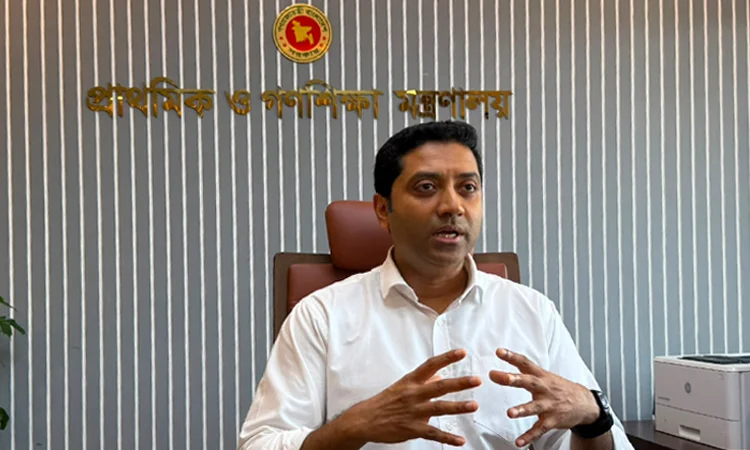
Primary and Mass Education State Minister Bobby Hajjaj disclosed the information in an exclusive interview with Bangladesh Sangbad Sangstha at his office at the Secretariat here recently.
During the interview, Hajjaj spoke in detail about progress in implementing the election manifesto during the first 180 days of the BNP-led government, the initiative to introduce 100 per cent quality-assured mid-day meals, measures to prevent primary-level dropout, efforts to revise the curriculum to remove subject-related fears among primary students, and the ongoing process of recruiting new teachers.
IT Ecosystem and ‘One Teacher, One Tablet’
Criticising ineffective and fragmented spending during the previous Awami League government, Bobby Hajjaj said technology does not simply mean purchasing laptops or tablets. Rather, the government’s objective is to establish an integrated digital system for education and the monitoring of teaching activities.
“We are creating a comprehensive ‘IT ecosystem’ in which every teacher will have a tablet. It will operate as part of an integrated central network. Through this system, it will be possible to monitor in real time whether there are problems completing the syllabus in any classroom or whether students are having difficulty understanding a particular lesson,” he said.
The state minister said a comprehensive roadmap for the initiative would soon be presented to the people through a press conference. The system will be expanded across the country within the next two to three years, he added.
Implementation of the Election Manifesto
Regarding the completion of the government’s first 180 days, or six months, Hajjaj said the BNP’s election manifesto was essentially a comprehensive five-year commitment made to the people.
“However, during the first six months, we are doing everything that can be initiated and implemented. Recently, a high-level review meeting was held at the ministry with relevant officials. We discussed in detail 37 manifesto-related issues directly and indirectly connected with primary education. The review showed that most of the commitments have already made positive progress,” he said.
He added, “A skilled team is working with tremendous dynamism. It will be possible to achieve 100 per cent of the key commitments of the manifesto within the next two to three years.”
Ensuring Quality in School Mid-Day Meal Programme
Highlighting government measures to ensure the quality of the school mid-day meal programme, Hajjaj said surprise visits to food-supplying institutions and the activation of ‘Mother’s Committees’ were being used to monitor the quality of meals.
Within the next one to one-and-a-half months, the programme will be expanded nationwide across government primary schools after ensuring ‘zero defect’, or 100 per cent error-free, food supplies, he said.
MORE TO FOLLOW...