Saturday
01 August, 2026
News Flash
News Flash
By Esme Azom
DHAKA, May 30, 2026 (BSS) - To truly evaluate Shaheed President Ziaur Rahman, one must look far beyond his declaration of independence or his tenure in government. Instead, it requires analyzing how exceptional courage, diplomatic foresight and a deep sense of compassion for his people converged within him.
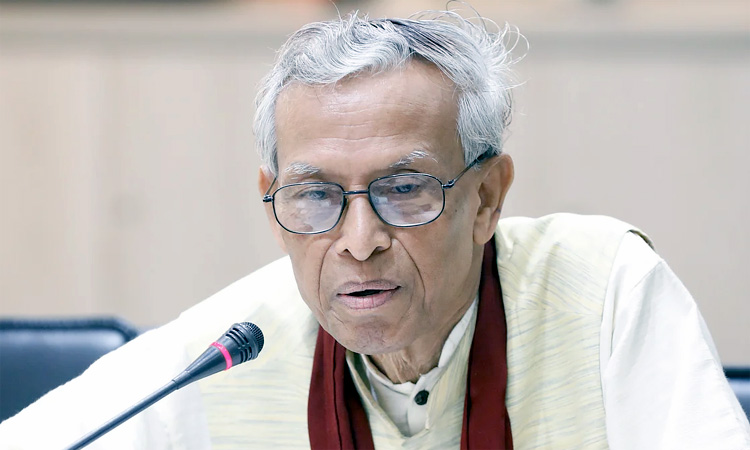
This assessment was shared by Dr. Sukomal Barua, Swadhinata and Ekushey Padak recipient, eminent educationist, Buddhologist and Supernumerary Professor at Dhaka University, in an exclusive interview with Bangladesh Sangbad Sangstha (BSS).
Dr. Barua reflected deeply on Shaheed Zia's contributions to the Liberation War, his unique governance strategies, revolutionary foreign policy, the philosophy of Bangladeshi nationalism and his enduring relevance for the present generation.
He described Ziaur Rahman's role in the 1971 Liberation War as a foundational chapter of the nation's history. Recalling the dark days of March 1971 when the Pakistani military launched its brutal crackdown on unarmed Bengalis, Dr. Barua highlighted the historical gravity of Zia's actions.
"There were many sector commanders at that time. Many were older, senior and militarily more experienced than Shaheed Zia," Dr. Barua noted, raising a crucial psychological question.
"Yet, he was the one who risked everything to declare independence and plunge into the war. What kind of raw courage and mental strength does a person need to lead in such a catastrophic situation? It remains a matter of deep reflection."
Despite the Pakistani army maintaining rigid structural control over East Pakistan, Zia utilized sharp military intellect to systematically reclaim ground. Dr. Barua expressed amazement at how a highly trained military officer, educated within the Pakistani establishment, stood resolutely against that very force.
"To truly evaluate Ziaur Rahman's role, we must look beyond the battlefield," Dr. Barua said, adding, "We must examine his leadership mentality, his willingness to accept ultimate risk and his subsequent philosophy on nation-building."
During a trip to Bogura for a Ministry of Education workshop, Dr. Barua made a personal detour to visit Shaheed Zia's ancestral home in the remote Bagbari Union of Gabtali Upazila.
"I was astonished standing in that secluded village," Dr. Barua shared. "How did a boy emerge from such a remote corner to lead a nation with such extraordinary vision? Without a rare, 'nectar-like' courage and impossible foresight, no statesman could have stabilized a war-torn country so quickly or dared to dream of a modern Bangladesh."
That vision quickly extended to international diplomacy. Within just four years of governance, Ziaur Rahman completely overhauled Bangladesh's foreign policy, building robust global alliances.
Dr. Barua pointed specifically to Zia's early engagement with Beijing: "If we look back from 2026 to the late 1970s, it is astonishing to realize how he foresaw China's trajectory toward becoming a global superpower. That is rare geopolitical wisdom."
Central to this strategy was Zia's 'Look East' policy, which fostered deep bilateral ties with predominantly Buddhist nations in Southeast Asia, including Japan and Thailand. Furthermore, his architecture of the South Asian Association for Regional Cooperation (SAARC) introduced a revolutionary framework for regional stability and border security.
Despite not being an academic political theorist, Ziaur Rahman conceptualized 'Bangladeshi Nationalism', a framework Dr. Barua describes as incredibly modern and timeless.
"Shaheed Zia rejected fragmented thinking," Dr. Barua explained. "He recognized that this land belongs to the Chakmas, Marmas, Rakhains and various other ethnic minorities of both the hills and the plains. If national identity was defined strictly as 'Bengali', where would these non-Bengali citizens fit? By introducing the inclusive identity of 'Bangladeshi', he united all citizens under a shared sovereign identity, effectively bridging internal inequalities and empowering the masses."
Dr. Barua categorized Zia's socio-economic reforms as "the unveiling of a new horizon" for a young nation. Facing severe structural deficits, Zia launched targeted institutional initiatives.
"He established the nation's first Ministry of Women and Children Affairs to integrate half the population into the formal economy. He laid the foundational groundwork for the readymade garment (RMG) sector, which remains the backbone of Bangladesh's modern economy. Zia opened diplomatic channels with Middle Eastern and Arab nations, transforming domestic human resources into a vital stream of remittance. To revitalize the agricultural sector, he launched a massive nationwide canal-digging initiative that revolutionized the rural economy."
Recalling his student days in the Noakhali-Chattogram region along the Sangu River, Dr. Barua witnessed Zia's hands-on leadership firsthand during a canal-digging drive.
"I saw the President of the country, wearing simple sunglasses and a vest, working deep in the mud alongside ordinary laborers," Dr. Barua recalled. "When a head of state bridges the gap with the common people so completely, it inspires a nation. That genuine connection explains why his popularity remains unshakeable."
Dr. Barua also highlighted Zia's swift decisiveness and respect for religious harmony, sharing an encounter on Arakan Road in Chattogram. Upon spotting a senior Buddhist monk, Satyapriya Mahasthavir, alongside a group of young monks, Zia halted his military convoy to converse with them and invited them to the Circuit House.
Learning that the sacred Buddhist site 'Deb Pahar' in front of Chattogram College had been illegally occupied, Zia bypassed bureaucratic delays and issued immediate orders to evict the illegal occupants, restoring the holy property to the community.
Though a career military man, Zia possessed a deep affinity for the arts. He introduced the nation's highest civilian honors -- the 'Independence Award' (Swadhinata Padak) and the 'Ekushey Padak' -- to ensure intellectuals, writers and artists received state recognition.
"This was a profound expression of his structural, fundamental thinking," Dr. Barua noted.
Reflecting on the turbulent political landscape following Zia's assassination, Dr. Barua observed that despite decades of state-sponsored oppression, legal battles and systematic attempts to erase his legacy and party, the core political ideology has endured.
"The nationalist force and Shaheed Zia's ideology are rooted deep within the soil of this country," Dr. Barua said, adding, "A tree with roots that deep cannot be uprooted by any political storm. Other factions may fade, but Shaheed Zia's vision will survive."
Dr. Barua noted Zia's original 19-point program serves as the foundational blueprint for the country's development. This vision has since evolved into the contemporary 31-point state reform agenda, addressing modern governance, social justice and foreign policy.
Connecting the past to the present, Dr. Barua viewed BNP Chairman Tarique Rahman as the modern reflection of his father's legacy.
"When we look at Tarique Rahman today, we see the political image and principles of Shaheed Zia. The two figures complement each other seamlessly. Those from the newer generation who never witnessed Shaheed Zia can understand his philosophy by observing Tarique Rahman."
"To truly appreciate Ziaur Rahman, one must analyze his wartime bravery, his statecraft, his social philosophy and his bond with the masses as a cohesive whole," Dr. Barua urged. "You cannot understand Shaheed Zia by looking merely at the surface; you have to go deep."