Monday
24 August, 2026
News Flash
News Flash
By Najiur Rahman Sohel
DHAKA, Mar 7, 2026 (BSS)- State Minister for Social Welfare Farzana Sharmin, MP, has said the government will provide state and social recognition to the immense but often overlooked household labour performed by women.
She said the unpaid domestic work carried out by women plays a significant role in the national economy, yet it has long remained unacknowledged.
“The current government led by Bangladesh Nationalist Party (BNP) has begun initiatives to ensure proper recognition of this unpaid labour of women,” she said.
The state minister made the remarks in an exclusive interview with the Bangladesh Sangbad Sangstha (BSS) today on the eve of International Women’s Day billed for tomorrow.
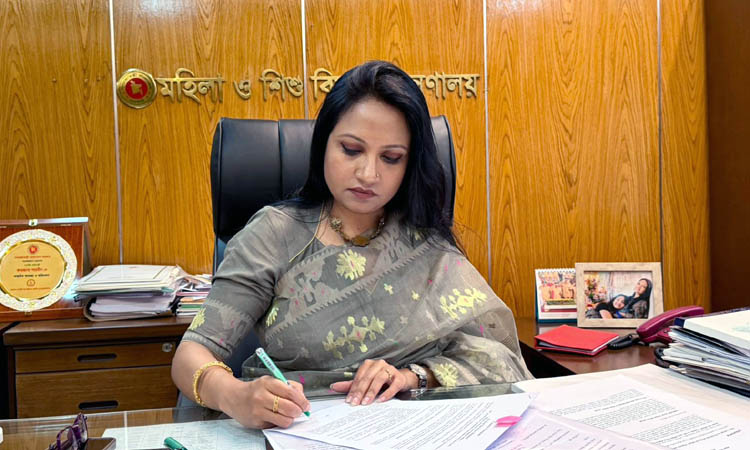
During the interview at her office at the Bangladesh Secretariat this afternoon, she spoke about various programmes marking the day, the ministry’s new flagship initiative titled “Family Card,” recognition of household labour in GDP calculations, and government’s long-term plans for protecting women and children.
Referring to the valuation of women’s household labour and its contribution to GDP, the state minister said homemakers perform extremely hard work throughout the day but usually receive neither financial valuation nor recognition.
Highlighting the need to change this mindset, she said, “Women who are working at home in a passive way are contributing nearly 18 percent to our GDP. If they did not take care of household responsibilities, we would not be able to work outside. The core philosophy of the ‘Family Card’ is to honour this invisible labour. It is a small gesture of appreciation from the state.”
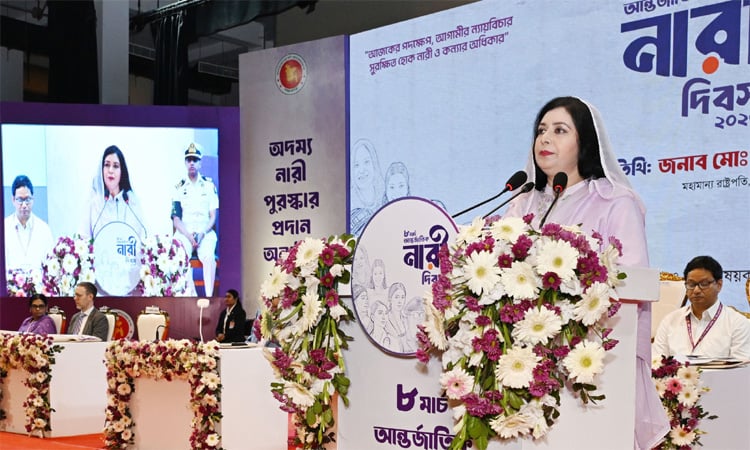
At the beginning of the interview, Sharmin outlined programmes scheduled for tomorrow marking International Women’s Day. She said the Ministry of Social Welfare will confer the “Indomitable Woman (Odommo Nari)” honour on former three-time prime minister Begum Khaleda Zia in recognition of her courage and leadership during the struggle for democracy.
Explaining the ministry’s milestone initiative “Family Card,” Sharmin said it is the first universal project in the country’s history that will be issued in the name of the senior-most woman of each family.
Declaring the family as the core unit of development, she said the government has chosen families—not individuals—as the foundation of sustainable development.
“We believe that if a family becomes self-reliant, the state will progress. The ‘Family Card’ programme has been designed with that vision,” she added.
The state minister said the programme will initially begin on March 10, when primarily more than 50,000 women will receive direct transfers of Taka 2,500 each in their bank accounts. Gradually, members of lower-middle, middle and even upper-income families will be brought under the initiative.
Speaking about the government’s tough stance against violence against women, Sharmin said although laws exist, lengthy investigations and repeated victimisation of survivors often hamper justice.
“We are working at the policy level so that the state can ensure both physical and psychological security for victims. Preparations are underway to transform safe homes into genuinely secure shelters rather than nominal facilities,” she added.
The state minister also highlighted her long-term plans for women and girls with special needs. She said Prime Minister Tarique Rahman prefers not to use the word “disabled,” instead referring to them as “specially empowered children.”
“After taking office, I observed that although infrastructure exists at the upazila level, there are gaps in facilities. My goal is not to increase numbers but to ensure quality. Rather than establishing 10 safe homes or schools, I would prefer to build three high-quality centres that can truly transform lives,” she said.
Emphasising the importance of technology in building a new Bangladesh, Sharmin said women must become more ICT-oriented.
“Information is money. Through collaboration with the ICT Ministry, we want to make women more ICT-friendly. But, we are prioritising quality over quantity. Instead of producing hundreds of unskilled workers, our aim is to create five self-reliant families,” she added.
Regarding women’s progress in education, the state minister said that the pass rates in public examinations seen over the past 17 years were largely “show-off,” as genuine intellectual development had not improved sufficiently, leading many female students to drop out at the higher education stage.
“We are now focusing on quality rather than quantity,” she said.
Concluding the interview, Sharmin called upon women across the country to recognise their own inner strength.
“Self-realisation must be the foundation of women’s empowerment. No matter your social or economic position, believe in your inner strength. Our slogan is- ‘If you want, you can do it,’” she said.