Friday
26 June, 2026
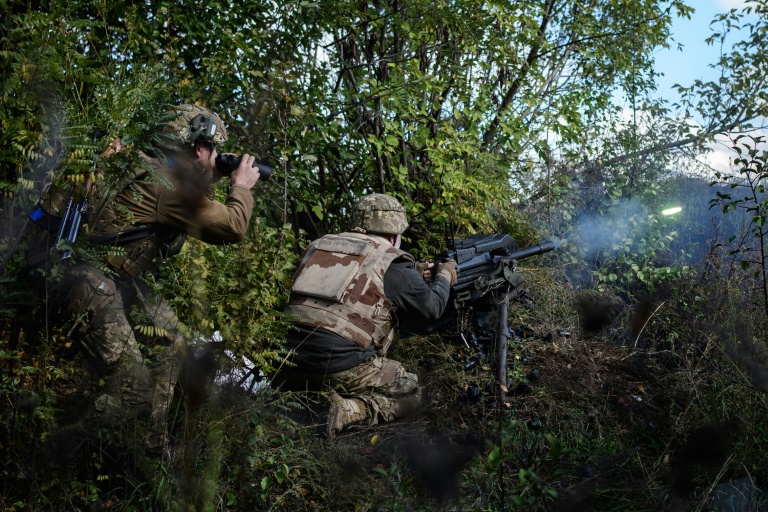
TORETSK, Ukraine, Oct 12, 2022 (BSS/AFP) - First there was a teasing
crackle of small arms fire then a burst of sharp bangs as Ukrainian assault
infantry fired their US-made grenade launder at the Russian positions opposite.
The frontline in this part of the Donetsk region in eastern Ukraine has
been fairly stable since 2014, when Moscow's proxy forces in the so-called
Donetsk People's Republic (DNR) seized an enclave.
But many Western weapons -- like the Mk-19 automatic grenade launcher --
have only arrived on this battlefield since February this year, when Russia
escalated the conflict with a full-scale invasion.
On Wednesday, soldiers of Ukraine's 5th Regiment of Assault Infantry loaded
their launcher from a crate of 40 millimetre grenades and set it on its low
tripod in a thicket of trees and brush near their position.
Russian troops were dug in less than 800 metres (half-a-mile) away. A jet
-- it wasn't clear whose -- roared overhead and then rifle shots rang out and
bullets whizzed audibly but harmlessly overhead.
The Russians had taken what the Ukrainians jokingly called "the bait".
An order came in over the radio and the Mk-19 operator shouted "Glory to
Ukraine" then opened up, firing a sustained burst of high-explosive grenades
toward the source of the incoming gunfire.
The belt of ammo used up, the soldiers scrambled to dismantle the
35-kilogram (77-pound) weapon and to move back to cover, in case the Russian
forces decided to respond with an artillery strike.
On a frontline that has remained more-or-less stable for more than eight
years, familiar tactics had been shaken up for a few moments by the
introduction of a US-made weapon, giving Ukraine a slight edge.
If that seems almost too neat an example of what has happened over recent
weeks, when Ukrainian forces have successfully counterattacked Russian forces
on several fronts, it also demonstrates the limits of the strategy.
For the men of the 5th Regiment, on one hill overlooking the Russian-held
town of Gorlivka, the Mk-19 is a morale booster.
But it is not a game changer.
"We definitely need more artillery," said an officer with the 5th, who gave
his name as "Sergiy".
"When it comes to artillery, they still have an advantage so we can't
return fire equally.
"We are firing more precisely now, but with fewer strikes. Meanwhile, they
are not very precise, but they fire more."
- No breakthrough -
The Ukrainian forces fighting along this Donetsk front -- in a line south
from the town of Bakhmut through the region's coal-mining villages and conical
slag heaps -- have not made any breakthrough.
Russian forces have in recent weeks captured a group of villages south of
Bakhmut, and the town and its remaining residents have been under shellfire for
months.
The reason, the troops explain, is that the Russian forces here are still
supplied from the former separatist enclave -- now claimed as "annexed"
territory by Moscow -- on established routes.
Unlike the Russian troops holding the territories captured this year, who
in places crumbled in front of last month's counter-offensive, Moscow's local
forces have had experience holding the enclave since 2014.
And Russia's massive superiority in artillery still counts here.
Successful Ukrainian offensives in Kharkiv to the north and Kherson to the
south used advanced Western weapons like HIMARS rocket artillery in support of
daring armoured manoeuvres to encircle towns.
- Mismatched fatigues -
But, the Ukrainian soldiers say, if they are to win a final victory and
expel the Russians from the east, they will need more Western supplied weapons
and ammunition -- a lot more -- and quickly.
"We have to hold them here, and Europe should understand this. Better to
hold them here, and not in Europe," said Sergeant Mykola Lupiy, urging European
and US taxpayers to see the value in defeating Russia.
The soldiers of the 5th Assault Infantry wear a mismatch of Western kit.
Some are in US-style fatigues, one has French body armour and another a
British set in desert camouflage that he said he chose because it fitted him
better.
Most carry one version or another of the Soviet-designed Kalashnikov series
of assault rifles, but one has a futuristic-looking Belgian-made FN F2000,
which fires NATO's standard 5.56mm ammunition.
The regiment's badge incorporates the familiar outline of the US defence
department's Pentagon as a background to the 5th's red lightning bolt --
because "we need so many US arms" an officer joked.