Wednesday
09 September, 2026
News Flash
News Flash
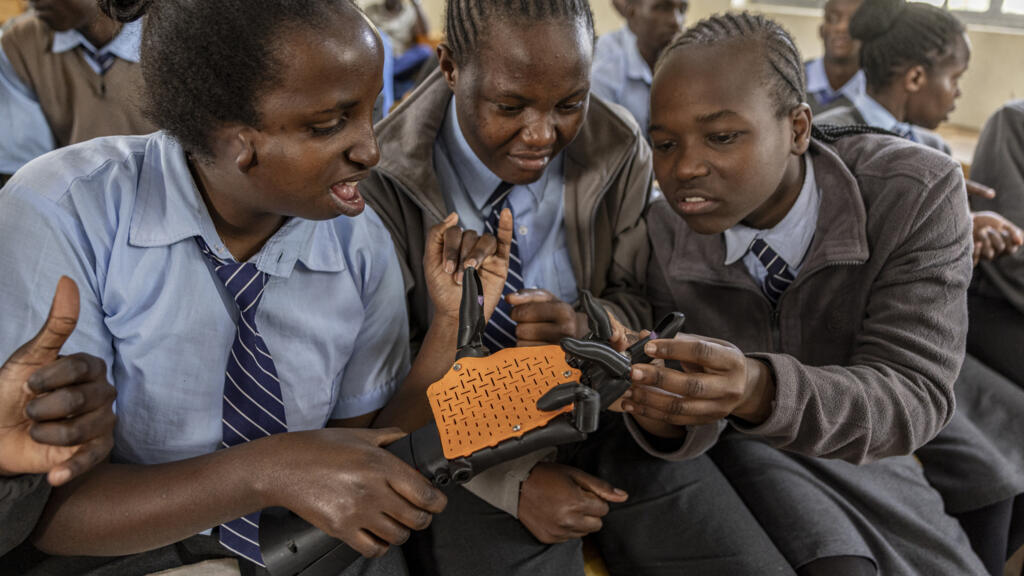
NAIROBI, Sept 9, 2026 (BSS/AFP) - In a school for the deaf in Kenya, children signed their excitement as a team demonstrated how a robotic arm could revolutionise their studies.
Roughly 300,000 children in the east African nation have a hearing impairment, according to the Kenya Society for Deaf Children, but just 20,000 were enrolled in schools as of 2024.
Kenyan start-up ZeroBionic, co-founded by 22-year-old Norah Kimathi, hopes to tackle some of the educational difficulties they face.
It has built a mechanical hand that can translate a teachers' voice into sign language in real time, allowing deaf children to learn alongside their hearing counterparts.
For the pupils at the Kasarani Treeside Secondary School for the Deaf in Nairobi, there is another element of the technology that is even more promising.
The robotic arms are trialled by deaf teachers to record and store signs using a bodysuit, which ZeroBionic imported for the task.
In the process, they are building a database of technical terms -- drawing on English, American and Kenyan signs -- that is helping to expand the language and make it easier for deaf children to learn and communicate.
"The biggest challenge we faced actually was in Africa we don't have a standardised African sign language dataset," Kimathi told AFP at the company's tiny lab in Nairobi.
"No one else had built this on the continent... We had to start from scratch," she said.
Many deaf children in Kenya learn a patchwork of makeshift signs, and the local dialect lacks many technical terms used to teach subjects like maths and biology.
Sharon Mumbe, 19, one of the pupils at the deaf school, says it gives her "hope for the future".
"I'll be able to understand different concepts better," she told AFP.
Numerous prototype limbs litter the surfaces in Kimathi's lab.
The team works with Africa One, a humanoid robot they built, to refine and expand the signs their mechnical arms are able to produce.
Everything has been designed and built in-house, using recycled materials to reduce costs and environmental impact, produced using 3D printers that thump away constantly in the background.
Each hand costs roughly $350 and can last for up to two years. They are already in 78 schools across Kenya.
They boast a 92-percent speech-to-sign accuracy rate and Kimathi says the results have made all the long hours in the lab worthwhile.
"We know we're going to put a smile on someone else's face," she said.