Saturday
15 August, 2026
News Flash
News Flash
KYIV, Ukraine, Aug 15, 2026 (BSS/AFP) - At a mere mention of her son, Olena's blue eyes lit up -- a smile rediscovered after finding refuge from her violent ex-husband.
She and her toddler live in a shelter in Kyiv -- an anonymous apartment building which since Russia invaded in 2022 has been taking in not only victims of domestic violence, but mothers and children forced to abandon their homes in eastern Ukraine.
Among them is Olena -- name changed -- who lost her job and moved to an European Union country at the start of the war.
She met a man there and within a few months was pregnant, married and trying to hide the bruises after being beaten by her new husband.
Now divorced and seeking sole custody of her child, she told AFP she feels "much safer" in a country at war than at the mercy of her ex-husband.
"It's really good that there are places in Ukraine where a woman can hide," she said.
Doubled poverty rates -
The shelter, funded by the Ukrainian Public Health Foundation -- a charity supported by the international World Vision nonprofit -- has taken in 150 women and children since 2022.
Natalia Lieshukova, who runs the facility, told AFP she would like to "help all women".
But only six can be housed at any time, and the waiting list is long.
In the shelter's office, pictures of famous visitors and supporters line the walls.
British musician Elton John on a visit to Kyiv in 2018 chief among them.
The war has pushed many Ukrainians into hardship, heaping pressure on stretched social institutions, many of which have been damaged by Russian strikes.
The poverty rate has doubled to 41.6 percent since 2021, the year before Russia invaded, according to World Bank estimates.
"Women with children became more poor because they have multiple problems," said Halyna Skipalska, executive director of the foundation that runs the shelter.
"Not just violence in the family, (but) no documents, children affected by the war with different serious mental health diseases, issues with speech, malnutrition," she added.
Most of the mothers at the shelter had lost their homes -- destroyed or located in territory now occupied by Russian forces.
Life 'over' -
Shelter resident Khrystyna -- whose name has also been changed -- is to give birth to a baby girl in the coming months.
She moved to Kyiv from a frontline area this year and found a job as a cashier.
"I'd been working there a month when I found out I was pregnant. I told this bloke what was going on. To put it bluntly, he just told me to get lost," she told AFP.
Thinking she could not work as a single mother, she faced the prospect of returning home -- to a "derelict" house with no heating, under constant Russian bombardment, and her alcoholic father and brother.
"I thought my life was over."
But determined to stay, her sister helped her find a place at the shelter.
"Here I sleep peacefully, and I love the little one -- she kicks a lot," she said.
A house, a swing, a dog -
A particular problem for the foundation is the growing demand for speech therapy for children traumatised by the war.
Brother and sister, Diana, five, and Bogdan, four, come from the devastated eastern city of Bakhmut. They "stopped speaking after seeing a wall collapse onto people," Lieshukova said.
After six months, the family were ready to leave the shelter Only to receive news their father, a soldier, had been killed at the front.
After weeks spent in the doldrums, one day the mother, who was pregnant, announced: "I want a house, a swing and a dog"
"I nearly fainted... thank God she had started to see a future for herself," said Lieshukova.
The family has moved to a house in the northern Chernigiv region, where the children have started school.
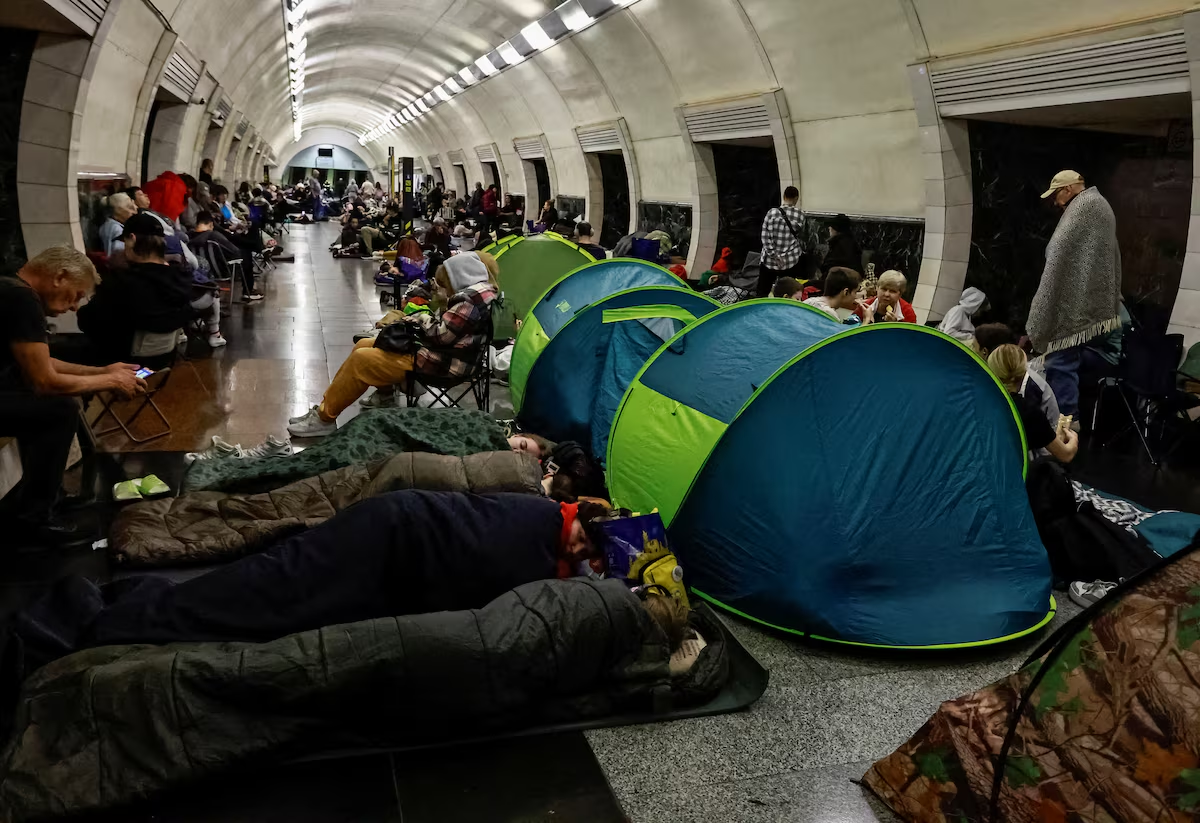
As Lieshukova recalled the story, the hubbub in the shelter was interrupted by the blare of an air-raid siren.
Staff said the central corridor is the safest place to wait out a possible attack.
Olena held her son as he looked at a drawing of giraffes on the wall.
"Together, it's not so scary," said Lieshukova.