Friday
24 July, 2026
News Flash
News Flash
LONDON, July 24, 2026 (BSS/AFP) - British Prime Minister Andy Burnham will
open his newly created northern office on Friday, as he bids to launch his
flagship policy of reversing decades of centralising power over England in
London.
Ahead of officially opening his "Number 10 North" hub in Manchester, Burnham
-- who replaced Keir Starmer in 10 Downing Street on Monday -- reiterated his
vow to put "more power into every postcode" to spur economic growth.
"For 40 years, power and resources have been sucked into the centre, and too
many communities have felt forgotten," he said in a statement late Thursday.
"No 10 North will change that," Burnham declared, adding it would hand power
to "people at a local level, so they can turn things around".
Burnham aims to work there at least one day a week, his office dubbing it a
"situation room for growth".
The former mayor of Greater Manchester argues the thriving city-region --
which has outscored Britain's national performance in various areas,
including economic growth -- provides a model for other parts of the country.
But devolution experts appear unconvinced, noting No. 10 North's creation is
technically not even devolution.
"It's what's known as 'de-concentration', something done in even very
centralised states and in itself doesn't signify any transfer of power,"
academic and policy adviser Alan Trench told AFP.
"At most, it transfers public sector jobs and the lives and incomes of those
who hold them."
- 'Badly needed' -
The UK -- comprising England, Scotland, Wales and Northern Ireland -- saw
significant constitutional reforms in the late 1990s that created devolved
parliaments in Edinburgh, Cardiff and Belfast. London also got a directly-
elected mayor and scrutinising assembly.
But England has proved a thornier proposition and remains one of Europe's
most centralised nations despite the creation of some regional mayors and
other bodies in the last decade, experts say.
"Nowhere in England has any devolved law-making power," Trench noted.
University of Glasgow professor Nicola McEwen said English devolution had
been "very asymmetric", hindered by London largely viewing it as something
that "happens somewhere else".
Burnham experienced the limits of the current system during his nine years as
Manchester mayor, with his previous powers there limited to a few policy
areas like transport.
Now in charge nationally, he has ordered departments including the finance
ministry to make "targeted transfers of overarching strategic functions" to
No. 10 North, a minister told parliament this week.
It will sit within a new Office for the Prime Minister and the Cabinet
(OPMC), led by civil service chief Antonia Romeo. However, she is London-
based.
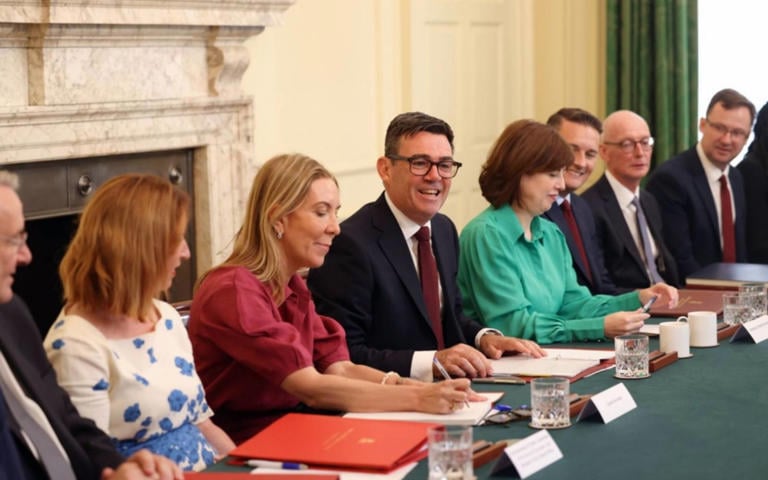
Burnham will also re-establish the National Economic Council, created in 2008
to deal with the economic fallout from the global financial crisis.
His office said he would chair its first meeting at No. 10 North on Friday,
convening senior ministers and regional mayors.
- 'Deeply ironic' -
McEwen said handing No. 10 North a strategic role was "positive".
"The key thing, though, will be that it reaches out to devolved institutions
and enables their development and governance but also reaches back into the
heart of (London's) Whitehall to make sure that they are adapting to the
vision."
Trench also welcomed the idea, saying something like OPMC was "badly needed
and long overdue".
However, University of Aberdeen politics professor Michael Keating noted it
was "deeply ironic that to deal with centralisation you set up a central
government department that's going to decide exactly who gets what".
Under "real" devolution "you get out of their way", he said.
Keating fears trying to create "a counterweight" to the finance ministry --
known as the Treasury -- in No. 10 North is doomed to fail.
"That has been tried before," he told AFP. "The Treasury always wins. They'll
not let go of the purse strings."
Others noted relocating civil servants was neither bold nor original, with
existing hubs in Glasgow, Sheffield and Darlington.
Around 80,000 government staff already work in northwest England, Burnham's
spokesman acknowledged this week.
Burnham, who met the nationalist leaders of Scotland and Wales during a
Scottish visit Thursday, has said little about further devolution -- other
than ruling out supporting independence referendums.
Scots voted to remain in the UK in 2014 but the ruling Scottish National
Party is pushing for a re-run. Wales has never held such a vote but the pro-
independence Plaid Cymru party won May elections there.