Monday
06 July, 2026
News Flash
News Flash
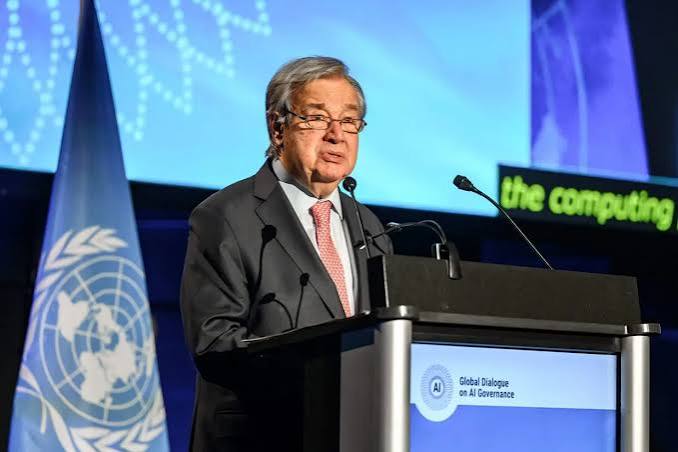
GENEVA, July 6, 2026 (BSS/AFP) - The United Nations chief called Monday for a
global governance system to shape artificial intelligence for the good of
humanity, warning against allowing the technology itself to "vibe-code" our
future.
With AI advancing at "runaway speed", UN Secretary-General Antonio Guterres
cautioned that "an experiment is being run on our own societies, without a
plan and without consent".
"That is not sustainable," he said, speaking before a first Global Dialogue
on AI Governance in Geneva, which brings together governments, tech
companies, academia and civil society.
"AI is already transforming our world," he pointed out.
"The question is whether we will shape this transformation together, or let
it shape us."
Guterres warned that AI systems were "no longer tools awaiting instruction".
"They are writing code, acting online and making choices with less and less
human oversight," he pointed out.
"Our institutions were built to govern machines that follow commands. They
are not ready for machines that decide."
Guterres voiced concern at how AI was further obscuring what is true and
false, and highlighted a growing tendency to leave important tasks up to the
technology and blindly trust the results.
So-called "vibe-coding", or using AI to tell a machine what you want instead
of coding it yourself, "can do wonders", he acknowledged.
"But we cannot vibe-code the truth. We cannot vibe-code the future of
humanity."
- Major risks -
Another risk flagged by Guterres was the concentration of power in a handful
of AI companies and in a handful of countries.
Most countries "have had no say in decisions that will shape their futures",
he warned.
In the face of such challenges, he said countries faced a stark choice,
"between governing by design and drifting by default".
The UN chief highlighted the potential of AI technologies for everything from
accelerating development, to improving healthcare and providing broader
access to education.
But he insisted developments needed to be guided by several key priorities,
including safety and respect for human rights, to ensure that people
everywhere reap the benefits.
He called for "common methods to evaluate and verify risks" and jointly-
agreed standards, particularly for ensuring the safety of children accessing
AI systems.
"We do not let medicine reach a child until it is proven safe. We test every
toy," Guterres pointed out.
"Yet AI has reached our children - their learning, their friendships, their
most private questions - before anyone asked what it would do to them."
Guterres called for an AI Child Safety Pledge, requiring companies to prove
that any system accessible to children is safe and has zero tolerance for
sexual abuse.
The systems must also connect any child showing signs of distress to real
human support, he said.
"No child should be a guinea pig for unregulated AI," he insisted.
- 'Killer robots' -
Boosting AI capacity and access in developing countries was also key, he
said, to ensure that the existing, deep digital divide does not "harden into
an AI divide".
Guterres said he would urge the UN General Assembly to create a Global Fund
for AI, "to build skills, data and affordable computing power everywhere".
Another priority was reducing AI's climate impact, he said, reiterating his
call for companies to reveal their growing environmental footprint and to
commit to powering every data centre with renewable energy by 2030.
The UN chief meanwhile said that his biggest concern revolved around AI in
military settings, and in particular so-called lethal autonomous weapon
systems.
"Let us call them what they are: Killer robots," he said.
"Machines selecting and engaging their target and taking a life, - without
human control and judgement".
"That is morally repugnant... And it must be banned by international law."
Guterres stressed the urgency of creating sufficient guardrails to steer AI
in a positive direction.
"We may be the last generation able to set the terms on which humanity and
machines coexist," he said.
"The door is still open. It will not stay open long."