Saturday
12 September, 2026
News Flash
News Flash
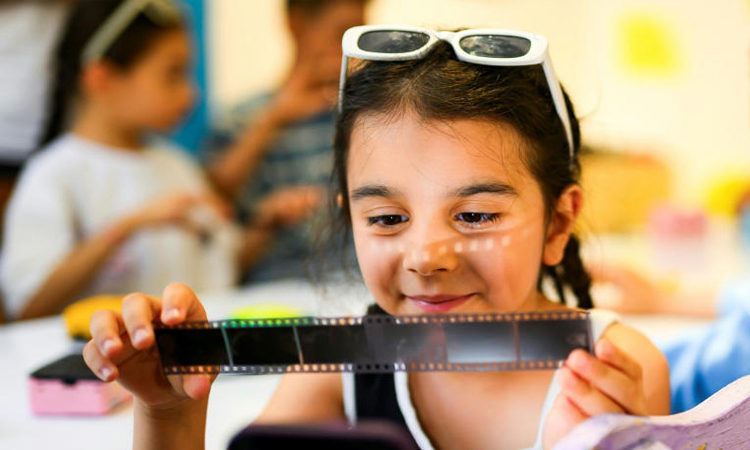
MARDIN, Turkey, June 22, 2026 (BSS/AFP) - In a dimly lit room illuminated by a pair of red lamps, eight-year-old Zeynep waits to see photographs she has taken, now trapped as shadows and silhouettes on a roll of film.
"How big is your curiosity?" asks her mentor, 40-year-old photographer Amar Kilic, as he develops the negatives in a sink.
"As big as the world," she replies.
Originally from the southeastern province of Mardin, Zeynep is among eight children taking part in a two-month analogue photography workshop for local and migrant youth near Turkey's borders with Iraq and Syria.
The project, called Fotohane Darkroom, started in Mardin in 2024, by Kilic and Syrian photographer and educator Serbest Salih. In Turkish, Arabic, Kurdish and Persian, Fotohane means "house of photo", a name chosen by the children.
In fact, insists Kilic, the children are in charge throughout the process.
"From loading film, to developing it and printing their own photographs, they do everything by themselves. They get to set and write their own rules also."
- Fleeing IS -
Once part of Mesopotamia, the walls of Mardin's old city, traversed by narrow streets, holds thousands of years of history and attract tourists from all over the world.
But the city is also home to low-income families and refugees who fled Syria's civil war.
Among them are the families of 13-year-old Yahya, 12-year-old Yusuf, 11-year-old Nihal and 13-year-old Sam. They came from Damascus in 2014 and 2015 when Islamic State (IS) jihadists started a war inside Syria.
"I'm very excited when I take pictures, it's all very interesting for us", says Nihal, swinging a small, black camera from her wrist as she searches for a frame to capture.
Their teacher, 32-year-old Serbest Salih, a smiling photographer with curiosity-filled eyes, fled the Kurdish town of Kobane, in northern Syria, when it came under assault from the IS group in 2014.
Thousands of Syrian refugees have settled across the Turkish border in Mardin region during the war that ended with the fall of Syrian president Bashar al-Assad.
His own struggle is a topic Salih wants to avoid and instead insists all the attention should go on the children he's patiently educating, switching effortlessly between Turkish, Kurdish, Arabic and English.
Since his arrival in Turkey, he has been trying to establish himself as a bridge of tolerance and integration.
He started his first analogue photography workshop in 2015 in a secondhand caravan, driving to villages along the border and focusing on vulnerable local and refugee children.
"Analogue photography is about self-confidence. When taking a digital photograph you might think about deleting it on the spot. But with film, they spend the whole workshop thinking and feeling every one of those 36 frames, and only see them at the end. And their photos are beautiful," Salih says.
- 'The magic room' -
Ask any of the children what part of the process is their favourite and the answer will be: the darkroom where the images they first see through the viewfinder and captured by pressing the shutter come to life.
"They call it the magic room", says Murat Kilic, who teaches development and printing, always with a smile on his face while giving feedback.
"Seeing an image on a completely white sheet of paper, bringing to life with their own hands an image they themselves took, creates a very special feeling for the children. They say: 'I was able to produce this'," says Kilic.
Most of the project's financial resources come from support events organised abroad, as well as donations.
This summer, children's photos are on display in Italy, Belgium, Britain and Indonesia.
Salih and Kilic are hosting the workshop in the centre of Mardin, but they think about returning to Salih's initial approach with the darkroom in a caravan.
"The most logical way is to become mobile. To go to different regions, offer training and have them carry it forward," says Kilic.
BSS/AFP/MNH/1219HRS