Sunday
13 September, 2026
News Flash
News Flash
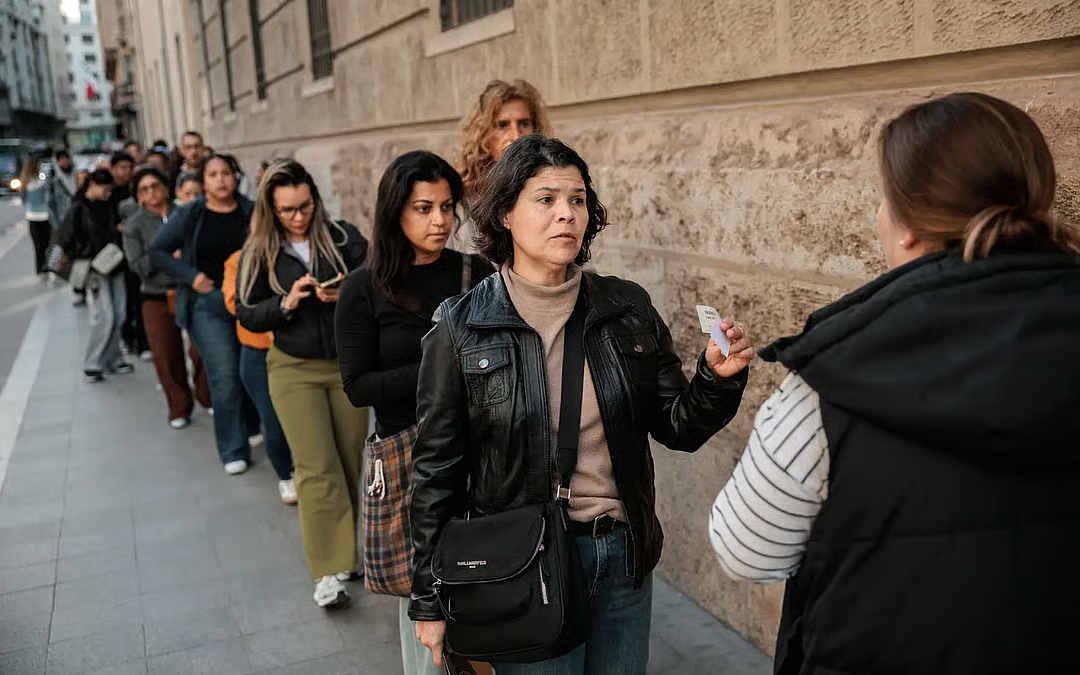
MADRID, April 17, 2026 (BSS/AFP) - Hope and frustration are coursing through undocumented migrants in Spain as they begin a race against time to cobble together essential paperwork under the left-wing government's new mass regularisation scheme.
"There's nothing but problems," a rueful Madeleine Castillo told AFP outside the Peruvian consulate in Madrid, which was brimming with would-be applicants on Thursday.
"We're told that everything is free, but there are formalities that are hard to complete without lawyers," added the 28-year-old mother of three young daughters, who needs a consular document to prove she is Peruvian.
At the other extreme of the emotional rollercoaster, Carolina, a 30-year-old Colombian who declined to give her surname, emerged with a beaming smile from a building belonging to the Madrid region's government.
She had just obtained the history of her public transport subscription and her renewals, a common way for migrants to show they have spent at least five consecutive months in Spain, a requirement under the scheme.
Normalisation would be "a turning point in my life", said Carolina, who has been living in Spain for a year and a half.
She would have typically had to wait two years before applying for a residence permit under a pre-existing regularisation path frequently used by irregular migrants.
"But as soon as they started talking about this extraordinary route, in January, my lawyer urged me to get together the documents," Carolina said.
- Paper chase -
Around 500,000 people are expected to benefit from the regularisation, mostly Latin Americans, as Spain pursues a more open migration policy while European neighbours have moved to crack down on irregular arrivals.
Long queues have snaked around official buildings representing Latin American and North African nations in large Spanish cities.
Some migrants are attempting to prove their residence with supermarket loyalty cards or records of remittances sent to relatives back home, Carolina explained.
Evidence of past medical appointments in the public health system are also valid, as Spain offers free healthcare to undocumented residents.
Applicants must also have a clean criminal record in Spain and previous countries of residence as well as "not represent a threat to public order", according to a decree that became law this week.
Depending on the migrant's profile, proof of previous work, the family unit or a situation of vulnerability may also be necessary.
Those extra demands have tempered the joy of Alejandra, a 38-year-old woman from Colombia's capital Bogota who arrived in Spain in 2022.
She had just left her country's consulate in Madrid holding a new Colombian passport, the last document she needed, but her husband remains in limbo.
"I have all my papers because I am an asylum seeker, but my husband isn't and he lacks the vulnerability certificate," Alejandra told AFP.
"He can't get work because he doesn't have papers, and he can't get that certificate, it's difficult" for him, she said.
- Fear of 'bottlenecks' -
The window for regularisation applications opened on Thursday and will close on June 30. The relevant authorities have 15 days to inform applicants if their file has been accepted.
Faced with the incoming tsunami of admin, the government has prepared "an operational plan that is up to the task with an incredible amount of work and care", Migration Minister Elma Saiz has said.
A network of around 450 social security, postal service and immigration offices has been set up with longer opening times.
More than 550 extra staff have been hired to work exclusively on the processing of the applications.
Guillermo Valderrabano, founder and director of the law firm ExtranjeriaClara.com which helps immigrants with legal processes, said his firm had been receiving 400 calls every day from regularisation hopefuls.
The current system "is already slow in normal processing" conditions, he warned, saying "time will tell" if the reinforcement measures can cope.
"The key is not just the volume, but how the documentation is interpreted and how it is managed in each office. That's where the bottlenecks have come up historically," said Valderrabano.
"Additional resources to collect information have been put in place, now the challenge is to process it at the promised speed," he said.