Sunday
13 September, 2026
News Flash
News Flash
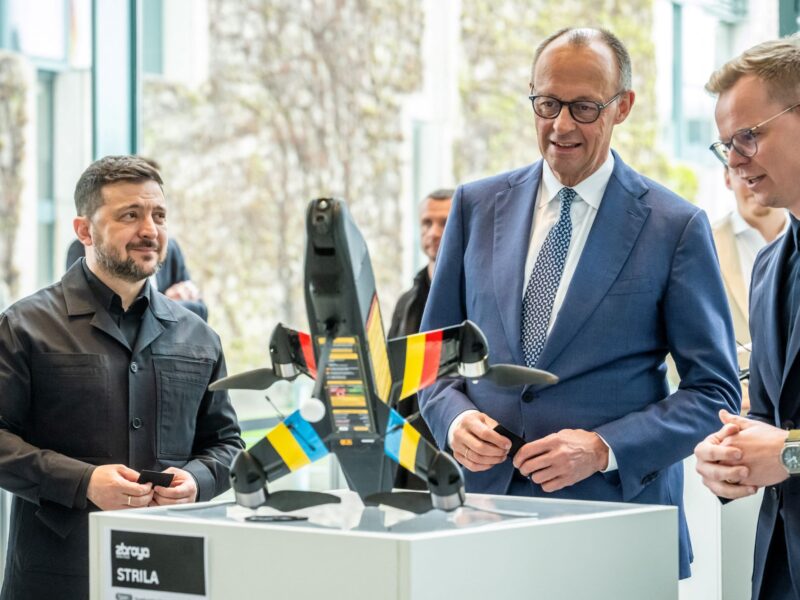
BERLIN, April 14, 2026 (BSS/AFP) - The leaders of Ukraine and Germany on Tuesday announced a strategic partnership centred on defence as Europe seeks to learn from Ukrainian battlefield expertise, especially in drone warfare.
President Volodymyr Zelensky led a government delegation to Berlin, where they met Chancellor Friedrich Merz and key ministers to discuss Ukraine's war against Russia, now in its fifth year.
Europe's top economy has become Ukraine's biggest military backer as the United States under President Donald Trump has scaled back support.
But Germany, eager to build up its armed forces to deter Russia, is also looking to tap Kyiv's expertise in rapidly evolving drone technology.
The two countries pledged to "strengthen cooperation in the air defence field" and Germany said it would "continue supporting Ukraine's drone industry as well as establishing drone co-production ventures".
The German defence ministry said it had agreed to fund contracts for several hundred Patriot missiles from US defence giant Raytheon as well as Iris?T air defence launchers from German manufacturer Diehl.
Ukrainian Defence Minister Mykhailo Fedorov on X thanked his German counterpart Boris Pistorius for the package, which he said was worth four billion euros ($4.7 billion), calling it "a massive boost for our air defence... to protect our cities and critical infrastructure".
Zelensky, in a press conference with Merz, said "we have proposed to Germany a drone agreement, a bilateral drone deal -- involving various types of drones, missiles, software and modern defence systems".
Merz said the partnership "isn't just beneficial for Ukraine's defence... It's also beneficial for us, for our security, because no army in Europe has been as battle-tested in recent decades as Ukraine's.
"No society has become more resilient than Ukraine, no defence industry has become more innovative than Ukraine's," he said.
- Drone technology -
The Middle East war has given Kyiv a chance to showcase its drone expertise, with Zelensky dispatching specialists and visiting countries targeted by attacks from Iran, a Russian ally.
Zelensky in February visited a drone production site in Munich established by a joint venture between Germany's Quantum Systems and Ukraine's Frontline Robotics, called Quantum Frontline Industries (QFI).
During the Berlin talks, Quantum Systems announced two further joint ventures with Ukraine -- one focused on strengthening air defence capabilities together with Ukrainian partner WIY Drones, another, dedicated to unmanned ground systems, in partnership with Ukrainian manufacturer Tencore.
The Berlin consultations come as US-initiated peace talks between Russia and Ukraine have stalled, and the Middle East war has effectively relegated the issue to the back burner.
Merz emphasised that any final peace deal will have to bear "Europe's signature", speaking a day before NATO chief Mark Rutte and defence ministers allied to Kyiv are to hold a Ukraine Defence Contact Group meeting in Berlin.
- Hungary vote raises hopes -
Hopes are rising that the European Union can soon provide Ukraine with a 90 billion euro ($105 billion) loan agreed in December that had been blocked by Hungary's nationalist prime minister Viktor Orban.
Merz said that, after Orban's election defeat last weekend to conservative Peter Magyar, "the funds for military support must now be disbursed quickly. Ukraine urgently needs them. This will also enable Ukraine to finance its defence in the long term. Russia should take this seriously."
Zelensky said "we are counting on Germany, as one of the leaders of the European Union, to help us quickly unlock 90 billion, so that we can replenish our Ukrainian production with investment".
In a gesture to Budapest, Zelensky said that a pipeline carrying Russian oil through Ukraine to Hungary and Slovakia that was damaged in attacks by Moscow would reopen by the end of April.
As the Ukraine war grinds on, Germany has hosted hundreds of thousands of refugees.
To kick off Tuesday's talks, Ukraine's Social Minister Denys Uliutin met German Interior Minister Alexander Dobrindt at a cultural and citizens' advice centre called a "Unity Hub".
The hub "will serve as a central point of contact" to support Ukrainian refugees, but it will also aim to "encourage a willingness to return" to Ukraine, the interior ministry said.
Merz said the two countries had agreed to "coordinate closely to facilitate the return of Ukrainian citizens... to their homeland", stressing that "we support Ukraine's efforts to reduce the emigration of Ukrainian men of military age".