Sunday
14 June, 2026
News Flash
News Flash
LAREDO, United States, Feb 24, 2026 (BSS/AFP) - President Donald Trump's
administration gave Nayda Alvarez five days to decide whether to let a US-
Mexico border wall run through her back yard.
If she refuses, she says, her house along the Rio Grande in Texas will be
expropriated, just like that.
Trump's obsession with keeping undocumented foreigners from entering the
United States and expelling the ones already in it helped get him elected to
a second term in 2024.
That crackdown -- including plans to seal the border with Mexico more tightly
-- is an essential part of the aggressively inward-looking, Americans-first
policy that Trump will discuss in his State of the Union speech to Congress
on Tuesday night.
Trump is now targeting the border in and around Laredo, Texas, a mostly
Hispanic town of 250,000 located along the Rio Grande, which forms the
natural border between the United States and Mexico.
All along the river in Laredo are homes, parks, bike and jogging paths,
fishing spots and even a cemetery. There is no wall.
But this month at least 60 area homeowners received a letter from the federal
government that read, "Notice of Interest - Property Located Near Planned
Border Barrier Construction Projects."
Edgar Villasenor, an activist at the Rio Grande International Study Center,
said "the issue in Laredo, Texas, and all of south Texas, and all of the
riverfront properties along the Rio Grande, is that they're basically doing a
massive land grab."
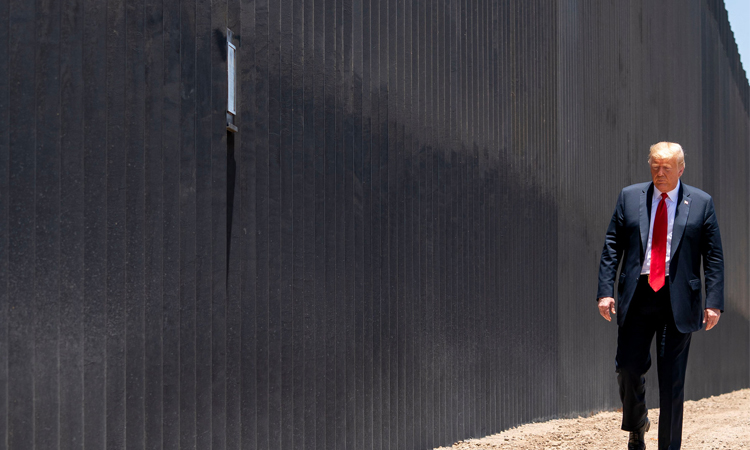
The Trump administration plans to build a so-called "smart wall" along parts
of the 3,000-km (1,900-mile) border with Mexico that remain unfenced.
Trump did some wall-building during his first term. Between that and walls
that predate him, a third of the border already had some kind of barrier when
Trump started his second stint in January 2025, the government says.
The new plan calls for physical walls or, depending on the area, water
barriers, patrol roads and technology designed to catch people trying to
sneak in from Mexico.
AFP asked US Customs and Border Protection about the letters homeowners are
receiving but got no answer.
- Consider your options-
"The wall would be in the backyard," said Alvarez, a 54-year-old teacher who
lives in La Rosita, a tiny town 87 miles (140 km) southeast of Laredo.
She said the letter she received this month outlined her options: she could
let the government build in her backyard for $1,000, or negotiate a deal to
sell the house or rights to the backyard to the government.
If she does neither, the letter said, the government would assert eminent
domain -- the right to take private property for public use, paying
compensation for the seized assets.
"Either you comply, you negotiate, or they're gonna take it away," Alvarez
said, adding that she has not yet decided what to do. Although the five-day
deadline has passed -- the letter was dated February 13 -- she has had no new
word from the government.
Villasenor's advocacy group helps people understand their options and defend
themselves. He said some homeowners have gone along with the government out
of fear, pressure or ignorance, but most have refuse to sign.
- Security first-
"In President Trump's first year back in office, we have delivered the most
secure border in American history," Homeland Security Secretary Kristi Noem
said in early February.
She said January was the ninth month in a row that border agents released
zero undocumented people inside US territory. This is what the agency does
with people who are not sent right back into Mexico and instead are awaiting
a court date to determine if they can stay.
The main park in the border town of Eagle Pass, 112 miles (180 km) northwest
of Laredo, was militarized with troops in January 2024. They and a barrier of
large orange buoys in the river are meant to deter illegal crossings. Access
to the river is also blocked with barbed wire.
This ruined 65-year-old Jessie Fuentes' business offering kayak trips on the
river.
He said the administration cares only about security, not the environmental
impact of what it is doing to keep people from crossing the river.
"Like you see, it's all dead behind me," he said as he stood at a ten-foot
(three-meter) fence blocking access to the water.
Villasenor said claims by Trump and other conservatives that migrants who
enter the United States illegally are criminals bent on causing harm to
Americans are bogus.
"The need for the wall is very false, but they're saying this. The people
that are saying this is people in Washington, DC," said Villasenor.
"The landowners, the people that live right there along the river, are not
scared of anything," he said.