Monday
10 August, 2026
News Flash
News Flash
PARIS, France, Feb 10, 2026 (BSS/AFP) - Iran stepped up its crackdown on Monday after recent protests, making more arrests while holding the door open to Washington for further nuclear negotiations.
The arrests -- including that of Javad Emam, the spokesperson for the main reformist coalition -- came after Iranian and US officials held talks in Oman that both sides painted as positive.
On Saturday, Iran heaped more jail time on Nobel Peace Prize winner Narges Mohammadi, and on Monday arrested Hossein Karoubi, the son of prominent dissident Mehdi Karoubi.
Weeks after repressing a wave of protests, one of the greatest challenges to the government since it came to power in the 1979 Islamic revolution, Tehran has taken a two-track approach.
It is rounding up and jailing perceived critics, while at the same time pursuing a potential diplomatic opening with US President Donald Trump's administration.
A spokesperson for the Reformist Front coalition told local media on Monday that Iran's Revolutionary Guards had arrested the group's spokesman Emam.
Emam was one of at least five Reformist Front figures to be detained, as were several activists and filmmakers who co-signed a protest statement.
Iran's government has branded the protests "riots" fuelled by its arch-foes Israel and the United States.
- 'Frustrate the enemy' -
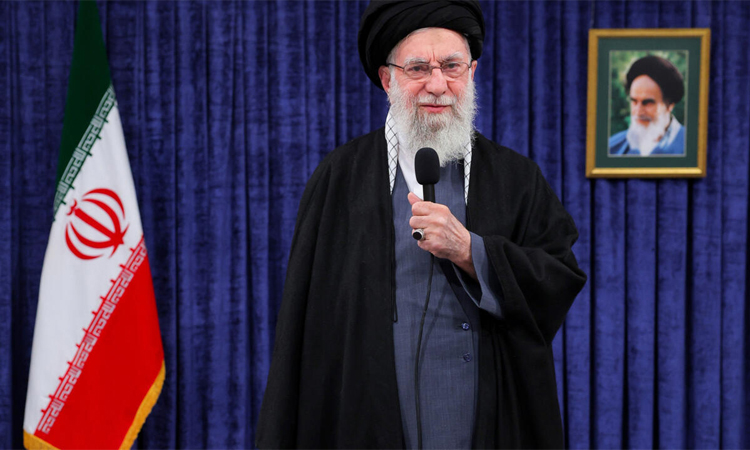
On Monday, supreme leader Ayatollah Ali Khamenei called on the nation to show "resolve" against foreign pressure.
"National power is less about missiles and aircraft and more about the will and resolve of the people," Khamenei said, adding: "Show it again and frustrate the enemy."
Alongside its defiant pronouncements, Iran has signalled it could come to some kind of deal to dial back its nuclear programme to avoid further conflict with Washington.
The official IRNA news agency reported that Iranian atomic agency chief Mohammad Eslami had said Tehran could dilute its highly-enriched uranium in return for sanctions relief.
"In response to a question about the possibility of diluting 60 percent enriched uranium," IRNA reported, Eslami "said this depends on whether all sanctions would be lifted in return".
The report did not specify whether such an agreement would include only nuclear sanctions imposed on Iran by the United States, or all international economic measures targeting the Islamic republic.
Diluting or "downblending" uranium means mixing it with other substances to reduce the enrichment level, so the final product does not exceed a given threshold -- thus extending the amount of time it would take Iran to create sufficient nuclear material for a bomb.
Tehran adamantly insists it has never planned to build a nuclear weapon and that enrichment for civilian research and energy is its sovereign right, but the US, Israel and most Western capitals do not believe this.
At the talks in Oman last week, the US and Iran agreed to discuss Tehran's nuclear programme, though Washington and Israel also want to put its ballistic missiles and support for regional militant groups on the agenda.
In separate calls with his Egyptian, Saudi and Turkish counterparts, Iranian Foreign Minister Abbas Araghchi "described the talks as a good start while emphasising the need to dispel mistrust about the American side's intentions and objectives", state television reported.