Wednesday
10 June, 2026
NEW YORK, Oct 3, 2021 (BSS/AFP) - After his small Manhattan food stand
lost its customers during the coronavirus pandemic, Abdul Rahman -- an Afghan
vendor who arrived in New York in 1992 -- has resumed service, albeit at a
fraction of former business since offices are still far from full.
Rahman and the thousands of street vendors like him, emblematic of New
York's sidewalks, were hoping things would finally go back to normal in
September.
But that's far from the case: "The business is like, 20, 30 percent (less)
than before the pandemic," Rahman, 44, told AFP, standing in front of a
display case of doughnuts and other pastries. On the counter is a jug of
coffee, which he says he has trouble emptying.
With a wave of his arm, he points to where customers used to form long
lines in front of his mobile stand.
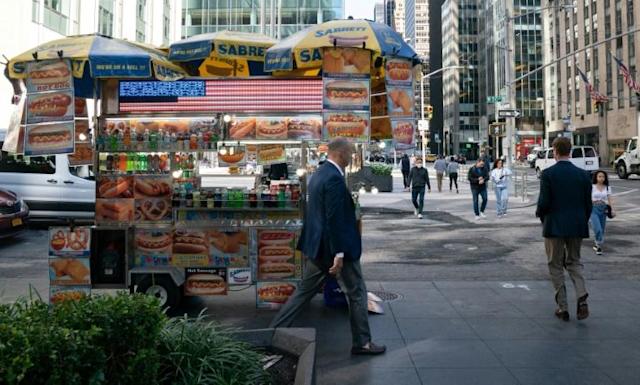
Like yellow taxis, the metal food carts -- stocked with coffee, muffins,
bananas and hard boiled eggs -- are part of New York's cityscape.
An estimated 20,000 vendors are on the streets of the Big Apple, and many
of them are immigrants who have no other way of earning money.
A city hall permit is clearly visible on Rahman's cart, as is a photo of
his three children, all born in the United States.
It has been 20 years since Rahman arrived in New York to escape the war
back home in Afghanistan.
He set up shop on the sidewalk of Whitehall Street, in the south of
Manhattan. It is a good location, at the foot of office buildings, near a
subway exit and not far from the docks where ferries full of tourists leave
and return for the Statue of Liberty, as well as boats transporting workers
from Staten Island.
- 'Better than nothing' -
Some customers are loyal, such as Mike Reyes, a maintenance worker, who
says he comes every morning.
"We need affordable (things) like donuts, coffee, because I do know in the
city it's very expensive," he explained. "To me, they are really essential."
But tourists are still few and far between as a result of the Delta
variant, so "people work mostly from home," said Rahman.
According to a survey conducted by the Partnership for New York City
organization, only 23 percent of the one million office workers in Manhattan
had returned to their offices by August, and employers were anticipating a
rate of 41 percent by the end of September -- well below the two-thirds
expected in May.
With a baseball cap on his head and black mask over his nose and mouth,
Rahman hopes things will go back to normal in October... or maybe January.
"I don't know what's going on in the future," he said worriedly, noting
that he relies on his wife's salary as a teacher to support the family.
For the time being, after 15 months of inactivity due to the pandemic,
during which he was able to receive public aid, he prefers to go to work.
In order to get into the city from his home in Nassau County in eastern
Long Island he has to get up at 2:30 am, Monday through Friday.
"It's better than nothing," he said, although the times of earning $800-900
in a good week are a distant memory.
"If I stay home, (there's) more pressure on me, and what should you do at
home?" he said.
After 20 years on the job, Rahman is thinking of switching to another line
of work. His wife tried to find him a job as a school bus driver, but it was
only part-time.
Besides, "I know all the people here," he said. "It's almost 21 years, it
looks like a life here."