Saturday
22 August, 2026
News Flash
News Flash
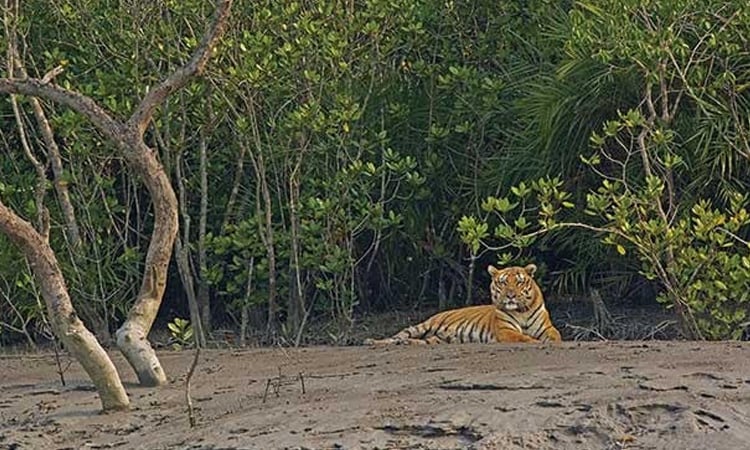
BAGERHAT, Aug 21, 2026 (BSS) - The Forest Department has intensified surveillance to locate a tigress that was released into the Sundarbans on July 12 after receiving treatment for six months for serious injuries sustained in a poacher's trap.
Despite installing 40 automatic camera traps across an area of around eight square kilometres to monitor the tigress's movements, her presence has yet to be captured on camera more than a month after her release.
The tigress was released in the Andharmanik area of the Chandpai Range in the eastern division of the Sundarbans. Earlier, on January 3, she was seriously injured after becoming trapped in a leaf trap reportedly set by deer poachers near the Sharkir Canal.
Forest officials later rescued the injured tigress after administering a tranquilizer and took her to Khulna, where she received treatment and care for six months before being returned to the forest.
Initially, 20 automatic cameras were installed in the Andharmanik area to monitor her movements. Later, another 20 cameras were set up along the eastern bank of the Shalnadi and in the Joymani area. The cameras are also recording the movements of other tigers and wildlife in the forest.
However, none of the cameras has so far captured the released tigress. Footage has instead confirmed the movement of three other tigresses in the deeper parts of Andharmanik, prompting the Forest Department to continue its search and monitoring efforts.
Forest officials said the tigress's footprints were found within an area of about 150 metres shortly after her release, suggesting that she had moved around the vicinity. No reliable information about her whereabouts has been obtained since then.
Eastern Sundarbans Divisional Forest Officer Md Rezaul Karim Chowdhury said the tigress should not be presumed dead simply because she has not been captured by the cameras.
"There is no way to conclude that the tigress is dead just because her image has not been captured by the cameras. A tiger can move within a range of 30 to 40 kilometres. So, she may have moved beyond the area covered by the cameras," he said.
According to the Forest Department, footage from all 40 cameras will be reviewed again, while additional surveillance measures are being planned in areas where the tigress is likely to have moved.
Wildlife conservationists said post-release monitoring is crucial when rescued wild animals are returned to their natural habitat, particularly those that have spent a considerable period under human care.
They said close monitoring is necessary to assess an animal's movement, ability to find food and adaptation to its natural environment after release.
The Forest Department is continuing efforts to trace the tigress through analysis of camera footage and field-level surveillance.