Tuesday
01 September, 2026
News Flash
News Flash
DHAKA, Sept 1, 2026 (BSS) - Retailers, wholesalers and corporate importers of essential commodities today said there is no scope for an increase in the prices of essentials in Bangladesh as long as supply remains normal.
They, however, warned that maintaining market stability would become difficult unless the government quickly resolves the ongoing fuel shortage, removes obstacles in the supply chain and curbs the influence of middlemen.
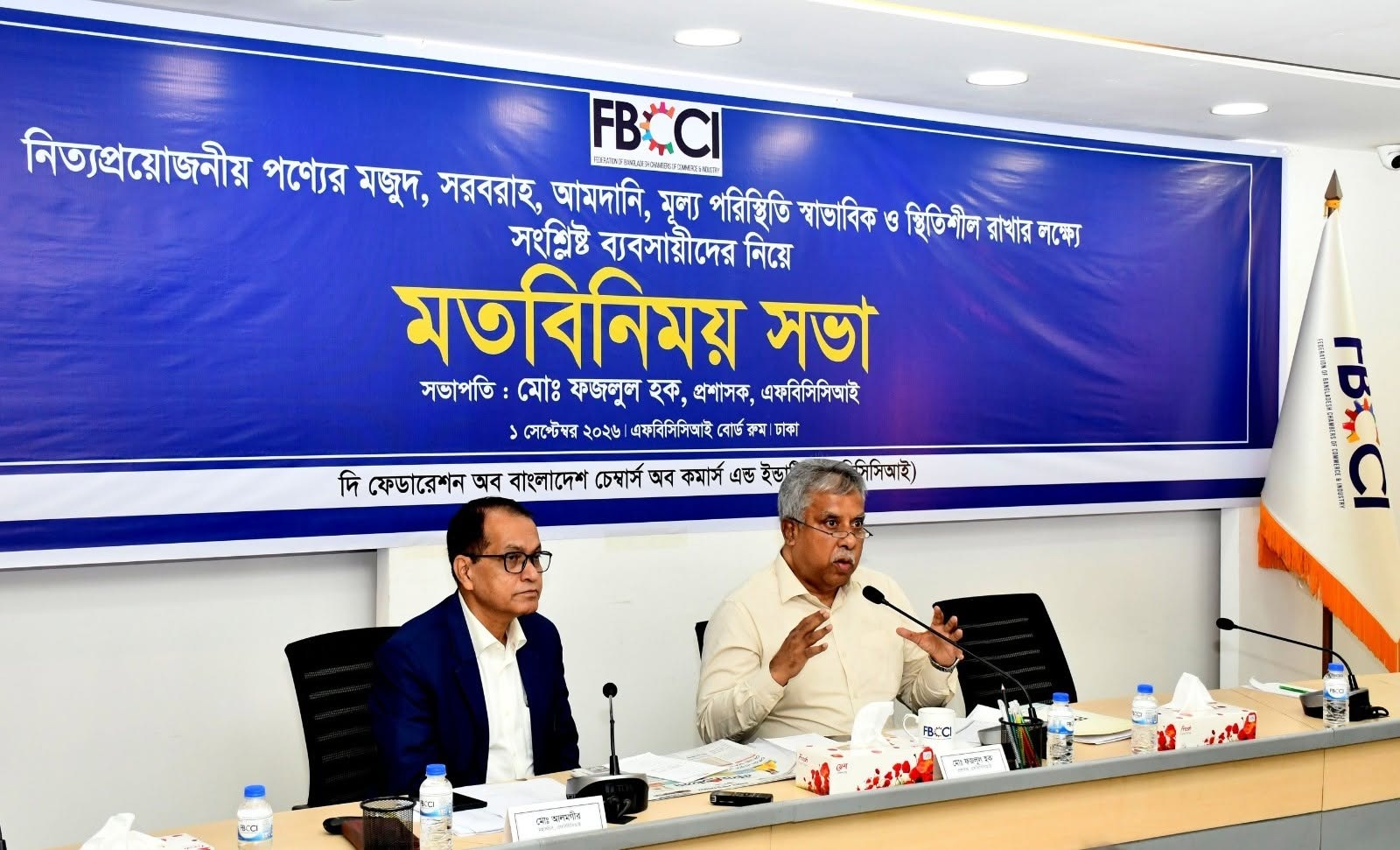
The observations came at a views exchange meeting on the market situation of essential commodities held at the office of the Federation of Bangladesh Chambers of Commerce and Industry (FBCCI) in Motijheel.
The meeting was chaired by FBCCI Administrator Md Fazlul Hoque.
Business leaders said adequate supply of sugar, edible oil, lentils, flour and wheat flour in line with market demand would prevent any abnormal price increase. They also called for uninterrupted fuel supply to production-oriented industries to ensure smooth manufacturing.
Representatives of mill owners said they were trying to maintain stable supplies and prices of essential commodities despite the existing energy crisis. They claimed that domestic sugar prices have remained unchanged although global prices of raw sugar have increased.
During the open discussion, Golam Mowla, general secretary of the Moulvibazar Traders Association, said it would not be possible to keep the market stable unless imports and mill-level production continued uninterrupted. He urged the government to resolve the fuel crisis and remove complications related to letters of credit (LCs).
Saifur Rahman Sujon, general secretary of the Karwan Bazar Raw Materials Arat Traders Owners Association, called for bringing street hawkers and unregistered traders under market monitoring to strengthen price control.
Md Zakir Hossain, general secretary of the Bangladesh Super Market Owners Association, recommended reducing the number of intermediaries in the supply chain to keep the market stable.
Leaders of different trade bodies also sought intervention by law enforcement agencies to stop harassment at various stages of the supply system and demanded stronger monitoring of prices at mill gates, wholesale and retail markets.
Md Abul Kalam Azad, organising secretary of the Consumers Association of Bangladesh (CAB), said both the government and the private sector must play a more responsible role in ensuring uninterrupted supply and controlling middlemen.
Mill owners also highlighted that recent shortages of gas and electricity had disrupted production and drew the government's attention to persistent LC-related complications.
A representative of the Trading Corporation of Bangladesh (TCB) said the state-owned agency is selling essential commodities at subsidised prices to nearly 10 million families through its Family Card programme.
A representative of the Directorate General of Food said rice is being distributed to low-income people at subsidised prices under the Food-Friendly Programme, adding that the initiative has contributed positively to price stability.
Business leaders, however, suggested that TCB should strengthen its capacity for direct imports and procure products from alternative international sources alongside purchasing from local companies.
Concluding the meeting, FBCCI Administrator Md Fazlul Hoque said the recommendations and opinions placed by business leaders would be documented and submitted to policymakers.
He also urged traders at all levels to cooperate so that the government's newly announced national pay scale does not create any unjustified impact on the prices of essential commodities.
Senior officials of FBCCI, leaders of various chambers and trade associations, representatives of corporate organisations and officials from the ministries of commerce, industries and food, TCB, the Bangladesh Trade and Tariff Commission, the Bangladesh Competition Commission, the Directorate of National Consumer Rights Protection, CAB and the Bangladesh Food Safety Authority attended the meeting.