BSS
  27 Jun 2026, 17:40

Uninterrupted electricity supply is key factor of EV sector's success: BEPRC Chairman

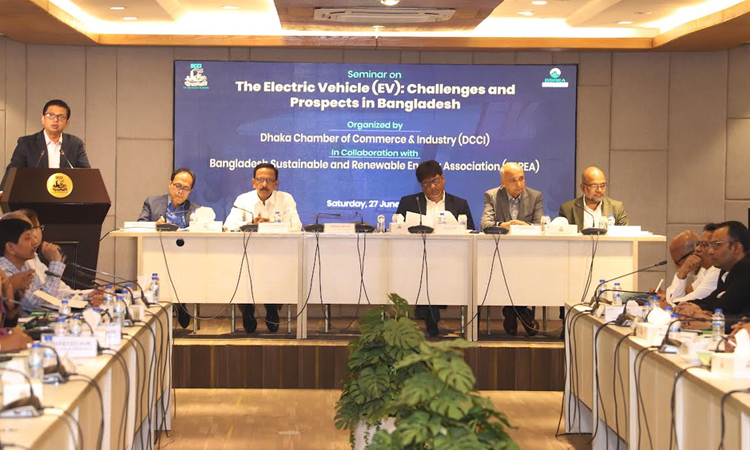
BEPRC Chairman Mohammad Wahid Hossain stresses uninterrupted electricity supply for sustainable electric vehicle industry growth nationwide. Photo : BSS

DHAKA, June 27, 2026 (BSS) - Mohammad Wahid Hossain, chairman (Senior Secretary) of Bangladesh Energy and Power Research Council (BEPRC), today stressed that uninterrupted electricity supply is the key factor for the success of the EV sector. 

"Since, Bangladesh's economy is primarily driven by the private sector, stronger collaboration between the public and private sector is essential for achieving the country's development goals," he said.

The BEPRC Chairman said this while addressing a seminar organised by Dhaka Chamber of Commerce & Industry (DCCI), in collaboration with Bangladesh 
Sustainable and Renewable Energy Association (BSREA), on "The Electric Vehicle (EV): Challenges and Prospects in Bangladesh " held at the DCCI Auditorium in the capital.

BEPRC Chairman Mohammad Wahid Hossain and Abdun Naser Khan, secretary of Ministry of Industries, attended the event as special guests while DCCI President Taskeen Ahmed presented the keynote paper. 

Wahid suggested establishing a dedicated cell involving all relevant government agencies currently working on expanding the EV industry to ensure 
better policy coordination. Furthermore, he underscored the importance of increasing the share of renewable energy and developing a reliable database 
on how many electric vehicles are currently operating across the country to facilitate effective planning.

Abdun Naser Khan, secretary of Ministry of Industries, informed that a draft EV policy has already been prepared and has undergone inter-ministerial consultations as well as stakeholder consultations. 

He stated that the primary objective of the proposed policy is to reduce dependency on imported fossil fuels while enhancing the country's energy 
security. He assured that a practical and future-ready EV policy would be finalized based on the recommendations of all stakeholders.

In his presentation Dhaka Chamber President Taskeen Ahmed stated that the global transportation sector is undergoing a significant shift driven by the 
goals of sustainable development, climate change mitigation and carbon emission reduction, resulting in the rapid expansion of electric vehicle (EV) adoption worldwide.


He noted that in order to support the development of the EV industry in Bangladesh, the government has already introduced various policy measures, including tax and duty incentives. 

The DCCI President suggested that further initiatives such as building adequate charging infrastructure, ensuring reliable electricity supply, 
establishing advanced battery management systems, providing necessary 
incentives to the private sector are required to develop this industry. 

He emphasized that Public-Private Partnership (PPP)-based investment is essential for expanding charging infrastructure, alongside the formulation of 
a coordinated and long-term policy framework. He mentioned that though nearly 6 million three-wheelers are currently operating across the country, only 669 
EV cars have been registered with the Bangladesh Road Transport Authority (BRTA). 

He urged the government to formulate a comprehensive national EV policy to tap the sector's full potential.

The panel discussion featured Shibir Bicitro Barua, additional secretary (IIT) of Ministry of Commerce; Md Aminur Rahman, director (Joint Secretary) 
of Sustainable and Renewable Energy Development Authority (SREDA); Dr. Md. Moksed Ali, joint secretary [Additional Charge of Planning and Activities 
Branch] of Road Transport and Highways Division; Md. Mofijul Islam, chief engineer of Bangladesh Power Development Board (BPDB); Dr. Md. Ehsan, 
Professor of Department of Mechanical Engineering, BUET; Mostafa Al Mahmud, 
president of Bangladesh Sustainable and Renewable Energy Association (BSREA); Hafizur Rahman Khan, president of Bangladesh Automobiles Assemblers and Manufacturers Association (BAAMA) and chairman of Runner Automobiles PLC; Tanvir Ebne Bashar, vice president of Infrastructure Development Company Limited (IDCOL); and Sk. Amin Uddin, chief executive officer (CEO) of Akij Motors.

Shibir Bicitro Barua stated that although official statistics indicate that only around 700 EVs have been registered, a significantly larger number of electric vehicles are already operating on Bangladesh's roads. 

Hafizur Rahman Khan said that the EV industry has opened new avenues for employment generation.

Md Aminur Rahman informed that the authority has approved 32 EV charging stations so far, of which 9 have already been established. He stressed the 
need for ensuring quality standards for both EV charging stations and imported electric vehicles.

Dr. Md. Moksed Ali stated that the government has undertaken several initiatives to promote sustainable transportation and is working towards reducing the existing duty structure applicable to the EV sector.

Md. Mofijul Islam mentioned that as there is no proper registration process for battery-operated electric vehicles, the government currently lacks 
accurate information on electricity consumption in the sector. He also observed that the use of substandard batteries is causing considerable electricity wastage.

Mostafa Al Mahmud noted that Bangladesh spends nearly Taka 65,000 crore annually on fuel for the transport sector, most of which is import-dependent. 
He stated that increasing EV adoption would significantly reduce pressure on fuel imports and help conserve foreign exchange.

Dr. Md. Ehsan observed that Bangladesh has yet to fully assess and utilize its domestic capabilities in the EV sector. The increasing use of electric 
three-wheelers has reduced diesel imports by approximately 1.5 million tonnes annually as a result pressure on government expenditure and foreign exchange have significantly been reduced, he added.

Tanvir Ebne Bashar emphasized the need for the rapid expansion of charging infrastructure, simplification of import procedures, and provision of long-term financing to accelerate EV adoption.

Sk. Amin Uddin stated that EVs reduce fuel costs by approximately 30 percent, making them an economically viable transportation solution.

During the open floor discussion, President of BARVIDA Abdul Haque has called for greater emphasis on manufacturing electric three-wheelers and EV 
components locally. Former DCCI Vice President M. Abu Hurairah stressed the importance of developing a comprehensive implementation plan before introducing the proposed 2,000 electric buses in Dhaka city.

Following the seminar, DCCI and BSREA signed a Memorandum of Understanding (MoU) to promote collaboration in energy policy, innovation, and market 
development. DCCI Secretary General (Acting) Dr. AKM Asaduzzaman Patwary and Engr. Mohammad Ataur Rahman Sarker, General Secretary of BSREA signed the MoU one behalf of their respective organisations.

DCCI Senior Vice President Razeev H Chowdhury, Vice President Md. Salem Sulaiman, members of the DCCI Board of Directors and representatives from both public and private sectors were also present on the occasion.