Wednesday
26 August, 2026
News Flash
News Flash
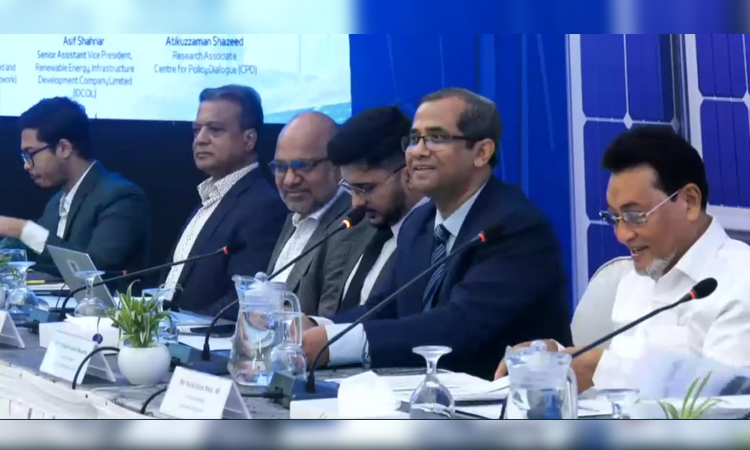
DHAKA, June 23, 2026 (BSS) - Energy experts and policymakers at a dialogue in the city today emphasized the urgent need for comprehensive policy, fiscal, and financial reforms to accelerate Bangladesh's transition toward a modern, grid-integrated renewable energy system, warning that existing structural barriers are constraining investment and slowing sectoral growth.
The dialogue titled "Solar Revolution in Pakistan in the Eyes of Country's Leading CSOs: Lessons for Bangladesh from National Budget Perspective" was held at a hotel in the city. The Centre for Policy Dialogue (CPD) organised the dialogue.
Chief Whip of the Jatiya Sangsad Nurul Islam Moni attended the event as the chief guest.
In his speech, he stressed the government's commitment to expanding renewable energy as part of broader efforts to ensure energy security, reduce dependence on imported fuels and support sustainable economic growth.
The session was moderated by Dr Khondaker Golam Moazzem, Research Director of CPD, who stated that Bangladesh must urgently realign its energy policy framework with emerging regional and global trends to ensure a more efficient, investment-friendly, and sustainable renewable energy ecosystem.
Presenting the Bangladesh perspective, Atikuzzaman Shazeed, Research Associate of CPD, noted that the country is currently undergoing a structural shift from its widely recognized off-grid Solar Home System programme toward on-grid solar and net metering-based systems.
He explained that while the Solar Home System initiative once successfully electrified around 20 million people, the model has now reached a saturation point due to rapid grid expansion.
He further highlighted concerns that nearly 47 percent of installed systems are currently non-functional, primarily due to battery degradation and the absence of a structured maintenance and transition mechanism.
He also pointed out that on-grid solar adoption remains limited despite growing potential, with only 4,551 net metering installations contributing a total capacity of 213.3 MW.
According to him, this reflects significant untapped opportunities for expanding distributed renewable energy, particularly in industrial and commercial sectors.
Keynote speaker Muhammad Basit Ghauri, Manager Special Initiatives and China Program of Renewables First of Pakistan, presented Pakistan's recent experience, where large-scale solar adoption surged due to high electricity tariffs and simplified net metering policies.
He noted that a major portion of investment in Pakistan's solar sector has been self-financed by consumers seeking to reduce electricity costs.
The speakers at the dialogue identified several major structural barriers affecting renewable energy expansion in Bangladesh.
These include high import duties on solar equipment ranging between 27.5 and 33.6 percent, limited access to affordable financing, and strict collateral requirements that discourage investment in solar projects.
Participants also noted that the lack of recognition of Power Purchase Agreements and solar assets as bankable instruments continues to hinder private sector participation.
Additionally, ongoing subsidies for diesel-based irrigation systems were cited as a distortionary factor that reduces the competitiveness of solar energy in the agricultural sector, while complex and time-consuming approval processes for net metering further slow adoption.
The discussion also highlighted the need for urgent policy reforms to unlock the sector's full potential.
The experts called for rationalization of taxes on solar components, the introduction of a unified digital platform for net metering approvals, and the development of OPEX and leasing-based financing models to improve project bankability.
They further emphasized the importance of integrating solar irrigation systems with the national grid to enable energy sales and improve efficiency, alongside a shift in national energy planning from installation-based targets to performance and long-term reliability metrics.
Representatives from Infrastructure Development Company Limited (IDCOL), Bangladesh Independent Power Producers Association (BIPPA), Bangladesh Sustainable and Renewable Energy Association (BSREA), and Coastal Livelihood and Environmental Action Network (CLEAN) also underscored the importance of regulatory stability, innovative financing mechanisms, and stronger coordination between public and private sector stakeholders.
The dialogue concluded that Bangladesh stands at a critical juncture in its energy transition.
While the country's off-grid solar programme remains a globally recognized success, participants cautioned that future progress will depend on decisive policy reforms, improved financial frameworks, and streamlined regulatory processes to ensure a resilient and sustainable renewable energy future.