Wednesday
22 July, 2026
News Flash
News Flash
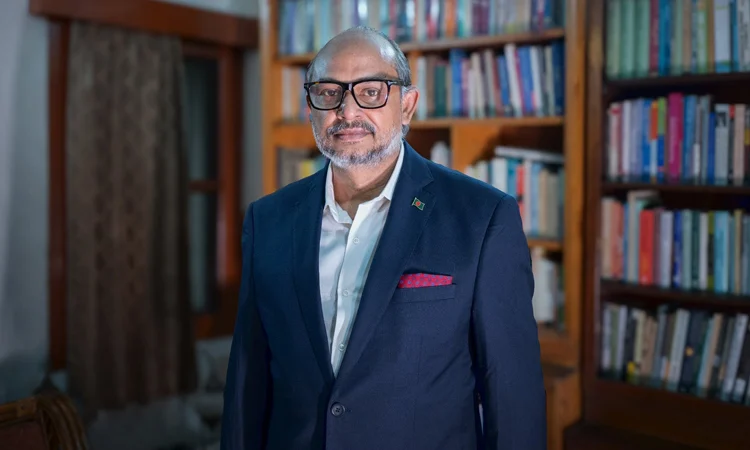
DHAKA, April 16, 2026 (BSS) – Dr Rashed Al Mahmud Titumir, Prime Minister’s adviser on the Ministries of Finance and Planning, has underscored that universal banking coverage and the strategic integration of women into the formal economy are imperative for national economic resilience.
“The country’s financial architecture is undergoing a paradigm shift, moving from an era where people went to banks to one where banks are reaching people,” he said.
The Adviser made these remarks while speaking as the chief guest at a ceremony held at the Microcredit Regulatory Authority (MRA) building in the city today to release the findings of a research study titled "Microfinance for Poverty Alleviation and Women Empowerment: Impact and Determinants."
In his speech, Titumir articulated a transformative vision for a cashless society where every citizen possesses a distinct financial identity through a personal bank account.
“Every individual in Bangladesh must have a bank account. We aim to connect everyone to the formal banking system. To achieve this, microcredit institutions must work in close coordination with scheduled banks to expand the reach of financial services to the last mile,” he added.
The Adviser presented a sobering analysis of the regressive impact of prolonged inflation, which has caused significant economic scarring across the nation’s vulnerable demographics.
Citing the newly released research study, Titumir highlighted how the erosion of purchasing power over the last three years has reversed previous gains in poverty reduction and social welfare.
In response to these deteriorating social indicators, Dr. Titumir posited that the inclusion of women in the formal labour market is a structural necessity rather than a mere social objective.
He noted that historical data demonstrates that when women’s formal participation increased, it served as a primary driver of structural economic change and poverty reduction in Bangladesh.
He argued that formal sector participation acts as a vital shock absorber during periods of global volatility, such as pandemics, energy crises, and international conflicts.
Without bringing women into the formal economic fold, the Adviser warned, the country would struggle to withstand external shocks and risk falling short of its Sustainable Development Goals (SDGs).
Dr. Titumir detailed the evolution of chip-based card systems designed to replace legacy models prone to inefficiency.
Addressing systemic flaws in the social safety net, the Adviser offered a candid critique of previous programmes.
He noted that past initiatives were frequently undermined by exclusionary errors, where political influence and administrative irregularities led to the waste of resources and the exclusion of the genuine poor.
The transition to the ‘Family Card' is a cornerstone of the government’s commitment to a transparent, technology-driven system that provides social security based on a citizen's life cycle rather than political patronage, he added.
Dr Titumir defined ‘Economic Democracy’ as the marriage of universal participation and financial identity.
He proposed that by ensuring every citizen has a bank account and every woman has a formal economic role, the nation can build a truly accountable economy.
The research release event was organised by the Microcredit Regulatory Authority (MRA).
Notable participants included Professor Dr. Mohammad Helal Uddin, Executive Vice-Chairman of the MRA; Saif Uddin Ahmed, Director General of the Bangladesh Academy for Rural Development (BARD); and Dr. Shuvasish Barua, Associate Professor of the Department of Development Studies at the University of Dhaka.