Wednesday
22 July, 2026
News Flash
News Flash
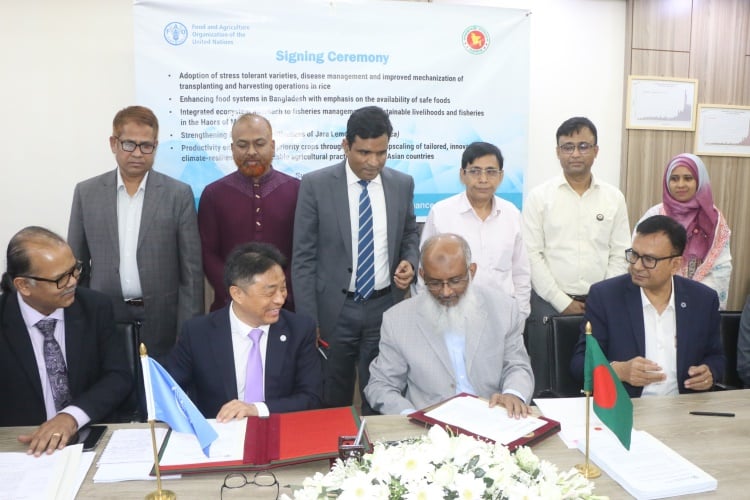
DHAKA, Mar 8, 2026 (BSS) - The Food and Agriculture Organization of the United Nations (FAO) signed five projects with the government of Bangladesh today at the Economic Relations Division (ERD), Ministry of Finance.
Four of these projects, respectively, “Adoption of stress-tolerant varieties, disease management and improved mechanization in rice”; “Enhancing Food Systems in Bangladesh with emphasis on the availability of safe foods”; “Integrated Ecosystem Approach to Fisheries Management for Sustainable Livelihoods and Fisheries in the Haors of Moulvibazar” and “Strengthening Export Competitiveness of Jara Lemon (Citrus medica)”are funded under FAO’s Technical Cooperation Programme (TCP) allocation, and the remainder, “Productivity enhancement of priority crops through piloting and upscaling of tailored, innovative, climate resilient, and sustainable agricultural practices in South Asian countries” project is financed by FAO’s Flexible Voluntary Contribution (FVC) pooled funded instrument.
TCPs have been pivotal in making FAO’s technical expertise available to member countries upon request, since its creation in 1976. TCP projects also contribute significantly to FAO’s work in Bangladesh, providing access to a wide range of technical expertise related to agriculture, food and nutrition, said a press release.
All projects are aligned with the national planning documents, strategies and priorities of the government of Bangladesh.
Md. Shahriar Kader Siddiky, Secretary, Economic Relations Division (ERD), Ministry of Finance, Jiaoqun Shi, FAO Representative in Bangladesh and AKM Sohel, Additional Secretary and UN Wing Chief, Economic Relations Division (ERD), Ministry of Finance were present at the signing ceremony.
Welcoming the guests and dignitaries attending the project document signing ceremony, AKM Sohel, UN Wing Chief, ERD, expressed gratitude for the implementation of 420 FAO-supported projects in Bangladesh so far, which have mobilized $426 million in grants.
He emphasized that these efforts have significantly strengthened food security. He also called on FAO to support Bangladesh in designing and implementing large-scale, catalytic climate-smart agriculture projects to attract climate finance from the GCF, GEF, and other multilateral and bilateral sources.
Jiaoqun Shi, FAO Representative in Bangladesh, emphasized the collaborative efforts and stated, “I hope the allocated funds serve their purpose and work towards mobilizing larger investments towards more efficient, inclusive, resilient and sustainable agrifood systems in the country—for better production, better nutrition, a better environment, and a better life, leaving no one behind.”
In his concluding remarks, Md. Shahriar Kader Siddiky, Secretary of the Economic Relations Division, reiterates ERD's commitment to engagement with FAO and calls upon FAO to focus on climate-sensitive agricultural interventions, leveraging innovative financing models such as equity and insurance, building food quarantine facilities, and developing agro-product market value chains locally, regionally, and even globally.
Projects in Brief:
Adoption of stress-tolerant varieties, disease management and improved mechanization in rice:
With a budget of US$250 000, the project, in collaboration with Bangladesh Rice Research Institute (BRRI), aims to minimize yield loss due to abiotic and biotic stresses and reduce cultivation costs by expanding mechanization during transplanting, harvesting, and post-harvesting operations.
Enhancing Food Systems in Bangladesh with emphasis on the availability of safe foods:
With a total investment of US$ 270 000, the TCP project aims to develop the implementation process for food systems transformation, as well as its financing strategy and mechanisms, and a monitoring and evaluation plan. The project also envisages capacity enhancement that complements existing initiatives of the Ministry of Food, the Food Planning and Monitoring Unit (FPMU), and the Bangladesh Food Safety Authority (BFSA).
Integrated Ecosystem Approach to Fisheries Management for Sustainable Livelihoods and Fisheries in the Haors of Moulvibazar:
Working hand-in-hand with the Department of Fisheries (DoF), the TCP, with a funding of US$ 250 000, aims to promote an Ecosystem Approach to Fisheries Management (EAFM) to restore the haor ecosystems in the district, enhance the biodiversity of selected threatened fish species, replenish fish stocks, and improve the livelihoods of local communities.
Strengthening Export Competitiveness of Jara Lemon (Citrus medica):
With a budget of US$ 275 000, the project, in collaboration with the Bangladesh Agricultural Research Institute (BARI), aims to develop a sustainable value chain for Jara Lemon by strengthening production and quality, while increasing incomes and creating opportunities for women and youth across Jara Lemon clusters in Bangladesh.
Productivity enhancement of priority crops through piloting and upscaling of tailored, innovative, climate resilient, and sustainable agricultural practices in South Asian countries:
The project, with a total investment of US$ 216 000, will work with BRRI towards improving the productivity of Boro rice, Fallow, T. Aman rice, and Rapeseed mustard cropping systems in Bangladesh.