Wednesday
22 July, 2026
News Flash
News Flash
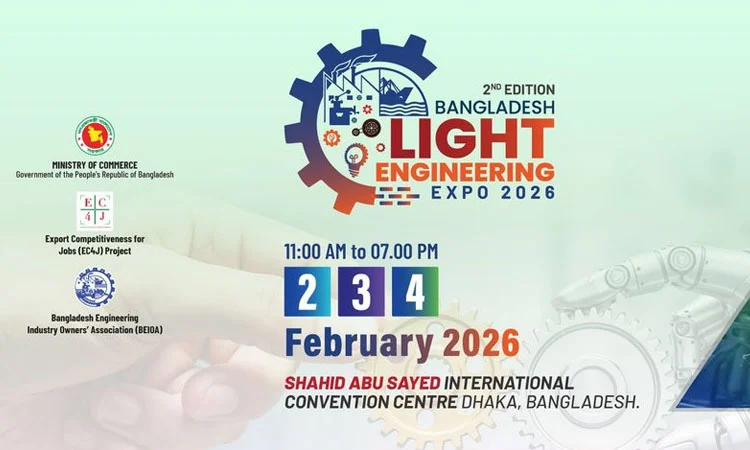
DHAKA, Feb 2, 2026 (BSS) - Stakeholders have stressed the need for coordinated and strategic efforts to transform Bangladesh’s light engineering sector into a more export-oriented and competitive industry, positioning it as a key driver of the country’s next phase of industrialisation.
With Bangladesh set to graduate from least-developed country status and gradually lose duty-free market access, the speakers emphasised the urgency of strengthening capacity, upgrading technology, and ensuring effective policy support for the sector.
The remarks were made at the inauguration of the three-day 2nd Bangladesh Light Engineering Expo 2026, organised by the Bangladesh Engineering Industry Owners Association (BEIOA), which began in the capital today.
The expo will run until February 4 and remain open daily from 11:00 am to 7:00 pm, showcasing the latest technologies, components, machinery, and innovative products from the country’s light engineering sector.
Speaking as the chief guest, Md Abdur Rahim Khan, additional secretary and project director of the Export Competitiveness for Jobs (EC4J) project, said that although development issues across various sectors had long been discussed and studied, the expected outcomes had not been fully realised.
He observed that, globally, light engineering products play a critical role in shifting export structures, but Bangladesh has failed to capitalise on this opportunity over the past five decades.
“Gradually, we moved from agriculture to manufacturing and became deeply involved in textiles and readymade garments. But, the next step — light engineering — has not seen the kind of transition it should have,” he said.
Khan noted that Bangladesh is scheduled to graduate from LDC status in November this year, after which duty-free access for Bangladeshi products will begin to phase out — starting in some countries as early as 2026 and in others from 2029.
He added that while the country should ideally have built stronger capacities by now, time has not yet fully run out.
“We still have adequate time. We must strengthen the capacity of institutions responsible for implementing government policies, while entrepreneurs need to further activate management efficiency, innovation, and research,” he said.
He further said that under the EC4J project, a technology centre was being established in Gazipur to support capacity building and encouraged industry players to make full use of its facilities.
As a special guest, Hosna Ferdous Sumi, senior private sector specialist (finance, competitiveness, and investment) at the World Bank, said that under the EC4J project, the World Bank was providing a wide range of support to enhance the competitiveness of the light engineering sector.
She highlighted that alongside export markets, the domestic market — valued at around $8 billion — also presents a significant opportunity for the sector.
“The biggest challenge we face, both in local and international markets, is product quality and whether products are truly serving their intended purpose,” she said.
According to her, quality compliance, improving production efficiency, and reducing costs are major challenges. If these issues are addressed, light engineering products from Bangladesh would gain a strong competitive edge in international markets.
She also noted that global production and growth trends are changing rapidly, making it essential to adopt Internet of Things solutions, reduce rejection rates, shift to resource-efficient production, and use precision technologies.
In his address as chair, Abdur Razzaque, president of BEIOA, said that the light engineering sector provides critical backward linkages to agriculture, textiles, construction, power, automobile, and household appliance industries.
He said that Bangladesh currently has around 50,000 small and medium light engineering enterprises, employing nearly 300,000 skilled workers, with the sector contributing about 3 per cent to national GDP.
He also said that the sector meets nearly half of the country’s $8.2 billion domestic demand and produces around 3,800 types of machinery, spare parts, dies, and moulds. However, significant reliance on imported machinery and components still remains, indicating substantial scope for expansion.
Globally, the engineering products market is estimated at around $7 trillion, yet Bangladesh’s share remains below 1 per cent. At present, exports from the light engineering sector stand at approximately $795 million. With appropriate policy support, technological advancement, and increased investment, exports could reach $12.56 billion by 2030, he said.
He also outlined key policy proposals, including the establishment of dedicated light engineering zones; support for technology transfer and research; reduced duties on raw material imports; simplified patent and design protection; training programmes for women and youth; cash incentives; and preferential access to bank financing.
Razzaque added that proper implementation of the recently formulated Light Engineering Industry Development Policy, particularly its time-bound action plans, could significantly contribute to export diversification.
The inauguration ceremony was attended by BEIOA senior vice president Abdur Rashid, vice president Raju Ahmed, other central directors, representatives from the EC4J project, and representatives from the Ministry of Commerce.