Friday
10 July, 2026
News Flash
News Flash
DHAKA, Jan 17, 2026 (BSS) - Amid growing concerns over hidden fiscal exposures and weak oversight of public resources, the government has introduced a new Property, Plant and Equipment (PPE) and Lease Manual aimed at strengthening asset governance and curbing long-term liabilities.
The move comes as the Finance Division revealed that Bangladesh's total contingent liabilities have reached Tk 6,39,782.58 crore, much of it linked to state-owned enterprises (SOEs) and poorly monitored asset and lease arrangements that pose serious risks to macroeconomic stability, said a press release.
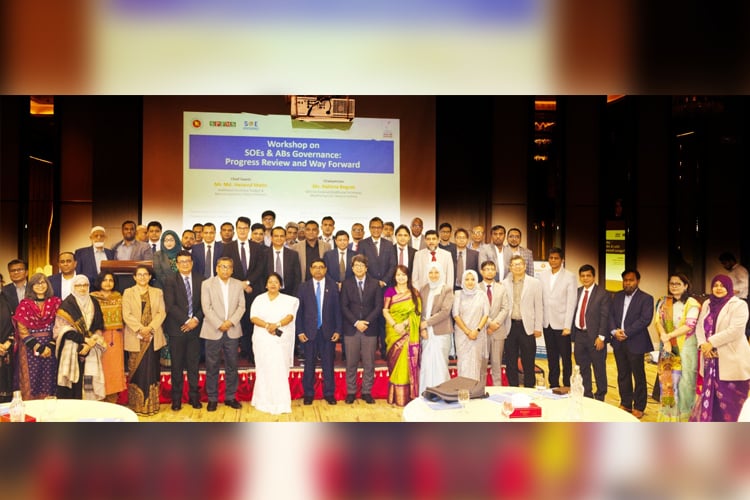
Senior government officials made the remarks at a two-day workshop titled "SOEs and ABs Governance: Progress Review and Way Forward", held on January 16-17, 2026, at a hotel in Cox's Bazar.
The event was organized by the Scheme on SOE Governance under the Strengthening Public Financial Management Program to Enable Service Delivery (SPFMS), Finance Division (FD).
Md. Hasanul Matin, Additional Secretary (Budget and Macroeconomics), FD, attended the workshop as the chief guest, while Dr. Ziaul Abedin, Additional Secretary (Budget) and National Program Director of SPFMS, joined as the guest of honour.
Rahima Begum, Director General (Additional Secretary), Monitoring Cell, FD, chaired the session.
Around 80 officials from the Finance Division and various ministries and autonomous bodies participated.
Addressing the inaugural session, Md. Hasanul Matin said, "Inefficient performance of several SOEs has significantly increased contingent liabilities. The creation of multiple authorities for similar purposes has led to overlapping functions, which must be avoided."
Bangladesh needs to restore its governance approach with global best practices, he added.
"Our major challenges today include rising debt burdens and declining revenue generation. Addressing these issues requires a whole-of-government approach," he noted.
Dr. Ziaul Abedin said, "In a market economy, only commercially viable SOEs should continue to operate, while others should be restructured or phased out. But this has not happened in Bangladesh. Transforming SOEs requires strong political commitment", he said adding, "We must rethink their future through broader, sustainable business models."
Rahima Begum emphasized that SOEs and autonomous bodies play a crucial role in strengthening the national economy, but inefficiency, weak financial management, and lack of accountability have sharply increased debt and contingent liabilities.
"We are identifying key challenges and focusing on practical solutions, including stronger audits, digital systems, and improved oversight to ensure good governance," she said.
Four business sessions were in the workshop. The first session was on SABRE+ System: An integrated Database of the SoE and Abs.
Presentation was made by Md. Amirul Islam, Additional Director General, Monitoring Cell, FD and the session was moderated by Md. Firoj Ahmed, Joint Secretary, Ministry of Shipping.
The session discussed that the SABRE+ (State-owned Enterprises, Autonomous Bodies, Budget Reporting and Evaluation System) is an integrated digital platform developed by the Finance Division.
It is integrated digital database for SOEs and ABs noted that contingent liabilities, arising from government guarantees, SOE losses, and poorly structured asset and lease arrangements, often remain outside regular budget calculations.
Without stronger oversight, these hidden risks can suddenly become direct government expenditures, undermining fiscal stability and public service delivery.
The second session was on DCL Statements and Fiscal Risk Statement of SoEs and Abs. Ibrahim Khalid, Director, SoE Wing, FD made presentation and the moderator was Rahima Begum, Director General, Monitoring Cell, FD.
The session outlined that according to an official assessment, 28 high-risk entities account for residual liabilities equivalent to 1.67 percent of GDP, while 14 very high-risk entities represent 3.13 percent of GDP. The Finance Division also identified persistent governance weaknesses, including delays in audited financial statements, weak audit committees, shortages of professional accountants, and incomplete financial data.
The third business session was on Policy and Procedures Manual for PPE and Other Assets and Preparation of Fixed Asset Register of SoEs and Abs where Md. Firoj Ahmed, Joint Secretary, Ministry of Shipping made presentation. The session was moderated by Muhammad Manjurul Haque, Joint Secretary Expenditure Management, FD.
The session highlighted that the newly introduced PPE and Lease Manual aims to address these gaps by setting clear and standardized rules for how public assets are classified, valued, depreciated, leased, and disposed of. Aligned with international accounting standards, the manual requires systematic tagging, registration, and tracking of government assets, improving traceability and accountability.
The fourth session was on SoEs and Abs Governance Reform Strategy 2025-30. The presentation of this session was made by Rahima Begum, Director General, Monitoring Cell, FD and the moderator was Dr. A K M Atiqul Haque, Joint Secretary, Budget Monitoring, Evaluation and Reporting, FD.
This session highlighted that the strategy focuses on strengthening core PFM institutions, modernizing systems and processes, and reinforcing governance and transparency across the public sector. Policy actions include enacting a comprehensive SOE law, publishing an annual fiscal risk statement, updating the PPE Manual, strengthening corporate governance practices, and promoting equity financing to reduce reliance on government transfers.
Also highlighted the institutional reforms emphasize capacity building, expanded independent performance evaluations, standardized reporting procedures, and stronger internal audits.